AI Routing Is Becoming the Real Margin Lever
The AI battleground is shifting from raw model quality to routing. The winners will route work across fast, slow, and governed paths well enough to protect margin and trust.

AI Routing Is Becoming the Real Margin Lever
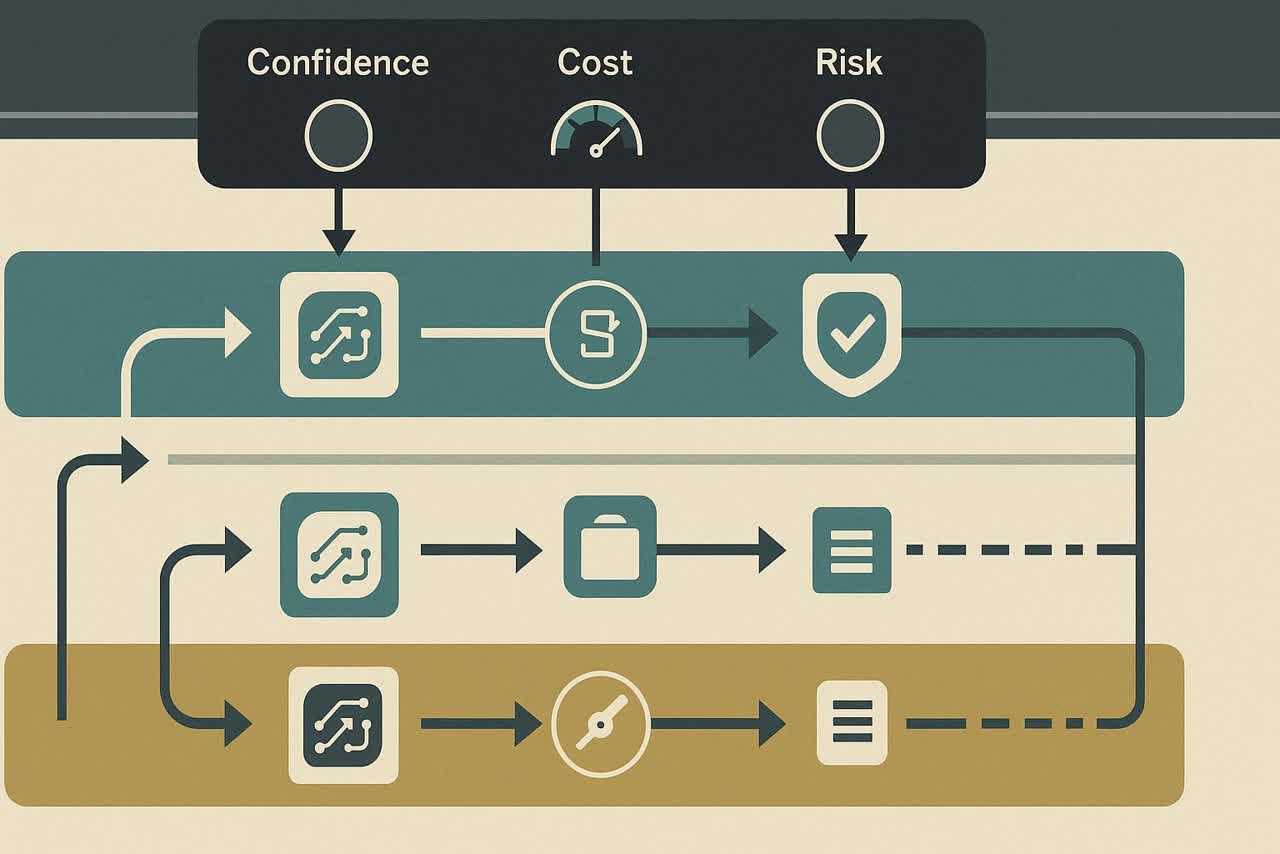
The important thing is not that models are getting cheaper; it is that routing is becoming the margin lever because the real product question is which task deserves the fast path, the slow path, or the governed path.
That sounds like an implementation detail, but the market is already treating it like strategy. Recent platform moves keep pointing in the same direction: vendors are adding model-picker controls, replayable workflows, and more explicit execution boundaries because the buyer is no longer shopping for a single “best model.” The buyer is trying to control cost, latency, and risk across many different task types.
That matters because most AI products are now mixed workloads. A support assistant may answer a simple policy question in one pass, escalate a billing dispute, call retrieval for a document lookup, and hand a sensitive account action to a human. A coding tool may autocomplete a line, explain a bug, generate a patch, and then stop before it changes production logic. A research agent may do cheap exploration on one model and reserve a better model for synthesis. In each case, the economic win comes less from a single model leap and more from sending each step to the right lane.
The mechanism is easy to miss. “Cheaper inference” does not simply lower bills across the board. It makes selective escalation viable. Once you can route low-risk work to a fast model and reserve expensive reasoning for the cases that actually need it, you can raise throughput without turning every request into a premium call. That is how routing becomes a product design problem, not just a backend optimization.
This also changes what a good AI interface looks like. The interface is no longer only where the user types the prompt. It is where the system decides whether the task can be answered immediately, whether it should retrieve context first, whether it needs a stronger model, whether a human must approve the action, and whether the whole path should be logged for replay. The visible UX may stay simple, but the hidden control plane is doing most of the business work.
The biggest mistake is to treat routing as a cost-cutting trick. If the system only routes to the cheapest model by default, quality will slide on exactly the tasks where trust matters most. The better pattern is task-aware routing: classify by intent, sensitivity, confidence, and expected value, then choose the cheapest lane that still satisfies the risk envelope. That requires telemetry, policy, and evals that look at the full path, not just the final answer.
That is why the current vendor moves matter more than they first appear. OpenAI-style model-picker controls are a signal that teams want to manage reasoning levels as an operational resource. Replay features are a signal that execution itself is becoming reusable infrastructure. And governed agent surfaces are a signal that the industry is learning the obvious but uncomfortable lesson: autonomy is not one feature. It is a portfolio of decision paths with different economics.
For builders, the implication is concrete. Do not design around “the model.” Design around task classes.
- Fast lane for low-risk, high-volume requests.
- Slow lane for ambiguous or high-value work.
- Governed lane for actions that can change state, spend money, or expose data.
Then measure the tradeoffs. Track cost per resolved task, not cost per token. Track how often the system escalates. Track how many “successful” completions still need human cleanup. Track the percentage of requests that should have been routed differently. Those numbers tell you whether routing is actually protecting margin or just hiding expense behind a nicer UI.
This also explains why AI coding tools are a useful reference point. The most durable products in that category are not just the ones with the best autocomplete. They are the ones that know when to stay cheap and local, when to call a stronger model, and when to stop before the action becomes dangerous. That is one reason the refreshed Top 10 AI Coding Assistants 2025 page remains relevant: the competitive question is increasingly about control, not novelty.
If you want the infrastructure version of the same idea, Inference Is Becoming the Product Roadmap is still the cleanest framing. If you want the workflow version, Workflows Are Becoming the AI Product Surface shows why replay and approval boundaries keep showing up in product announcements. And if you want the evaluation angle, AI Bills Are Becoming the Real Model Selection Test remains the clearest reminder that model choice is no longer a pure quality decision.
The reality check is that routing only creates margin if the system can classify tasks well enough to route them correctly. Bad routing can be worse than no routing: it can send high-value work to a weak model, over-escalate simple work, or create a false sense of efficiency while human operators quietly repair the misses. The watch-next indicator is whether vendors start publishing routing metrics alongside model benchmarks: escalation rate, governed-action rate, replay success, cleanup cost, and per-task economics.
If those metrics become common, the market will have admitted the obvious. The competition is no longer just about who has the smartest model. It is about who can turn mixed AI demand into the cheapest safe execution path.
Internal links
- Inference Is Becoming the Product Roadmap
- Workflows Are Becoming the AI Product Surface
- AI Bills Are Becoming the Real Model Selection Test
- 中文 companion: AI 路由正在成为真正的利润杠杆