The AI Race Is Moving Into Browser Work, Not Chat Polish
OpenAI and Anthropic are both pushing harder on browser work and agentic workflows. That is a sign the real competition is shifting from model eloquence to task completion in messy, stateful environments.

The AI Race Is Moving Into Browser Work, Not Chat Polish
The important thing is not which model writes the prettiest answer; it is which product can finish browser-shaped work reliably because the browser is where state, permissions, interruptions, and recovery all collide.
That shift is showing up in the last few days of vendor messaging. OpenAI’s new GPT-5.6 page says the model reaches a new state of the art on BrowseComp, a benchmark for agentic browsing tasks, and the company’s ChatGPT Work positioning now leans into desktop and browser task completion. Anthropic’s release notes also show the same gravity pull: the company is still shipping around agent behavior, computer use, and long-context work, not just conversational polish. The marketing language is different, but the direction is the same. The frontier is now being judged inside workflows, not just inside prompts.
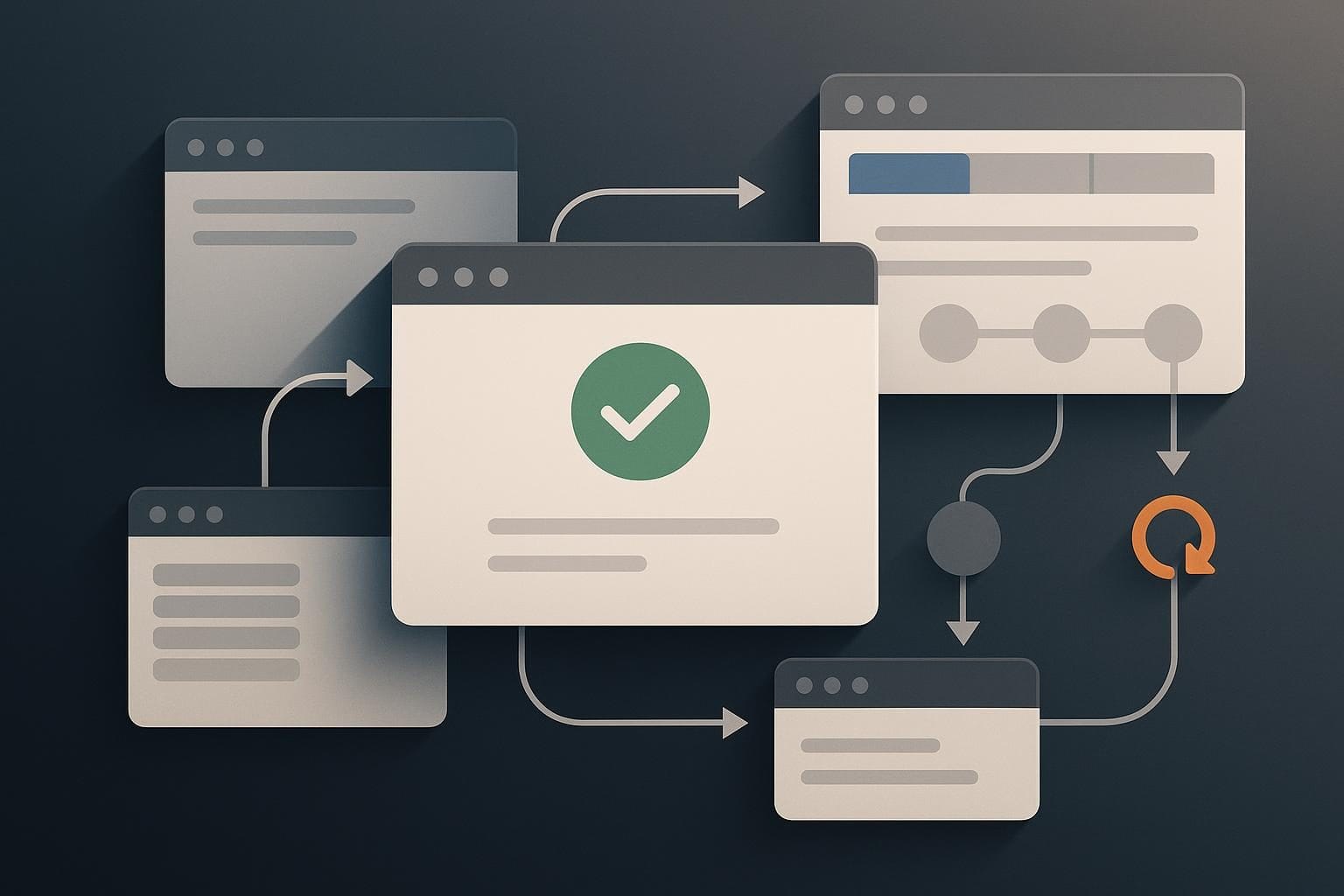
That matters because browser work is not a normal “LLM use case.” It is a hostile environment for clean demos. Pages change. Logins expire. Tabs get lost. Forms reject partial input. A task that looks trivial in a product video can turn into a sequence of retries, checkpoints, and human interventions once it runs against real accounts and real web apps. So when vendors highlight browse-ability, computer use, or work-style execution, they are not adding a small feature. They are moving the center of gravity of the product.
The mechanism is straightforward. Chat quality is mostly a local problem: produce a better response, improve the wording, reduce hallucinations. Browser work is a systems problem. The model has to plan, but the product also has to preserve state, track what already happened, decide what is safe to retry, and know when to stop and ask for help. In other words, the user does not buy “a smarter paragraph generator.” The user buys a workflow runner that can survive interruption.
That is why the current race is more interesting than a simple benchmark contest. BrowseComp, computer use, and similar tasks reward a product stack that can manage continuity, not just single-shot intelligence. A model that can reason well but cannot resume cleanly is still weak in production. A model that is slightly less dazzling but can preserve context, recover from failure, and hand off with evidence may deliver more value to a team. The evaluation target is shifting from output quality to task completion under friction.
The second-order consequence is that product teams will start to optimize around the browser boundary instead of the prompt boundary. That means session memory, auth handling, tab restoration, action logs, replayability, and checkpoint design become part of the core roadmap. It also means the old “just prompt it better” instinct will keep failing in places where the real issue is not instruction quality but environment control.
This is also where pricing and packaging start to matter. If browser work is the real product surface, then costs are no longer dominated by tokens alone. Failed retries, idle waits, human overrides, and long-running tasks all shape unit economics. That means two vendors can have similar model quality and very different product margins depending on how often their browser agents need to recover, re-run, or escalate. The buyer will feel that difference as reliability; the seller will feel it as support cost and inference burn.
There is a practical test here for builders and buyers. Ask whether the system can finish a real browser task when the page changes halfway through, when auth expires, or when a form returns an unexpected state. Ask whether the product can prove what it did, not just claim success. Ask whether it can resume from a checkpoint without repeating risky actions. If those answers are vague, the product is not yet an agentic workflow tool. It is a promising demo with a browser attached.
That is the reality check. The market keeps talking about “better models,” but the visible competition is moving to a different layer: browser execution as product surface. Once that happens, the winners will not be the systems that merely talk better about tasks. They will be the systems that can keep going when the web gets messy.
For a related read on how the browser layer is becoming operational rather than decorative, see Browser Agents Are Becoming State-Management Products.
For a related lens on why model choice is increasingly shaped by usage economics, see AI Bills Are Becoming the Real Model Selection Test.
The Chinese companion is here: AI 的竞争正在转向浏览器工作,而不是聊天润色.