Workflows Are Becoming the AI Product Surface
The real AI competition is shifting from chat quality to workflow control. Vendors are packaging routing, replay, and approval boundaries as the product surface.

Workflows Are Becoming the AI Product Surface
The important thing is not that models can do more tasks; it is that vendors are turning execution into a workflow product because routing, replay, and approval boundaries matter more than raw chat quality.
That shift is visible in this week's product announcements. Google’s June AI roundup highlighted computer use in Gemini 3.5 Flash, a push for custom agents that can see, reason, and act across desktop, mobile, and browser environments. In the same roundup, Google also positioned NotebookLM and other tools as structured environments for doing work rather than simply talking about work. OpenAI’s Enterprise and Edu release notes now give admins finer-grained model-picker controls and spell out Record & Replay in Codex, which is explicitly meant to turn a demonstrated workflow into a reusable skill. Anthropic’s newsroom, meanwhile, is emphasizing shared safety frameworks for scoring jailbreak severity with other major labs.
Those are different companies, but the underlying move is the same: the market is separating language generation from reliable execution. The model is still important, but the user experience is increasingly being defined by what happens around the model. Which tools are available? Which steps are approved? What gets recorded? What can be replayed? Where does the system fall back? Those questions are becoming the product.
That matters because “agentic” is too broad to sell by itself. A demo that can browse the web or fill a form is not yet a business workflow. Most real workflows need repeatability, permissions, exception handling, and a paper trail. Once a vendor ships replay, routing, and admin controls, it is acknowledging that the hard part is not one successful action. The hard part is making the action dependable enough to live inside someone else’s operating process.
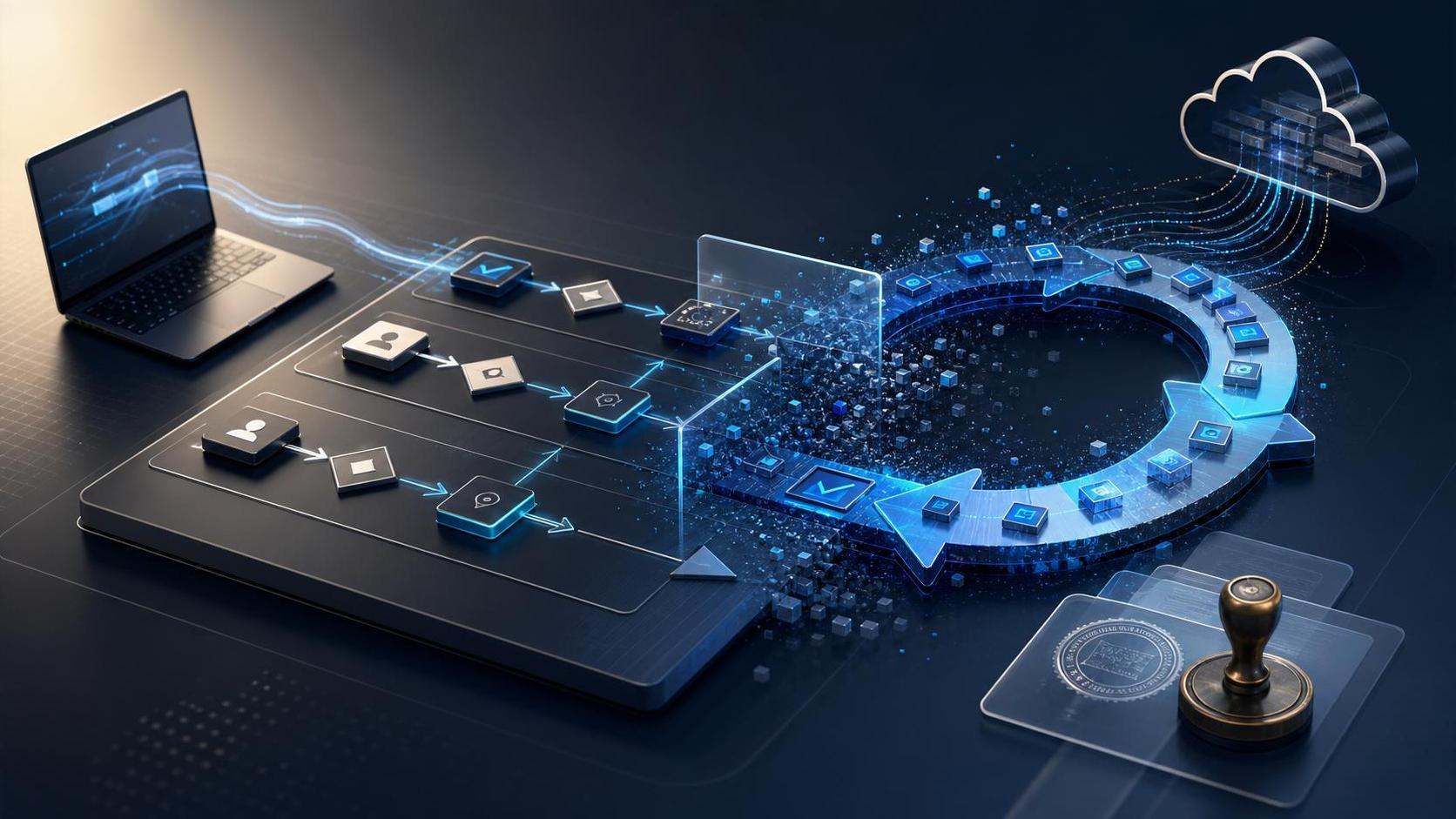
The mechanism is easy to miss. In the old mental model, the product was the model endpoint and the app just wrapped it. In the newer model, the model is one component inside a control plane. The control plane decides whether the task goes to a fast or slow path, whether a human must approve it, whether a workflow is recorded for reuse, and whether a task should be retried or abandoned. That means product differentiation moves up the stack from “which model?” to “which execution envelope?”
This also explains why admin and governance features are arriving alongside the flashier agent demos. The more the system can act, the more the buyer wants to know who can use it, what it can touch, and how behavior is constrained. OpenAI’s new model-picker controls are not just a convenience feature; they are a sign that teams are managing different levels of reasoning as a resource. Google’s emphasis on computer use is not just a capability claim; it is a bet that desktop and browser actions can be packaged as a managed automation layer. Anthropic’s severity-scoring framework points to the same reality on the safety side: if agents are going to act, the industry needs common ways to describe and compare risky behavior.
The second-order consequence is that “best model” is becoming a weaker buying criterion. A product team can love a model in a demo and still reject it if the workflow around it is fragile, expensive, or hard to govern. That shifts vendor competition toward the places where execution can be measured: task success rate, replayability, permission handling, auditability, and how much human cleanup a workflow creates after the model looks good.
For builders, the useful implication is specific. Stop treating orchestration as a thin wrapper around the model. Treat it as the value layer. If you are building an AI product, instrument the handoff points: where does the model defer, where does a human step in, which tasks are replayable, and what percentage of “successful” runs still need repair? Those measurements tell you whether you have a toy assistant or a workflow system.
This is also why the right internal comparison is not just against other agent demos. It is against existing workflow software. A model that can click through a browser is less interesting than a system that can survive auth changes, permission boundaries, and the boring failure cases that decide whether operations staff will trust it. That is the real test of product surface: not whether the AI can act once, but whether the entire route of action can be owned.
If this trend continues, watch for vendors to talk less about generic autonomy and more about execution primitives: replay logs, approval tiers, policy-aware routing, skill libraries, and admin-visible action histories. That is the sign that the market has moved from showing intelligence to shipping operability.
Two useful internal reads on the same shift are The IDE Is Becoming the AI Model Router and Agent Safety Is Becoming a Runtime Product. The first shows how control moves into the interface layer; the second shows how safety becomes a live operating system rather than a policy memo. If you want the infrastructure version of the same argument, Inference Is Becoming the Product Roadmap is still the cleanest example.