AI Investment Frontier — The Signal May Be Who Trades, Not Just What They Trade
A new study of public trader identities shows why investment AI should model participant histories as a time-varying evidence layer—while treating portability, privacy, and decay as first-class risks.

The next useful feature for investment AI may not be another price, quote, or sentiment variable. A new arXiv study examines a market where each order carries a persistent pseudonymous wallet identity and finds that trader history can add short-horizon information beyond anonymous order-book data. For builders, the important signal is not “copy the best wallets.” It is that participant identity can become a measurable, decaying evidence layer—if the data and governance make it legitimate to use.
The frontier signal
In Public Trader Identity: Adverse Selection and Return Predictability, the authors reconstruct a full-depth limit order book from 17.1 billion messages and 14.3 million aggressive orders involving 147,113 wallets. They report that wallets ranked by the price movement following their aggressive orders retain their ordering across adjacent ten-day windows, with a rank correlation of 0.52.
The study then adds live activity from the highest-ranked wallets to a benchmark containing prices, quotes, and order flow. Its reported out-of-sample explanatory power for one-second returns rises to an R² of 12.31%, a 13.2% gain relative to the anonymous benchmark. These are the authors’ results in this specific decentralized-market setting, not a general claim that identity data creates durable alpha.
Read the companion Chinese edition: 市场信号可能来自谁在交易,而不只是交易什么.
Why investors care
Most research systems treat order flow as a population aggregate. That is convenient, but it discards the possibility that the same observable action has different information content depending on the participant’s demonstrated behavior, horizon, and execution style.
An identity-aware layer could affect research triage, market-impact estimation, execution routing, and surveillance. It might help distinguish informed flow from liquidity-seeking flow, or help a risk system detect when a familiar activity pattern has changed. The investment implication is architectural: participant state may deserve its own feature store, separate from raw market data and from the model that consumes it.
This connects to the site’s existing work on an evidence layer for stock research and on temporal integrity in financial foundation models. Identity features make both problems harder: the evidence must be time-valid, and the model must know when a participant’s past is no longer informative.
Technical read-through
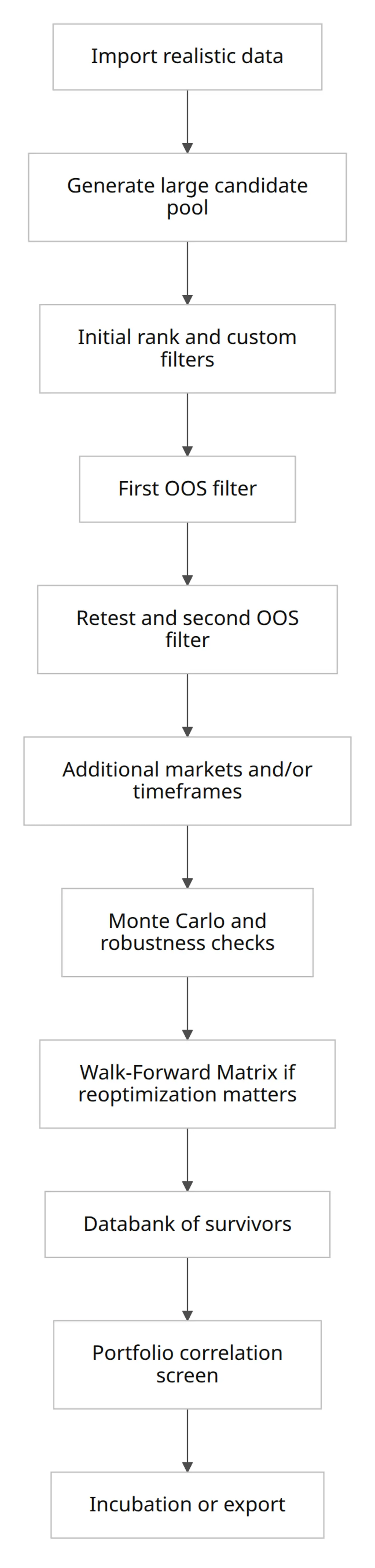
The useful pattern is a rolling ranking pipeline. First, define a participant score using only information available before the prediction timestamp. Next, maintain the score over adjacent windows and measure rank stability. Finally, add current participant activity to an anonymous baseline and evaluate strictly out of sample.
For a production prototype, the feature set could include signed post-trade price response, aggressor/passive mix, cancellation behavior, venue concentration, order-size distribution, and time since the participant last exhibited the behavior. Each feature needs timestamped lineage and explicit missingness handling. The target should be separated by horizon: one-second explanatory power is not a portfolio-return forecast.
The study’s placebo comparison is especially important. A useful identity feature should beat activity-matched cohorts, not merely a weak baseline. Evaluation should also include turnover, latency, fees, market impact, and the cost of acquiring or storing the data.
Reality check
Persistent pseudonyms are not universal identities. They can be fragmented across venues, intentionally changed, or controlled by automated strategies whose behavior shifts with incentives. A ten-day rank correlation is encouraging evidence of persistence in the sample, not proof of permanence.
The reported precision also depends on labels and on what is observable. A feature that works in a transparent decentralized venue may not transfer to equities or futures. More fundamentally, public identity data can create privacy, fairness, and market-abuse concerns. A research system should log why the feature is permitted, what information it encodes, and when it must be retired.
Builder takeaway
- Build an identity feature store with point-in-time joins, decay curves, and immutable source lineage.
- Benchmark against anonymous order flow and activity-matched placebo cohorts.
- Separate prediction horizons and report net economics after fees, impact, and latency.
- Test portability across venues, participant churn, regime changes, and deliberate behavior shifts.
- Add governance gates for pseudonym linkage, retention, access, and feature retirement.
Links / sources
- Public Trader Identity: Adverse Selection and Return Predictability — arXiv study and reported out-of-sample tests.
- The Evidence Layer Matters More Than the Stock Pick — related research architecture.
- The Real Test for Financial Foundation Models Is Temporal Integrity — related time-validity framework.