Stop Switching AI Models. Start Orchestrating Them.
A practical guide to cost-effective multi-model software engineering: assign reasoning, implementation, review, and verification to clear roles.

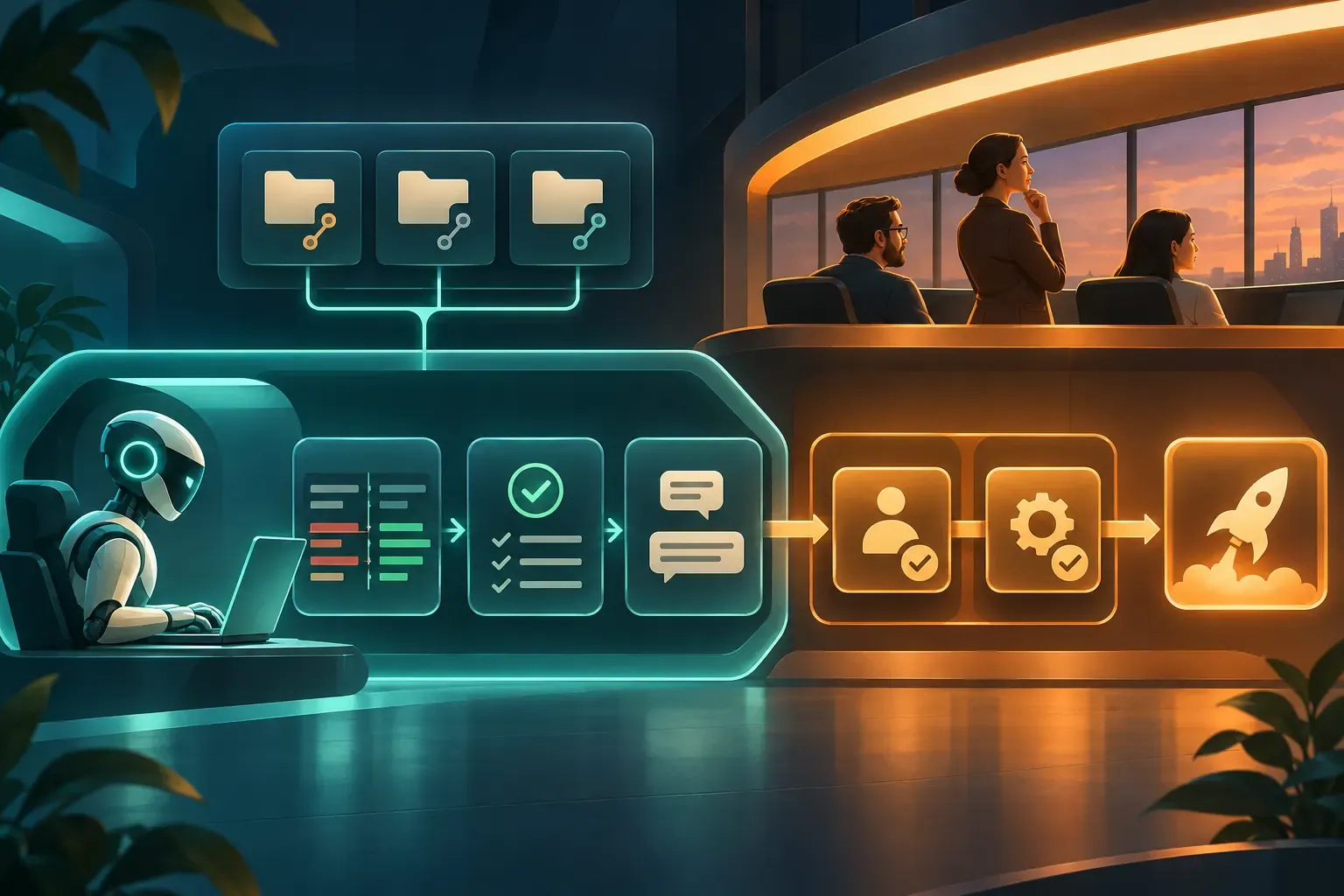
A Practical Guide to Cost-Effective Multi-Model Software Engineering
How to combine strong reasoning models, inexpensive coding agents, independent reviewers, and automated verification—without paying premium-model prices for every task.
The Real Problem Isn't Choosing the Best AI Model
Software development with AI has changed dramatically. Tools such as OpenAI Codex, Claude Code, and Google Antigravity are no longer limited to suggesting individual lines of code. They can inspect repositories, design implementations, modify multiple files, execute tests, investigate failures, and coordinate other agents.
Yet many developers still use these powerful systems inefficiently.
A typical workflow looks something like this:
- Start with a cheap model to implement a feature.
- Encounter a difficult problem and switch to a more capable model.
- Switch back to the cheap model for subsequent implementation.
- Switch again to a premium model for review.
- Return to the original model to fix the review findings.
- Repeat until the feature appears complete.
This approach seems financially sensible: use inexpensive models whenever possible and reserve expensive models for difficult problems.
But it has hidden costs.
Switching models within a long coding session may disrupt prompt-cache reuse. Different models may have to process substantial portions of the same history. Agents may repeat repository exploration, reconstruct earlier decisions, or lose important assumptions buried in previous exchanges.
Moreover, the most expensive development failures are not necessarily caused by choosing an inexpensive model. They often result from poorly specified requirements, inadequate verification, or using the same reasoning process to both implement and validate a solution.
A better strategy is to stop treating model selection as a sequence of manual switches and start treating it as an engineering orchestration problem.
The central principle is straightforward:
Use strong models to make consequential decisions, inexpensive models to execute bounded work, independent models to challenge critical assumptions, and deterministic tools to establish correctness.
This article explains how to implement that approach in practice.
1. Why Model Switching Has a Hidden Cost
Consider a development session containing 80,000 tokens of accumulated context: architectural discussions, repository exploration, implementation history, failed tests, and debugging observations.
The developer starts with Model A, switches to Model B for a difficult problem, and then returns to Model A.
Three kinds of overhead may arise.
1.1 Prompt-cache disruption
Prompt caching makes repeated requests cheaper by reusing previously processed, unchanged input prefixes.
However, a prompt cache is generally associated with the model and the provider's caching mechanism.
Claude Code's documentation explicitly states that switching models causes the first request on the new model to read the conversation without benefiting from the previous model's cache.
OpenAI similarly documents caching around reusable prompt prefixes.
This does not mean every model switch incurs the full cost of the entire history. Actual overhead depends on how context is constructed, provider-specific caching rules, compaction, and prior requests to the destination model.
Nevertheless, repeated switching can substantially reduce the economic value of caching.
1.2 Repeated context reconstruction
A new model often needs to understand decisions already made by another model.
It might reread the architecture, inspect the same files, reconstruct the failing execution path, or repeat assumptions that were established earlier.
This is not purely a token-cost problem. It also increases latency and introduces opportunities for inconsistent reasoning.
1.3 Accumulated conversation noise
Long development conversations contain useful decisions alongside obsolete hypotheses, failed approaches, tool outputs, and irrelevant details.
As conversations grow, the model must identify which information remains authoritative.
The correct solution is not always to provide a larger context window.
Often, it is to provide a smaller, better-structured task.
The alternative: stable agents with explicit handoffs
Instead of repeatedly changing models inside one conversation, assign different models to distinct agents, each with its own context and responsibility.
For example:
- A planning agent designs the architecture.
- An implementation agent writes the code.
- A testing agent executes acceptance checks.
- A reviewing agent independently evaluates the implementation.
- A coordinating agent manages handoffs and escalations.
Each agent receives only the information needed for its assignment.
The result is more predictable context usage and clearer responsibility boundaries.
The goal is to move work between agents rather than repeatedly move one conversation between models.
2. Model Selection Should Be a Risk-Based Decision
A common assumption is that the strongest model should handle the most difficult task.
That is only partly correct.
Difficulty matters, but so do the consequences of failure and the ease of checking the result.
Consider three development tasks:
Task A: Generate documentation for a Python utility.
The task is straightforward, the result is easy to inspect, and errors are relatively inexpensive.
A lightweight model is usually sufficient.
Task B: Implement a complex market-regime detection algorithm.
The task requires statistical understanding, careful time-series handling, and interpretation of market assumptions.
A strong model may be valuable during design, while implementation can be delegated to a medium-cost model once the specification is precise.
Task C: Modify an automated trading system's order-retry mechanism.
The code change might involve only a few lines, but an error could submit duplicate orders or bypass risk limits.
This task deserves careful design, independent review, and rigorous testing even if its apparent programming complexity is low.
The important distinction is:
Task complexity determines how much reasoning is required. Failure consequence determines how much assurance is required.
A practical model-allocation matrix
| Engineering activity | Recommended tier | Rationale |
|---|---|---|
| Requirements and architecture | Strong | Poor decisions create expensive downstream rework |
| Task decomposition | Medium | Requires coherent planning but usually less deep reasoning |
| Codebase exploration | Economical | Mostly retrieval and summarization |
| Routine implementation | Economical | Well-specified tasks are easier to verify |
| Complex algorithm design | Strong | Mathematical and conceptual reasoning dominate |
| Standard debugging | Economical → Medium | Start with evidence-driven diagnosis |
| Difficult debugging | Strong | Escalate when the failure mechanism remains unclear |
| Test generation | Economical | Useful for producing candidate tests |
| Independent critical review | Strong | Requires challenging assumptions and detecting subtle defects |
| Documentation | Economical | Easy to inspect and correct |
| Release verification | Strong + deterministic | Combines judgment with executable evidence |
These assignments are starting hypotheses, not universal model rankings. They should eventually be adjusted using measurements from the actual repository.
3. The Architecture: A Strong Planner and Specialized Workers
An effective multi-model development system does not need dozens of agents.
For most individual developers, five functional roles are enough:
The planner
The planner is responsible for understanding the problem and establishing the technical direction.
Its responsibilities include defining requirements, selecting the architecture, identifying dependencies, specifying interfaces, and establishing acceptance criteria.
A strong reasoning model is especially valuable here because architectural errors can propagate across many downstream tasks.
However, the planner should not continuously supervise every coding operation.
Ideally, it becomes active at project initiation, major design decisions, architectural changes, or unresolved technical problems.
The engineering coordinator
The coordinator is responsible for managing the workflow rather than solving every engineering problem personally.
It tracks task status, assigns implementation work, collects evidence, applies escalation rules, and determines when a task is ready for review.
A medium-capability model is often sufficient.
An important cost optimization is to avoid using the most expensive model as an always-active coordinator.
The implementer
The implementer writes production code according to an approved specification.
Its responsibilities are intentionally narrow: make the requested changes, write relevant tests, run the required checks, and report the result.
An economical model can be highly effective when requirements are clear and the task is appropriately bounded.
The implementer should not silently redesign the system when it encounters ambiguity. Architectural changes should be escalated.
The independent reviewer
The reviewer examines the implementation against its intended behavior, identifies defects, challenges assumptions, and evaluates missing tests.
For high-risk changes, the reviewer should be logically independent of the implementation process.
Using a different model family can provide useful diversity, although independence is not guaranteed simply by changing vendors.
The reviewer's primary responsibility is finding correctness problems, not generating praise or proposing cosmetic improvements.
The validation system
Validation should not be delegated entirely to an LLM.
Compilers, type checkers, static analyzers, unit tests, integration tests, property-based tests, and domain-specific simulations provide stronger reproducible evidence.
The validation system should generate artifacts that other agents can inspect.
In a quantitative trading system, this includes backtests, walk-forward evaluations, broker simulations, and risk-limit checks.
The complete workflow
A practical sequence is:
Requirements → Architecture → Task decomposition → Implementation → Testing → Independent review → Correction → Regression testing → Final validation → Human release approval
Not every task needs every stage.
A documentation update may require only implementation and a quick check. A live trading execution change requires substantially more assurance.
This is the foundation of risk-adaptive orchestration.
4. Why a Strong Planner Should Not Run Continuously
It is tempting to place a premium model in charge of the entire workflow and let it manage every subordinate action.
This can work, but it may be economically inefficient.
Suppose the planner develops an architecture and decomposes it into 15 implementation tasks.
If the strong model remains active throughout all 15 tasks, it may repeatedly process status updates, code diffs, tool outputs, and routine test results.
Much of this information does not require premium-level reasoning.
A more efficient architecture separates planning from operational coordination .
The strong planner creates a plan with clear interfaces and acceptance criteria.
A medium-cost coordinator handles task execution.
The strong planner is consulted only when the coordinator identifies a meaningful architectural question, conflicting requirement, or unresolved high-impact problem.
This produces a hierarchical design:
Human → Strong planner → Medium coordinator → Economical workers
Independent review and deterministic verification operate as additional quality gates.
The design resembles how well-run engineering organizations distribute responsibilities.
Senior architects do not need to supervise every line of code. Their value lies in making high-leverage decisions and resolving problems that exceed the scope of routine implementation.
The same principle applies to AI engineering.
5. What Codex, Claude Code, and Antigravity Support
As of November 2026, all three environments offer meaningful multi-agent capabilities, although the exact configuration and execution model differ.
OpenAI Codex
Codex supports specialized subagents that run in separate contexts.
Its custom agent configuration can specify a model and reasoning effort for each role.
Developers can create project-specific agent definitions under:
.codex/agents/
or personal agent definitions under:
~/.codex/agents/
The configuration supports default subagent models, limits on concurrent agent threads, and role-specific instructions.
One important limitation: custom Codex subagents inherit the parent agent's model provider and relevant permissions. They do not automatically constitute a multi-provider router.
Codex is therefore a good starting point when most work happens within the OpenAI ecosystem.
Claude Code
Claude Code supports custom subagents defined in Markdown files with YAML frontmatter.
For example, a project can define agents in:
.claude/agents/
Each agent can specify a model family, such as Haiku, Sonnet, or Opus, depending on model availability and account configuration.
Claude Code can select agents based on their descriptions, or the user can explicitly request a specialized agent.
This makes it convenient to use one model for routine implementation and another for critical review.
However, developers using gateways or tools such as CC Switch must verify the actual provider-model mapping.
Requesting an Opus alias does not guarantee that the gateway sends the request to Anthropic Opus.
Google Antigravity
Antigravity supports subagents, orchestration, and scripted Dynamic Workflows.
Its Dynamic Workflows can assign different model tiers to workflow agents, return structured outputs, and execute predictable sequences such as code review followed by correction.
The documented workflow model tiers include options such as flash_lite, flash, and pro, subject to account availability.
Antigravity also supports isolated Git worktrees for certain delegated tasks, which can help prevent multiple agents from modifying the same working tree concurrently.
Its Orchestrator mode and Dynamic Workflows are particularly interesting for developers who want a stronger planner coordinating less expensive execution.
Capability comparison
| Capability | Codex | Claude Code | Antigravity |
|---|---|---|---|
| Custom specialized agents | Yes | Yes | Yes |
| Isolated subagent contexts | Yes | Yes | Yes |
| Model selection by agent role | Yes | Yes | Yes, within supported tiers |
| Task delegation | Yes | Yes | Yes |
| Independent review workflows | Yes | Yes | Yes |
| Workflow scripting | Through scripts/APIs | Through hooks/SDK/scripts | Dynamic Workflows |
| Multi-provider routing | Requires compatible external integration | Requires compatible gateway/integration | Provider-dependent |
| Best initial use | Coding and repository workflows | Coding and specialized review | Orchestration experiments |
The practical lesson is not to choose one platform as the universal winner.
Use the system that gives the best combination of reliable implementation, understandable configuration, acceptable quotas, and measurable verification quality.
A more elaborate orchestrator is not automatically better if its overhead exceeds the value of the work being delegated.
6. Practical Setup: Role-Based Agents in Codex
Consider a project with three agent roles: planner, implementer, and reviewer.
A minimal Codex configuration might look like this:
.codex/config.toml
model = "gpt-6.1-sol"
model_reasoning_effort = "medium"

[agents]
enabled = true
max_concurrent_threads_per_session = 3
default_subagent_model = "gpt-6-luna"
default_subagent_reasoning_effort = "medium"
This makes a medium-to-strong model the primary agent while directing most delegated work to a less expensive model.
Now define a specialized coding agent.
.codex/agents/implementer.toml
name = "implementer"
description = "Implement bounded coding tasks with tests"
model = "gpt-6-luna"
model_reasoning_effort = "medium"

developer_instructions = """
Implement one approved task at a time.

Follow the task specification and acceptance criteria.
Make minimal changes.
Write or update relevant tests.
Run checks before reporting completion.

Do not silently modify architecture.

Return:
- Changed files
- Test results
- Remaining issues
- Any required escalation
"""
Next, define a stronger reviewer.
.codex/agents/reviewer.toml
name = "reviewer"
description = "Independent correctness and risk reviewer"
model = "gpt-6.1-sol"
model_reasoning_effort = "high"

developer_instructions = """
Perform an independent review of the code diff.

Prioritize:
- Functional correctness
- Concurrency and state management
- Numerical correctness
- Error handling
- Security and execution safety
- Missing regression tests

Do not modify source files.

Return findings with:
- Severity
- File and location
- Failure mechanism
- Supporting evidence
- Suggested correction

Distinguish confirmed defects from possible risks.
"""
These model identifiers are examples supported by current Codex documentation. Actual availability depends on the account and environment.
The coordinator can now delegate implementation to the inexpensive agent and request an independent review using the stronger agent.
There is no need to repeatedly change the primary conversation's model.
For an even more economical configuration, the main coordinator could use a less expensive model, with a dedicated high-reasoning planner invoked only when necessary.
7. Practical Setup: Specialized Agents in Claude Code
Claude Code uses a similar concept but stores custom agent definitions in Markdown.
For example:
.claude/agents/implementer.md
---
name: implementer
description: Implement well-specified coding tasks
model: haiku
---

Implement the approved task.

Do not expand its scope.
Write unit tests.
Run the relevant checks.
Report changed files and verification results.

Escalate unresolved architectural questions.
A critical reviewer can use a stronger model:
.claude/agents/critical-reviewer.md
---
name: critical-reviewer
description: Review high-risk implementation changes
model: opus
---

Review the code independently.

Focus on correctness, hidden assumptions,
failure handling, race conditions,
and incomplete acceptance criteria.

Do not modify the implementation.

Report actionable defects with evidence.
Claude Code can automatically delegate work when an agent's description matches the task. Explicit invocation is more predictable when implementing a strict workflow.
A typical supervisor instruction might be:
Implement the approved feature using the implementer agent. Require passing tests before requesting an independent critical review. Return the findings to the implementer for correction. Do not declare the feature complete until regression tests pass.
One caveat matters when routing Claude Code through third-party gateways.
Different subagent aliases may be mapped to unexpected models. Verify the resolved provider and model using available routing logs and Claude Code's task inspection tools.
Do not assume that model-specific behavior or costs remain identical under a gateway.
8. The Missing Piece: A Common Task Contract
The biggest improvement to multi-model collaboration is often not a better orchestration framework.
It is a better task interface.
When one model delegates work to another, the receiving agent should not need to reconstruct the entire development conversation.
Instead, it should receive a compact, structured task packet.
Consider:
task_id: TRADING-042

objective:
  implement_safe_order_retry

component:
  broker_execution

risk_level: critical

requirements:
  - prevent_duplicate_orders
  - reconcile_broker_state
  - handle_partial_fills
  - respect_position_limits

constraints:
  - no_live_orders
  - preserve_existing_interfaces
  - no_architecture_changes

acceptance_tests:
  - duplicate_submission_test
  - timeout_recovery_test
  - partial_fill_test
  - exposure_limit_test

routing:
  implementer: economical
  reviewer: strong
  max_failed_attempts: 2

release:
  independent_review: required
  paper_trading: required
  human_approval: required
This task packet serves several purposes.
It makes requirements explicit. It defines success independently of the implementing model. It limits the scope of work. It also identifies when escalation and additional verification are mandatory.
A useful repository structure might be:
project/
├── AGENTS.md
├── docs/
│   ├── architecture.md
│   ├── engineering-standards.md
│   └── risk-policy.md
├── tasks/
│   └── TRADING-042/
│       ├── spec.yaml
│       ├── plan.md
│       ├── implementation.md
│       ├── tests.json
│       ├── review.md
│       └── validation.md
└── src/
The shared documents are the source of truth.
Individual agent conversations are temporary working environments.
This distinction substantially reduces the dependence on long conversational history and makes development reproducible across sessions, models, and tools.
9. Escalation: Don't Keep Asking the Cheap Model to Try Again
A cheap-first strategy becomes inefficient when the agent repeatedly attempts the same failing solution.
A practical escalation policy should distinguish several failure types.
Missing information: The model lacks the necessary requirements, logs, or repository context.
Solution: provide the missing evidence, rather than immediately upgrading the model.
Insufficient exploration: The model has not inspected the relevant execution paths or dependencies.
Solution: increase investigation effort or delegate focused codebase research.
Implementation defect: The model understands the problem but introduced a coding mistake.
Solution: run a targeted correction cycle with a failing test.
Reasoning failure: The model has sufficient evidence but repeatedly reaches an incorrect diagnosis.
Solution: escalate to a stronger model.
Architectural conflict: The implementation reveals inconsistent assumptions or incompatible requirements.
Solution: return to the planner.
For ordinary tasks, a useful starting policy is to permit one or two evidence-based repair attempts before escalating.
For critical trading-system changes, escalate immediately when the failure involves a misunderstood risk invariant, potentially unsafe execution behavior, or unresolved mathematical assumptions.
The objective is not to minimize the number of expensive-model calls.
It is to minimize the total cost of obtaining a verified result.
Focused escalation is more efficient
Suppose an inexpensive agent fails to implement volatility-adjusted position sizing for futures.
Instead of transferring the entire repository to a premium model, provide:
- The relevant position-sizing equations
- Contract multipliers and tick specifications
- The failing test case
- The implementation fragment
- The expected behavior
Ask the strong model for a diagnosis, ideally without permitting code changes.
Then return the diagnosis to the original implementer.
This is more economical than making the expensive model repeat every implementation step.
10. Code Review: Spend Premium Capacity Where It Matters
Independent code review is one of the strongest arguments for multi-model engineering.
The model that wrote the code may have adopted incorrect assumptions early in development.
When asked to review its own work, it may reproduce those assumptions.
A separate reviewing context can examine the result from a different starting point.
However, merely using a different model is not enough.
A reliable review process should include the original specification, acceptance criteria, relevant code, and test results.
It should avoid relying too heavily on the implementer's claim that the solution is correct.
Review in layers
The first layer consists of deterministic checks: formatting, compilation, type checking, linting, dependency analysis, and automated tests.
The second layer is a lightweight model review. It identifies straightforward defects, suspicious assumptions, missing tests, and integration mistakes.
The third layer is a strong independent review reserved for critical modules or changes with significant failure consequences.
This structure avoids spending premium-model capacity on problems that deterministic tools can identify more reliably.
A reviewer should report precise failure mechanisms, not vague concerns.
For example:
Weak finding:
There may be problems with the order execution logic.
Strong finding:
If the broker accepts an order but the client times out before receiving the acknowledgment, the retry path creates a new client order identifier. This can result in two accepted orders. Reproduce by simulating an acknowledgment timeout after broker acceptance.
The second finding is actionable, verifiable, and directly related to system risk.
A good review produces evidence. A poor review produces opinions.
11. Testing and Verification Must Remain Independent
AI models are useful for generating tests, but generated tests do not automatically establish that the implementation satisfies the true requirements.
If the same agent misunderstands the specification, it may write code and tests that consistently implement the same misunderstanding.
Therefore, correctness requires multiple forms of evidence.
For ordinary software, these might include:
- Unit and integration tests
- Contract tests
- Property-based testing
- Static analysis
- Regression testing
- End-to-end testing
For trading software, additional domain-specific validation is essential.
Backtesting correctness
Verify that features, labels, signals, and execution assumptions respect the information actually available at each historical timestamp.
Pay particular attention to look-ahead bias, survivorship bias, timestamp alignment, warm-up periods, and accidental leakage across training and evaluation windows.
Market-model validation
A trading algorithm should be evaluated beyond a single historical backtest.
Depending on the strategy, appropriate methods may include walk-forward testing, chronologically separated out-of-sample evaluation, parameter sensitivity analysis, realistic transaction costs, and stress testing.
For overlapping financial labels, purging and embargo techniques may be appropriate when constructing cross-validation folds.
Execution correctness
Backtest performance does not prove that live order execution is safe.
Broker integration requires explicit testing of rejected orders, partial fills, reconnects, stale account state, duplicate events, and idempotent retry behavior.
Risk-control correctness
Critical risk constraints should be implemented as enforceable system invariants.
Examples include:
- An order must not exceed approved position limits.
- Maximum permitted exposure must be checked before submission.
- Duplicate retry events must not produce unintended additional positions.
- A strategy must not bypass a disabled trading state.
- A kill switch must prevent new orders even when the strategy agent remains active.
An LLM may help inspect these controls, but it should never be the sole authority enforcing them.
12. A Quantitative Trading Example: Implementing a New Strategy
Consider a developer building an event-driven trading platform.
The platform consumes economic and market news, extracts events using LLMs, estimates market regimes, generates trading signals, selects strategies, and executes orders.
The developer wants to add a new breakout strategy that can operate alongside an existing mean-reversion strategy.
There is an important safety rule:
Only the approved strategy family may be active under a mutually exclusive allocation policy.
The workflow could proceed as follows.
Stage 1: Architecture
A strong planning model defines the breakout algorithm, required market data, activation conditions, execution assumptions, and risk constraints.
It also specifies how the strategy interacts with the regime detector and the mechanism enforcing mutual exclusivity.
The plan must distinguish between a strategic recommendation and a permissible order.
Even if the regime detector selects the breakout strategy, the independent risk engine must approve the proposed order.
Stage 2: Task decomposition
A medium model creates bounded work units:
Signal calculation, strategy activation, order preparation, broker integration, monitoring, and testing.
Each task receives acceptance criteria and explicit dependencies.
Stage 3: Implementation
An economical coding model implements isolated components.
For example, it writes the breakout signal calculation and tests.
The agent is not permitted to change broker risk-control interfaces or architecture without authorization.
Stage 4: Verification
Deterministic tests confirm calculation behavior under normal and edge-case conditions.
Historical tests check timestamp alignment and execution assumptions.
Separate tests ensure that mutually exclusive strategy activation works correctly.
Stage 5: Independent review
A strong reviewer examines the strategy and integration changes.
It specifically investigates whether a regime transition can activate two incompatible strategy families simultaneously.
It also examines whether a pending order from the previous strategy can execute after the system changes regimes.
This is an example of a defect that may be invisible in isolated strategy tests but dangerous in production.
Stage 6: Operational validation
The system enters a paper-trading environment.
The evaluation includes broker reconnects, order delays, partial fills, unexpected market movements, and emergency shutdowns.
Only after the required evidence is available should a human decide whether the strategy is eligible for controlled live deployment.
This workflow does not guarantee trading profitability or operational safety.
It does, however, separate software correctness, statistical validity, execution safety, and capital-allocation decisions—four concerns that are too often conflated.
13. A Better Definition of AI Development Cost
Comparing models solely by token price misses much of the engineering economics.
The relevant objective is expected total development cost:
C_{\text{total}} =
C_{\text{inference}} +
C_{\text{coordination}} +
C_{\text{rework}} +
C_{\text{verification}} +
E[L_{\text{escaped defects}}]
Here:
- (C_{\text{inference}}) is the amount spent on model usage.
- (C_{\text{coordination}}) includes orchestration and context-transfer overhead.
- (C_{\text{rework}}) reflects failed implementation and debugging attempts.
- (C_{\text{verification}}) covers testing, reviews, and validation.
E[L_{\text{escaped defects}}]represents the expected loss from defects that survive the process.
The final term is especially important in financial software.
A cheap model that produces defective order-management code may have a much higher expected total cost than a stronger model that produces a more reliable implementation.
Conversely, using a premium model to write routine documentation may offer little additional value.
The economically rational choice depends on both quality and failure consequence.
Budget allocation
For a developer with limited subscription quotas, a reasonable initial workload allocation might be:
| Model tier | Share of tasks | Primary work |
|---|---|---|
| Economical | 60% | Coding, exploration, tests, documentation |
| Medium | 25% | Integration, coordination, debugging |
| Strong | 15% | Architecture, hard problems, critical review |
These percentages are illustrative, not scientifically established optimal values.
They also represent the distribution of work rather than spending or tokens. A small percentage of premium-model tasks can account for a large percentage of API expenditure.
Under subscription plans, the optimization problem also includes usage quotas and access limitations rather than simply per-token pricing.
Subscriptions should not be treated as interchangeable API credit pools. External gateways and API-based orchestration may introduce separate charges.
14. Measure the Workflow Instead of Trusting Model Reputation
Public coding benchmarks provide useful evidence about model capabilities, but they do not completely characterize a particular development environment.
A model that performs well on isolated software-engineering tasks may perform differently when handling market data, event-driven architectures, numerical calculations, broker APIs, and long-running integrations.
The best strategy is to create a small internal benchmark.
Select 20–30 representative tasks from the actual project.
Include straightforward implementation, multi-file integration, debugging, mathematical reasoning, code review, and critical execution-safety scenarios.
Run comparable tasks under several configurations:
Configuration A: Economical model only.
Configuration B: Medium model only.
Configuration C: Economical implementer with strong independent review.
Configuration D: Strong planner, economical implementer, independent reviewer.
Evaluate the complete workflow rather than each model in isolation.
Track:
| Metric | Why it matters |
|---|---|
| Acceptance-test pass rate | Functional success |
| Total inference cost | Direct API expense |
| Quota consumption | Subscription efficiency |
| Time to accepted result | Development productivity |
| Number of repair cycles | Rework burden |
| Defect detection recall | Review effectiveness |
| False-positive review rate | Review noise |
| Human intervention | Coordination burden |
| Escaped critical defects | Residual engineering risk |
The benchmark should include hidden tests or seeded defects that are not disclosed to the implementing agent.
For trading systems, useful seeded defects include wrong contract multipliers, timestamp leakage, non-idempotent order retries, partial-fill errors, and ineffective position limits.
Over time, the data can support a routing policy based on expected cost and quality rather than intuition.
15. Avoid Overengineering the Orchestrator
Multi-agent systems are attractive because they resemble human engineering teams.
But every additional agent introduces coordination overhead, context consumption, potential disagreement, and failure modes.
Not every task benefits from decomposition.
A five-line bug fix should not require a planner, three implementers, two reviewers, and an integration manager.
The correct level of orchestration depends on task size and coupling.
For small, easily verified tasks, use one inexpensive agent with automated tests.
For medium tasks, use one implementer and one reviewer when necessary.
For large projects, use architecture planning, decomposition, bounded implementation tasks, independent review, and explicit integration gates.
Parallelism is valuable when work units are genuinely independent.
It can become counterproductive when several agents modify shared files, depend on the same mutable state, or require frequent synchronization.
Git worktrees, well-defined interfaces, explicit ownership, and isolated test environments help reduce these problems.
Agent count is not a performance metric. Verified engineering output is.
16. A Practical Implementation Roadmap
The most effective way to adopt model-aware orchestration is incrementally.
Phase 1: Separate the roles
Begin with a primary coding agent and an independent reviewer.
Define their responsibilities and establish a shared acceptance-criteria format.
Do not automate every development decision immediately.
Phase 2: Standardize task packets
Create a consistent task contract containing the objective, constraints, required tests, risk level, and escalation policy.
Store the contract in the repository rather than relying on conversation memory.
Phase 3: Add automated review gates
Run deterministic checks after implementation.
Request model-based review for changes that meet defined risk criteria.
Ensure that critical findings result in correction and regression testing.
Phase 4: Introduce coordination
Add an engineering coordinator that tracks task status and applies routing rules.
Use an inexpensive or medium-cost model unless coordination itself demands deeper reasoning.
Phase 5: Optimize from measured evidence
Track model usage, failed attempts, test outcomes, review quality, and engineering time.
Use these measurements to update task routing.
Only introduce a cross-provider orchestrator when native subagent capabilities become a demonstrated limitation.
Phase 6: Add production-grade safeguards
For financial and other safety-critical systems, integrate release approvals, environment isolation, audit logs, and explicit deployment restrictions.
Keep credentials and live-trading authority outside the control of unconstrained coding agents.
A model should never be able to bypass a mandatory human release gate simply because it declares the implementation complete.
17. Ten Operational Rules Worth Keeping
- Use premium reasoning for high-leverage decisions. Architecture, difficult mathematical reasoning, and critical defect analysis deserve stronger models.
- Default routine implementation to economical models. Good specifications make lower-cost models more useful.
- Keep model sessions stable whenever practical. Delegate bounded work rather than repeatedly switching one long conversation.
- Give every coding task explicit acceptance criteria. A vague instruction makes both implementation and verification more expensive.
- Escalate specific unresolved questions. Do not transfer an entire repository when a failing formula or execution trace is sufficient.
- Separate implementation from independent review. Avoid relying exclusively on the assumptions of the original coding agent.
- Use deterministic checks before premium review. Compilers and tests are better suited to many mechanical correctness questions.
- Make verification proportional to risk. A change to order execution deserves more scrutiny than a formatting change.
- Track total engineering cost, not just tokens. Rework, coordination, and escaped defects matter.
- Measure model performance on your own tasks. Benchmarks and model reputations are inputs to a decision, not substitutes for evidence.
Conclusion: From Model Switching to Engineering Orchestration
The evolution of AI-assisted software development is not simply a competition to find the single most capable coding model.
It is a transition from interacting with one model to designing reliable systems of specialized AI workers.
A strong model may be the best architect but an uneconomical implementer of repetitive changes.
A lightweight model may be effective at implementing a well-specified task but insufficient for investigating a subtle financial calculation error.
A separate reviewer may catch important problems, but it cannot replace deterministic verification.
And an orchestrator may simplify the workflow, but only if its coordination costs are justified by the value it creates.
The most effective engineering system therefore combines these capabilities deliberately.
The objective is not to use the cheapest model as often as possible, nor to use the strongest model everywhere. It is to use the least expensive workflow that can deliver the required level of verified correctness.
For developers building quantitative trading systems, this principle becomes more than an optimization.
It becomes part of the risk-management architecture itself.
The future of AI software engineering is not endless model switching.
It is disciplined, measurable, risk-aware orchestration.
Further reading
References
- OpenAI — Codex Subagents. Custom agents, model assignments, concurrency, and delegation.
- Anthropic — Claude Code Subagents. Specialized agents, model selection, context isolation, and agent permissions.
- Google — Antigravity Dynamic Workflows. Scripted workflows, structured agent outputs, and model-tier routing.
- Google — Antigravity Subagents. Agent delegation, isolated execution, and multi-agent capabilities.
- OpenAI — Prompt Caching. Prompt-prefix reuse and caching behavior.
- OpenAI — Agents API Multi-Agent Guide. Multi-agent delegation and coordination.
- OpenAI — Multi-Agent Responses API. Context separation, parallel execution, and limitations.
- OpenAI — API Pricing. Model pricing and cached-input rates.
The configurations and model assignments in this article are practical starting points. Product capabilities, model availability, subscription limits, and API pricing may change. Verify the applicable versions and permissions before deploying an automated development workflow.