AI Mental Health Frontier — Psychometric AI Needs a Consent and Validation Boundary
New reviews on AI psychometrics and workplace mental-health monitoring point to a practical rule: measurement systems need consent, validation, and human review before they become care infrastructure.

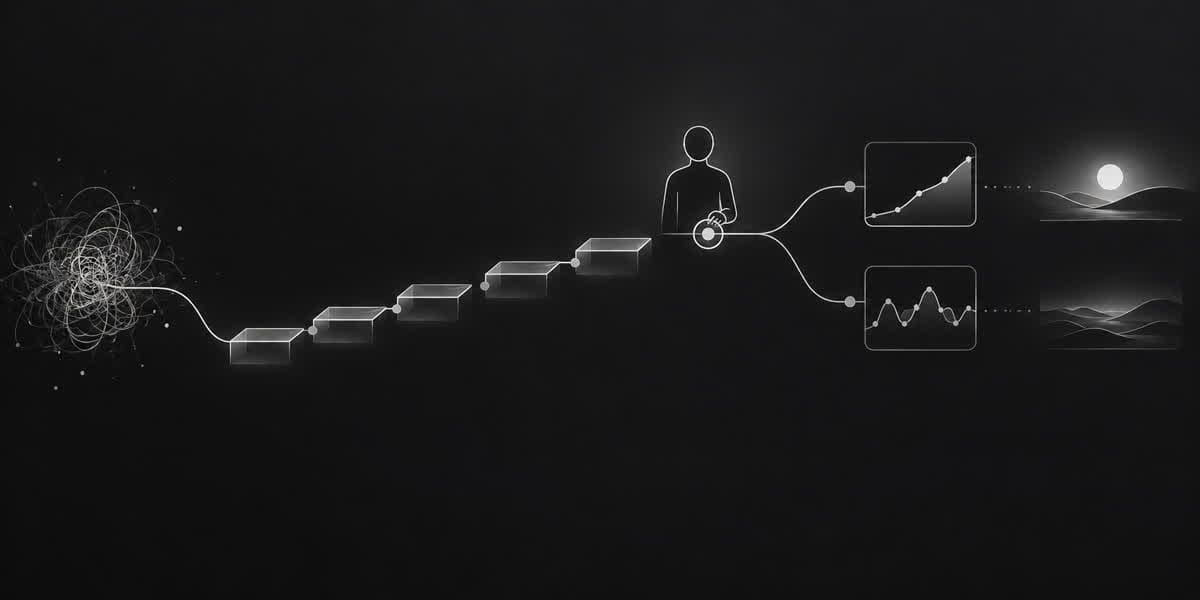
Two new reviews published this week sharpen the same deployment question from different angles: when AI turns behavioral traces into mental-health measurements, what makes that measurement legitimate? A PLOS Mental Health review maps the lifecycle and risks of generative AI in psychometrics, while a PLOS Digital Health scoping review examines AI-based workplace mental-health monitoring. Neither is evidence that automated inference is ready to diagnose people. Together, they are a warning to builders: the consent, validation, and escalation boundary is part of the product, not paperwork after launch.
The frontier signal
The psychometrics paper, published September 23, frames generative AI as a lifecycle problem: item or instrument design, data collection, scoring, interpretation, deployment, and ongoing monitoring each introduce different risks. The workplace-monitoring paper, published September 21, surveys how AI is being used to detect or track mental-health states in employment settings. The titles and publication contexts establish these as reviews, not clinical trials or regulatory clearances; their value is in organizing the evidence and implementation questions.
This matters now because workplace and digital-care products can collect unusually dense streams of text, activity, speech, survey responses, or usage patterns. A model may produce a plausible score, but plausibility does not establish construct validity, clinical utility, or permission to use the score against a person.
Why clinicians and builders care
For clinicians, the central risk is a category error: a screening signal can be treated as a diagnosis, or a change in digital behavior can be treated as a change in symptoms. For operators, the risk is a system that silently converts an exploratory metric into a performance, eligibility, or triage decision. For workers and patients, the boundary may be invisible: they may not know which data were used, what was inferred, who can see it, or how to challenge an error.
The series has recently examined psychiatric-intake quality assurance and multimodal mental-status assessment. The common design lesson is becoming clearer: AI can organize signals, but a safe workflow must preserve clinical context, a human checkpoint, and an auditable path from signal to action.
Technical read-through
Psychometric AI is not one model. It can include generative systems that draft items or summarize responses, classifiers that estimate a latent trait, retrieval systems that ground interpretation in an instrument, and dashboards that aggregate scores over time. Each component needs a different test.
Builders should separate at least four claims:
- Measurement claim: does the output track the intended construct rather than language style, device access, job role, culture, or momentary context?
- Reliability claim: does it remain stable when the same person is measured again, or when wording, language, and modality change?
- Decision claim: does using the output improve a defined workflow, such as follow-up completion or clinician review quality?
- Safety claim: does the system fail visibly and route uncertainty, crisis indicators, and disagreement to an appropriate human?
Workplace monitoring adds a governance layer. Voluntary participation, purpose limitation, data minimization, role-based access, retention limits, and a prohibition on covert individual surveillance should be modeled as technical constraints. A consent banner cannot repair a workflow in which managers receive an opaque risk score or workers cannot opt out without penalty.
Clinical reality check
Reviews are useful maps, not proof of benefit. The workplace literature may combine heterogeneous sensors, populations, definitions of mental health, and outcome measures. A psychometric pipeline can look rigorous while still failing on subgroup calibration, construct drift, or the difference between a population association and an individual-level inference.
There is also a therapeutic-alliance problem. If people believe ordinary help-seeking, writing, or workplace activity is being scored, they may avoid care or change behavior to satisfy the system. False positives can create stigma and unnecessary escalation; false negatives can create false reassurance. In high-sensitivity settings, uncertainty should be an explicit output, not hidden behind a single confidence number.
Builder takeaway
- Define the construct, intended user, and prohibited use before collecting new behavioral data.
- Test measurement invariance and calibration across language, culture, age, disability, job context, and access patterns.
- Keep screening, clinical assessment, and employment decisions on separate permission and data paths.
- Log model version, input provenance, uncertainty, human override, and downstream outcome for every consequential decision.
- Make escalation a staffed workflow with response-time targets; do not market a score as care.
Links / sources
- Psychometric applications of generative artificial intelligence: Lifecycle, risks, and research agenda — PLOS Mental Health, published September 23, 2026; lifecycle and risk review.
- Mental health monitoring in the workplace using artificial intelligence: A scoping review — PLOS Digital Health, published September 21, 2026; scoping review of workplace monitoring.
- The Growing Need to Address Mental Health Vulnerabilities to Artificial Intelligence — Psychiatric Services, published September 17, 2026; vulnerability and governance context.
- Training behavioral health students in the use of artificial intelligence: a framework for graduate education — Mental Health and Digital Technologies, published September 23, 2026; workforce capability context.
- AI Mental Health Frontier — High-Risk Conversation Testing Needs Clinical Calibration — related WisdomChain workflow analysis.