AI Mental Health Frontier — Multimodal Assessment Needs a Human Error Loop
A new multimodal mental-status benchmark points to a practical design rule: AI assessment should expose domain-level errors for clinician review, not hide behind an overall diagnosis score.

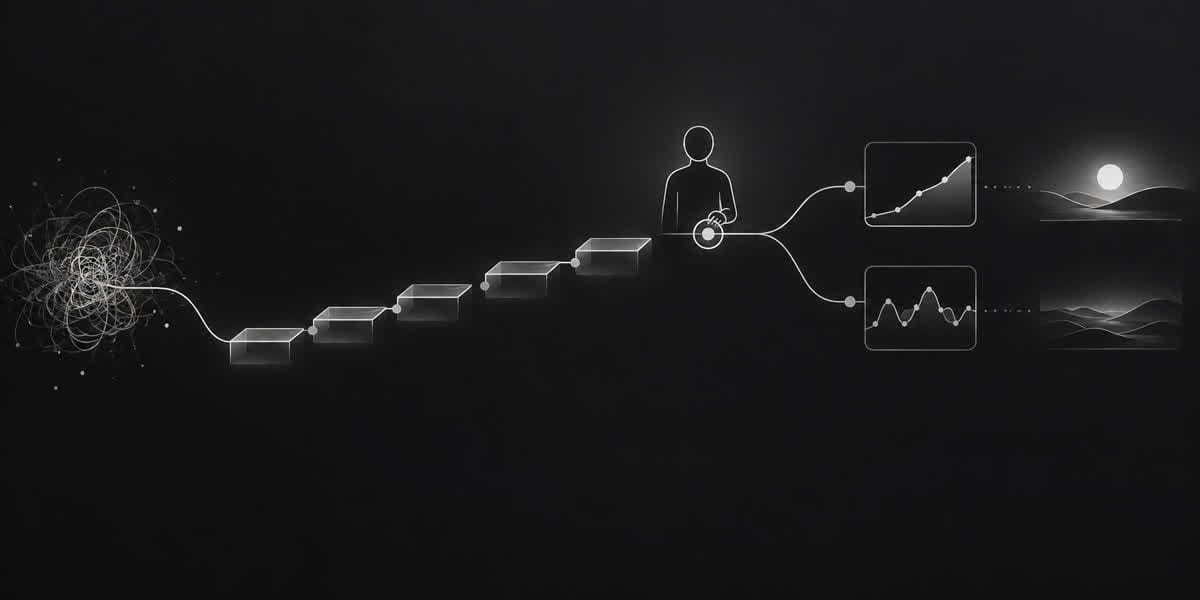
A new study in npj Mental Health Research evaluates a multimodal AI system against psychiatrist teams on the mental status examination. The headline is that its overall diagnostic performance was close to the human teams. The more useful finding for builders is narrower: the system was uneven across individual assessment domains. That makes the next product question less “Can the model diagnose?” and more “Can a clinician see, challenge, and learn from each important error?”
The frontier signal
Researchers from UTHealth Houston and Yale benchmarked a system built around Qwen3-Omni with software that analyzed recorded speech, tone, behavior, and video. The system produced written explanations for mental-status assessments. Standardized patients portrayed schizophrenia, obsessive-compulsive disorder, and bipolar disorder at different severity levels. Teams of psychiatrists and the AI were compared across ten criteria, including mood, appearance, behavior and cooperation, perception, speech, suicidality, delusions, obsessions or compulsions, and thought coherence and speed.
The study, reported by UTHealth Houston and linked to the published paper, says the model’s overall diagnosis was consistently accurate, while some individual criteria—such as appearance or fine motor movements—were more difficult. The authors describe educational and clinician-support uses, not replacement of psychiatrists.
Why clinicians and builders care
Mental-status examination is a structured observation layer inside a broader clinical workflow. A system that summarizes multiple modalities could help a trainee or a clinician working with limited specialist access notice patterns that deserve attention. It could also create a common review artifact across visits.
But an overall label is not enough for safe use. A clinician needs to know whether the system’s conclusion was supported by speech, behavior, observed affect, or an inference that the recording did not justify. The same final diagnosis can conceal very different failure modes. A useful interface therefore needs domain-level evidence, uncertainty, provenance, and a clear route for human correction.
This is the same deployment lesson seen in high-risk conversation testing and clinician-grounded psychiatric intake QA: clinical usefulness depends on calibration to the workflow, not just a benchmark score.
Technical read-through
The architecture combines a pretrained multimodal foundation model with custom software that turns video observations into a mental-status assessment. The evaluation compares the model with multi-center expert judgment on standardized cases, allowing controlled variation in diagnosis and severity.
For a production system, the important unit is not one aggregate accuracy number. It is a matrix: assessment domain by population, recording condition, severity, and reviewer confidence. Each output should retain the input evidence used, distinguish observation from inference, and show where clinicians disagree. A feedback loop can then convert corrected outputs into a quality-assurance dataset without treating clinician edits as unquestionable ground truth.
The educational use case is especially promising if errors are inspectable. A trainee can compare the model’s domain-level reading with expert reasoning. That turns the model from an opaque answer engine into a deliberately limited second reader.
Clinical reality check
Standardized-patient video is not routine care. Real recordings vary in lighting, audio quality, language, culture, disability, medication effects, privacy conditions, and willingness to perform for a camera. Behavioral signals are also context-dependent; a model can mistake recording artifacts or culturally different communication styles for clinical evidence.
The study’s overall result does not establish safety for unsupervised diagnosis, crisis decisions, or longitudinal monitoring. Suicidality is one of the assessed domains, but a benchmark result is not a validated crisis-escalation system. Any deployment should preserve clinician responsibility, provide a fast override, log model version and evidence, and test subgroup and domain-level errors before expanding scope.
Builder takeaway
- Build the review screen around ten assessment domains, not a single diagnosis badge.
- Store provenance: audio/video segment, observed feature, model inference, confidence, and clinician correction.
- Evaluate domain-level sensitivity and disagreement across language, age, disability, setting, and recording quality.
- Use educational mode first, with expert comparison and feedback before clinical decision support.
- Treat crisis-related outputs as escalation cues requiring validated human workflow, never as autonomous determinations.
Links / sources
- Mwangi et al., “Human vs. AI clinical assessment” — published multimodal mental-status benchmark.
- UTHealth Houston summary — study context and intended educational/clinical-support use.
- High-Risk Conversation Testing Needs Clinical Calibration — related workflow evaluation lens.
- Clinician-Grounded Psychiatric Intake QA — related clinician-grounded quality-assurance lens.