Enterprise AI Data Connectors: Knowledge Access vs. Permission Reality

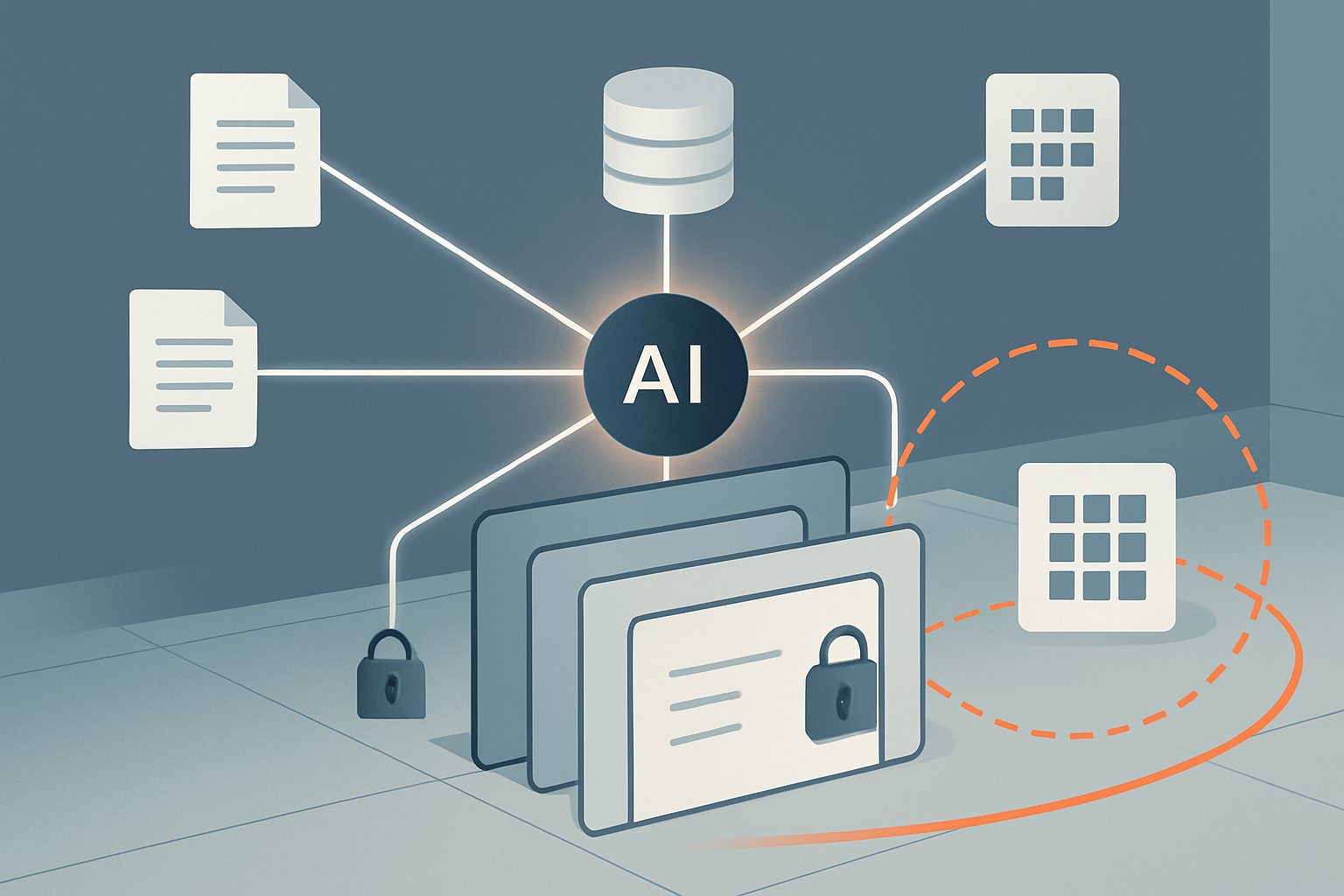
The signal: Enterprise AI is moving from standalone chat boxes toward connected knowledge systems. The promise sounds simple: connect the assistant to the company’s documents, tickets, CRM records, code repositories, project plans, meeting notes, and internal wikis, then let employees ask natural-language questions across everything. Instead of searching five systems and stitching answers together manually, the AI becomes a front door to organizational memory.
That direction makes sense. Many companies already have useful knowledge, but it is scattered across SaaS tools, file drives, Slack threads, email archives, data warehouses, and team-specific workflows. The problem is not always that the answer does not exist. Often the problem is that the answer is buried, duplicated, outdated, inconsistently named, or locked inside a system most employees do not know how to search. AI data connectors appear to turn that mess into a conversational interface.
The business signal is strong because connected AI changes the value proposition. A generic model can write a memo, summarize a public article, or brainstorm a plan. A connected enterprise assistant can answer, “What did we promise this customer last quarter?”, “Which policy applies to this contract?”, “Where did the deployment fail?”, or “What changed in the latest product requirement?” That is much closer to daily work. It also makes AI investment easier to justify because the system touches expensive bottlenecks: support escalation, sales preparation, engineering handoff, compliance review, onboarding, and internal research.
This is why vendors are racing to offer connectors, retrieval layers, knowledge graphs, permission-aware search, and agentic workflows that operate across enterprise systems. The demos are compelling. A user asks a question. The AI finds relevant documents, cites sources, checks a ticket, drafts a response, and suggests the next action. Compared with old enterprise search, the experience feels dramatically better.
The reality check: Access is not the same as readiness.
The first hard problem is permissions. In a real company, knowledge access is not flat. A manager may see compensation notes that an employee should not. A sales team may see customer records that engineering should not. Legal files, HR records, security incidents, financial forecasts, and acquisition discussions all have different boundaries. If an AI system can retrieve across many tools, it must preserve those boundaries at query time, not merely during initial indexing. “The model should not answer from documents the user cannot access” sounds obvious, but implementing it across fragmented systems is difficult.
The second problem is permission drift. Enterprise access changes constantly. People join teams, leave teams, move roles, receive temporary access, lose access, or inherit permissions through groups no one has audited in years. A connector that indexed content yesterday may carry yesterday’s assumptions into today’s answer unless permissions are refreshed, enforced, and logged carefully. The more systems are connected, the more the AI becomes a mirror of the organization’s access-control hygiene.
The third problem is data quality. Connected AI does not magically know which document is authoritative. It may find an old policy, a draft plan, a copied spreadsheet, a partial meeting note, and a current source of truth at the same time. If the retrieval layer ranks the wrong item higher, the generated answer may sound confident while pointing employees toward stale guidance. Enterprise search has always struggled with this. AI makes the output more polished, which can make the underlying uncertainty less visible.
The fourth problem is auditability. When an AI assistant answers using internal data, the company needs to know what sources were used, what permissions were checked, what action was taken, and who approved it. This matters for security, compliance, incident response, and trust. Without audit trails, a connected assistant can become a black box sitting on top of sensitive business systems.
The best deployments will treat connectors as governance infrastructure, not just convenience features. They will start with high-value, well-bounded knowledge domains instead of connecting everything at once. They will enforce document-level permissions, preserve citations, label source freshness, log retrieval and action paths, and create review loops for bad answers. They will identify owners for critical knowledge bases, because no connector can fix a source that nobody maintains.
Key points to remember:
- Connected AI is the next enterprise frontier - The value comes from grounding AI in company-specific documents, systems, and workflows.
- Permissions are the central risk - Enterprise assistants must respect access boundaries dynamically, not just during indexing.
- Data quality still matters - Old, duplicated, or unofficial documents can produce fluent but wrong answers.
- Audit trails are not optional - Companies need to know which sources, permissions, and actions shaped an AI response.
- Start narrow before going broad - The safest path is a controlled domain with clear owners, clean sources, and measurable review loops.
The bottom line: The signal is that enterprise AI will become more valuable as it connects to real organizational knowledge. The reality check is that the connector layer is not just plumbing. It is where search, security, compliance, and knowledge management collide. Companies that treat connection as a demo feature will create risk. Companies that treat it as governed infrastructure may finally make AI useful inside everyday work.