Enterprise AI Agent Benchmarks: Test Suites vs. Production Reliability

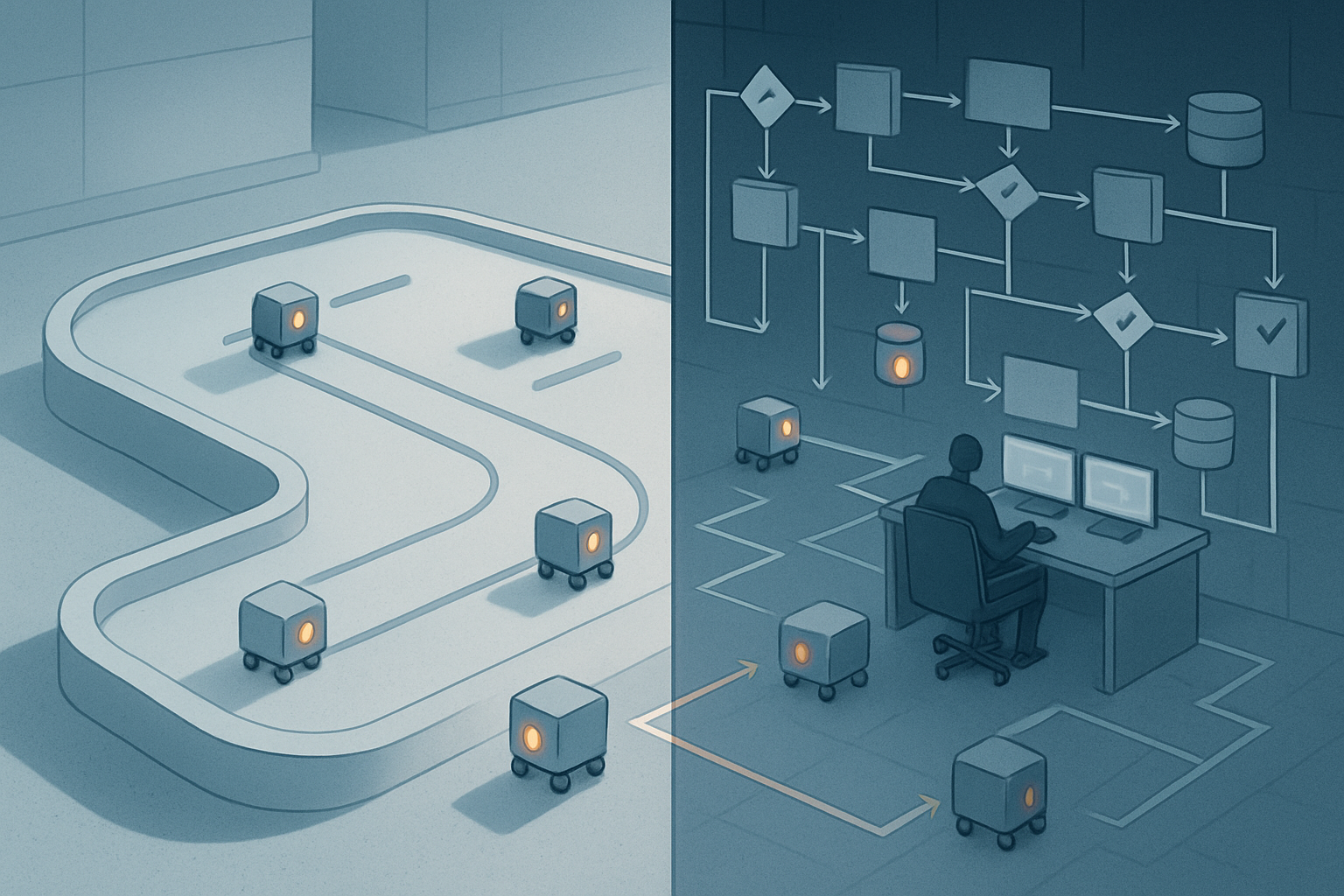
The signal: AI agents are moving into a more serious evaluation phase. The conversation is shifting from “Can the model answer a hard prompt?” to “Can the agent complete a multi-step business workflow without breaking something important?” That is a healthier direction. Enterprise AI does not fail only because a model lacks knowledge. It fails because real work contains permissions, partial information, brittle interfaces, hidden dependencies, approvals, exceptions, and consequences.
This is why agent benchmarks are becoming more workflow-shaped. Instead of testing a single chat answer, newer evaluations try to measure whether an AI system can plan, use tools, inspect results, recover from mistakes, and complete tasks across simulated enterprise environments. The benchmark may involve service operations, IT workflows, sales or support processes, browser tasks, document handling, database lookups, or multi-step decision paths. The goal is not merely fluency. The goal is operational competence.
That matters because the next wave of enterprise AI buying decisions will not be won by impressive demos alone. A demo can show an agent opening a dashboard, reading a ticket, drafting a reply, and updating a system. A deployment has to show that the same agent can handle the messy middle: incomplete tickets, conflicting records, changed UI labels, rate limits, expired credentials, ambiguous instructions, missing approvals, and users who ask for things they should not receive. Benchmarks that include multi-step workflows can expose some of those weaknesses earlier.
The business signal is strong. Vendors, platform companies, and enterprise customers all need a way to compare agent systems beyond model leaderboards. A model may score well on reasoning tests but still perform poorly when it must navigate a tool, preserve state, follow policy, and decide when to stop. Conversely, a less glamorous model embedded in a well-designed workflow may be safer and more useful. Agent benchmarks create a common language for this difference.
They also push teams toward better engineering habits. If a benchmark records tool calls, intermediate observations, failed actions, retries, and completion quality, it encourages builders to think in systems rather than prompts. The artifact being evaluated is no longer just the model. It is the model plus tools, instructions, retrieval, memory, guardrails, permissions, observability, and escalation paths. That is closer to how real AI products actually work.
The reality check: A benchmark is a map, not the territory.
The first limitation is environment fidelity. Simulated enterprise workflows can be useful, but production environments are stranger. Real companies have custom fields, old processes, undocumented shortcuts, inconsistent permissions, duplicate systems, and human habits that never appear in clean test suites. An agent that performs well in a benchmark may still struggle when the same nominal task is wrapped in local exceptions.
The second limitation is distribution shift. Interfaces change. APIs add constraints. Policies are updated. Data schemas drift. A workflow that is reliable this month may degrade quietly next month. Benchmarks often freeze the task environment long enough to compare systems fairly, but enterprises need continuous evaluation that follows their actual tools and business rules. A one-time score cannot prove ongoing reliability.
The third limitation is consequence modeling. Completing a task is not the same as completing it safely. Did the agent expose private information? Did it overstep approval boundaries? Did it update the wrong record? Did it create work for another team? Did it fail loudly enough for a human to notice? Many enterprise failures are not simple task failures. They are control failures.
The fourth limitation is benchmark gaming. Once a benchmark becomes influential, systems will be optimized for it. That is not automatically bad; optimization can improve real capability. But buyers should be careful when leaderboard gains are presented as deployment readiness. The question is not “What is the score?” The question is “What kinds of failure did the benchmark measure, and which ones did it miss?”
The best enterprise teams will use agent benchmarks as an input, not a substitute for local validation. They will build their own workflow evals around high-value tasks, include negative cases, test permission boundaries, measure recovery behavior, and require traceable evidence for important actions. They will evaluate not only final answers but also the path taken: sources used, tools called, approvals requested, retries attempted, and uncertainty expressed.
This changes procurement too. Instead of asking vendors only for benchmark scores, buyers should ask for run logs, failure taxonomies, sandbox trials, observability hooks, rollback options, and human-in-the-loop controls. A reliable agent is not one that never fails. It is one whose failure modes are bounded, visible, recoverable, and improving.
Key points to remember:
- Agent benchmarks are maturing - The focus is moving from isolated answers toward multi-step workflow performance.
- Workflow realism matters - Enterprise value depends on tools, state, permissions, exceptions, and approvals.
- Scores are not deployment proof - A benchmark can reveal capability, but it cannot certify local production readiness.
- Control failures matter as much as task failures - Privacy, authorization, auditability, and rollback must be measured.
- Local evals are the real moat - Teams that continuously test their own workflows will learn faster than teams that rely on public leaderboards.
The bottom line: The signal is that AI agent evaluation is becoming more operational, which is exactly what enterprise adoption needs. The reality check is that benchmark success is only the beginning. Production reliability comes from controlled workflows, continuous evals, observability, permission discipline, and human review where consequences are high. Treat agent benchmarks as useful instruments, not final verdicts.