AI Workflow Ownership: Agent Delegation vs. Accountability Gaps

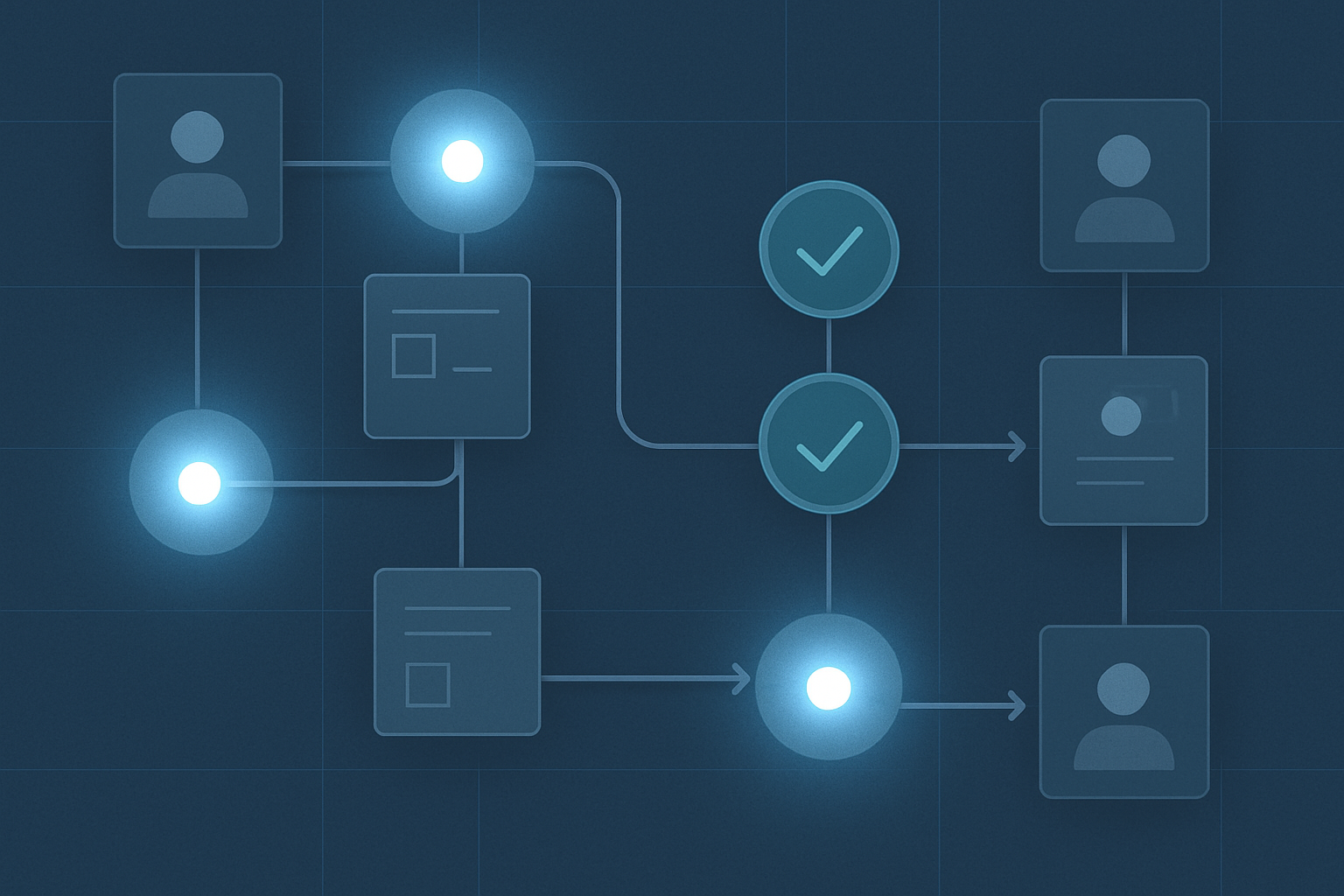
The signal: AI adoption is moving from individual productivity toward workflow delegation. The early promise was that a model could help one person write faster, summarize better, search more efficiently, or generate a first draft. The next promise is more ambitious: an AI agent can take a business request, break it into steps, move between tools, prepare artifacts, route exceptions, and keep work moving while humans focus on judgment.
That shift matters because most organizations do not suffer only from a lack of information. They suffer from handoff friction. A sales request waits on legal review. A support escalation waits on engineering context. A compliance question waits on the right policy owner. A product update waits on documentation, customer messaging, and internal enablement. If AI can reduce the time between these steps, the value is larger than a better chatbot. It becomes operational leverage.
This is why agent delegation is becoming attractive to executives and operators. A useful agent does not merely answer, “What should I do?” It can draft the ticket, collect the context, check the knowledge base, suggest the owner, prepare the customer reply, and ask for approval at the right point. In theory, the organization gets faster cycle times without forcing every employee to become a workflow expert.
The market signal is visible in the way AI products are being packaged. Vendors are no longer selling only smarter assistants. They are selling task runners, agent workspaces, AI coworkers, workflow copilots, and systems that promise to coordinate across email, documents, tickets, CRM records, calendars, code repositories, and internal dashboards. The language is shifting from generation to execution.
That is a real advance. Many business processes contain repetitive coordination work that is expensive precisely because it is fragmented. An agent that can gather context, maintain a checklist, preserve a trace, and escalate only when needed can save time even if it never becomes fully autonomous. In fact, the most useful near-term agents may be the ones that handle the middle of the workflow: not the initial decision, and not the final accountability, but the messy connective tissue between them.
The reality check: Delegation is not the same as ownership.
The first risk is accountability blur. When a human asks an agent to “handle this,” who owns the outcome? The requester? The team whose tools were used? The manager who approved the workflow? The platform owner who configured the agent? The vendor whose model made the recommendation? In low-risk tasks, this ambiguity may be harmless. In customer, legal, security, finance, or production operations, it becomes a serious design problem.
The second risk is orphaned work. Agents can make it easier to start tasks than to finish them responsibly. A system may draft a plan, create tickets, notify people, update fields, and produce summaries, while no human clearly owns the next decision. The result is not automation, but a wider surface of half-completed work. Organizations already struggle with Slack threads, ticket queues, shared documents, and approval chains. AI can reduce that noise, but it can also multiply it if delegation does not include closure rules.
The third risk is hidden handoff failure. Human teams often rely on tacit knowledge: who should be consulted, which exception matters, what history explains a strange policy, when a customer needs a personal call instead of a template, or which internal promise was made off-system. Agents can miss these social and organizational signals. They may route work to the technically correct owner while missing the practical owner. They may summarize the visible facts while omitting the context that actually changes the decision.
The fourth risk is review fatigue. If every agent action requires approval, the promised speed disappears. If too few actions require approval, risk accumulates quietly. The practical answer is not one universal human-in-the-loop rule. It is tiered delegation: low-risk actions can proceed inside narrow constraints; medium-risk actions need sampled review or explicit confirmation; high-risk actions need named human owners and auditable approvals.
Good AI workflow design should therefore begin with ownership mapping, not model selection. Before asking whether an agent can complete a process, teams should ask who owns each stage, what counts as done, which decisions are reversible, which handoffs require context, and where the agent must stop. A simple RACI-style map may sound boring compared with an autonomous demo, but it is often the missing infrastructure that makes delegation safe.
This also changes product requirements. The best workflow agents will need assignment state, escalation paths, approval receipts, completion criteria, exception handling, and clear audit trails. They should make ownership more visible, not less. A user should be able to answer: what did the agent do, what is waiting on whom, what evidence was used, what decision remains, and who is accountable now?
Key points to remember:
- Delegation is becoming the next AI interface - The value is shifting from isolated answers to coordinated workflow movement.
- Ownership cannot be automated away - Someone still needs to be accountable for outcomes, especially in high-consequence work.
- Handoffs are the hard part - Agents must preserve context, not merely move tasks between tools.
- Review needs tiers - Human approval should match risk, reversibility, and business impact.
- Workflow agents need receipts - Assignment state, approvals, traces, and completion criteria are core product features.
The bottom line: The signal is that AI agents are becoming delegation infrastructure. They can reduce coordination drag and make fragmented work move faster. The reality check is that speed without ownership creates accountability gaps. The organizations that benefit most will not be the ones that ask agents to “do more” in a vague way. They will be the ones that define who owns the work, where the agent fits, when humans decide, and how completion is proven.