AI Signals & Reality Checks — 2026-03-12
Signals worth tracking, constraints people miss, and a concrete action you can take this week.

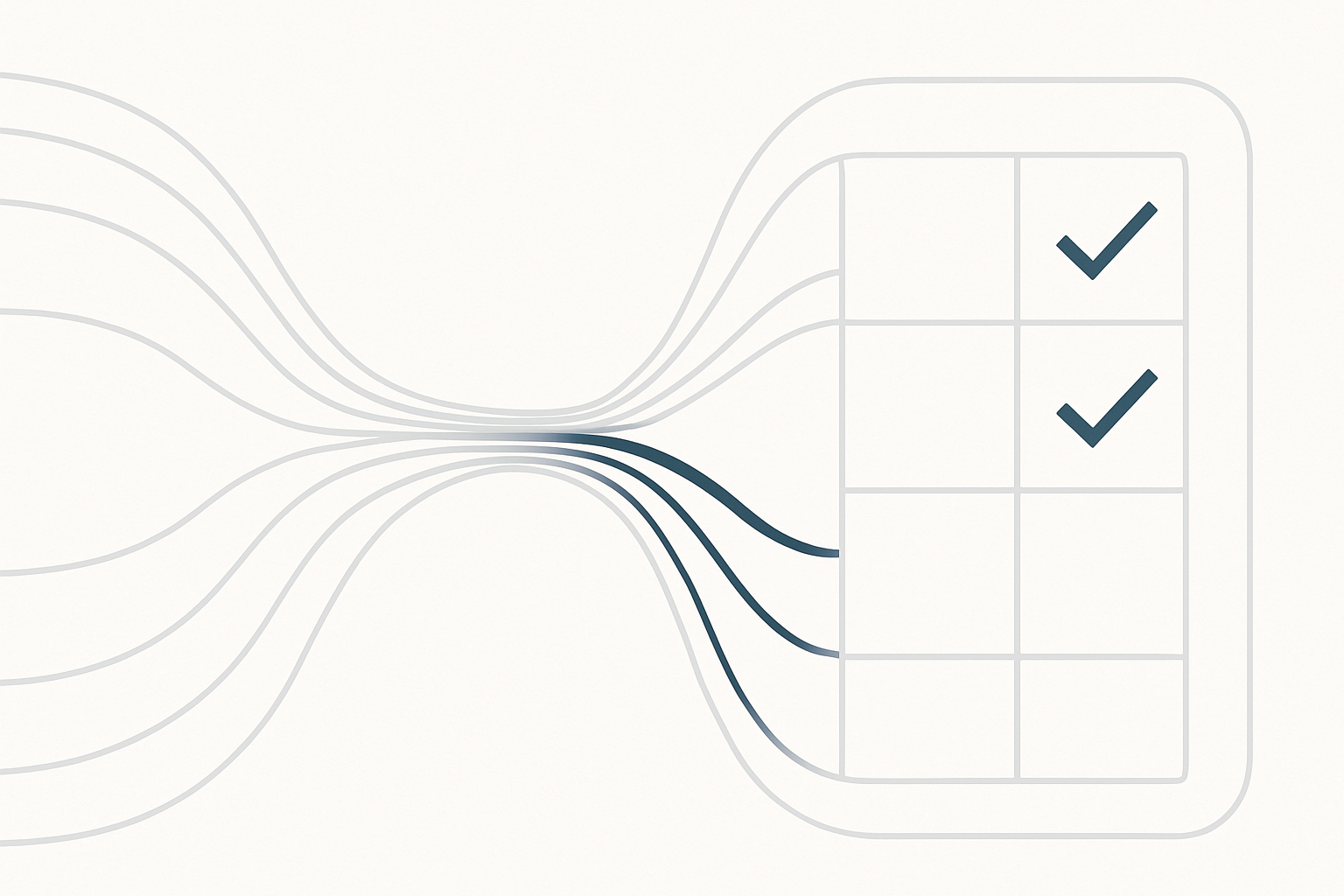
The most important shift in AI right now isn’t a single benchmark jump. It’s that the center of gravity is moving from “model capability” to “system reliability.” If you’re building, buying, or governing AI, your advantage comes from turning a messy probability machine into something your organization can depend on.
Here are three signals I’m using as reality checks.
Signal 1 — “Intelligence” is getting cheaper; decisions are getting more expensive
As inference costs drop and latency improves, we’re seeing more products try to push models closer to the edge of decision-making. But the closer an output is to a real-world action, the more expensive it is to be wrong.
What’s actually happening in good teams:
- They separate generation from commit. The model can draft; the system decides when it’s allowed to act.
- They treat cost as a budgeted resource, not a surprise bill. You don’t just “run the model”—you allocate spend per workflow, per user, per day.
- They instrument every action with a trace: inputs, tools, permissions, and what the model “thought” it was doing.
Reality check: your unit economics don’t collapse when tokens get cheaper. They collapse when you discover your workflow needs three retries, two human reviews, and one incident response per 1,000 runs.
Signal 2 — The bottleneck is shifting from “prompting” to interfaces and contracts
Prompts still matter, but the big gains now come from building the right interface between your organization and the model:
- A contract for inputs (what is allowed, what is required, what is forbidden)
- A schema for outputs (what fields exist, what gets validated, what gets rejected)
- A tool boundary (what the model can do vs. what the system must do deterministically)
This is why structured workflows beat free-form chat in production. The model is flexible; your business process is not.
Reality check: if your “agent” can do anything, it will eventually do something you didn’t mean. Safety isn’t a vibe; it’s a set of constraints enforced by software.
Signal 3 — Evaluation debt is becoming the hidden tax of every AI roadmap
Teams are shipping AI features faster than they can measure them. That creates evaluation debt: you accumulate behaviors you can’t confidently predict.
Three patterns show up when evals are missing:
- You can’t tell improvement from drift. A model update “feels better” until your edge cases explode.
- You can’t localize failures. When something goes wrong, you don’t know whether it was the prompt, the retrieval, the tool, or the policy.
- You can’t scale autonomy. Without metrics, you can’t safely increase permissions.
Reality check: you don’t need perfect evals. You need useful evals—small, living test sets that reflect your real failures.
What I’m watching next (near-term)
- Permissioning that looks like IAM: not “the agent can browse,” but “this step can call this tool with this scope for this account.”
- Model-agnostic workflow design: systems that survive model churn because the contracts, checks, and fallbacks are stable.
- Operational transparency as a product feature: end-users increasingly ask, “Why did it do that?” and “What did it use?”
A simple action for builders (do this this week)
Pick one workflow and write a one-page Reliability Spec:
- Goal: what “done” means (measurable)
- Constraints: what must never happen (data, money, user trust)
- Checks: what you validate before/after each step
- Fallbacks: what to do on low confidence, timeout, or tool failure
- Evidence: what you log so future-you can debug in 10 minutes
If you can’t write the spec, you’re not shipping a product—you’re shipping hope.