AI Signals & Reality Checks — 2026-03-12
Signals worth tracking, constraints people miss, and a concrete action you can take this week.

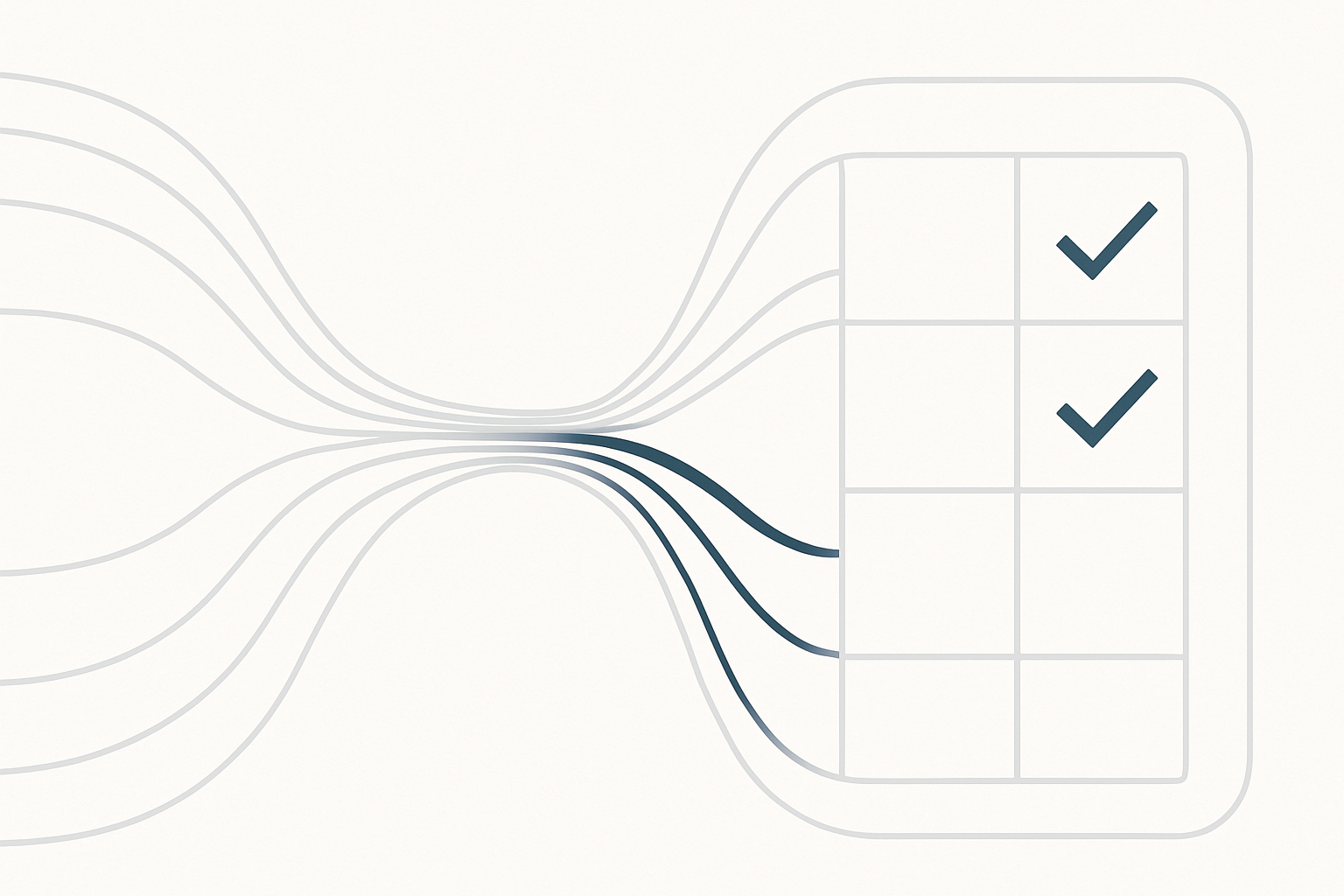
The most important shift in AI right now isn’t a single benchmark jump. It’s that the center of gravity is moving from “model capability” to “system reliability.” If you’re building, buying, or governing AI, your advantage comes from turning a messy probability machine into something your organization can depend on.
Here are three signals I’m using as reality checks.
Signal 1 — “Intelligence” is getting cheaper; decisions are getting more expensive
As inference costs drop and latency improves, we’re seeing more products try to push models closer to the edge of decision-making. But the closer an output is to a real-world action, the more expensive it is to be wrong.
What’s actually happening in good teams:
- They separate generation from commit. The model can draft; the system decides when it’s allowed to act.
- They treat cost as a budgeted resource, not a surprise bill. You don’t just “run the model”—you allocate spend per workflow, per user, per day.
- They instrument every action with a trace: inputs, tools, permissions, and what the model “thought” it was doing.
Reality check: your unit economics don’t collapse when tokens get cheaper. They collapse when you discover your workflow needs three retries, two human reviews, and one incident response per 1,000 runs.
Signal 2 — The bottleneck is shifting from “prompting” to interfaces and contracts
Prompts still matter, but the big gains now come from building the right interface between your organization and the model:
- A contract for inputs (what is allowed, what is required, what is forbidden)
- A schema for outputs (what fields exist, what gets validated, what gets rejected)
- A tool boundary (what the model can do vs. what the system must do deterministically)
This is why structured workflows beat free-form chat in production. The model is flexible; your business process is not.
Reality check: if your “agent” can do anything, it will eventually do something you didn’t mean. Safety isn’t a vibe; it’s a set of constraints enforced by software.
Signal 3 — Evaluation debt is becoming the hidden tax of every AI roadmap
Teams are shipping AI features faster than they can measure them. That creates evaluation debt: you accumulate behaviors you can’t confidently predict.
Three patterns show up when evals are missing:
- You can’t tell improvement from drift. A model update “feels better” until your edge cases explode.
- You can’t localize failures. When something goes wrong, you don’t know whether it was the prompt, the retrieval, the tool, or the policy.
- You can’t scale autonomy. Without metrics, you can’t safely increase permissions.
Reality check: you don’t need perfect evals. You need useful evals—small, living test sets that reflect your real failures.
What I’m watching next (near-term)
- Permissioning that looks like IAM: not “the agent can browse,” but “this step can call this tool with this scope for this account.”
- Model-agnostic workflow design: systems that survive model churn because the contracts, checks, and fallbacks are stable.
- Operational transparency as a product feature: end-users increasingly ask, “Why did it do that?” and “What did it use?”
A simple action for builders (do this this week)
Pick one workflow and write a one-page Reliability Spec:
- Goal: what “done” means (measurable)
- Constraints: what must never happen (data, money, user trust)
- Checks: what you validate before/after each step
- Fallbacks: what to do on low confidence, timeout, or tool failure
- Evidence: what you log so future-you can debug in 10 minutes
If you can’t write the spec, you’re not shipping a product—you’re shipping hope.
中文翻译(全文)
当下 AI 最重要的变化,并不是某一个基准测试突然大幅提升,而是:重心正在从“模型能力”转向“系统可靠性”。 如果你在做 AI 的建设、采购或治理,你的优势来自于把一个充满概率的“生成机器”,变成组织可以依赖的系统。
下面是我用来做现实校验的三个信号。
信号 1 —— “智能”更便宜了,但决策更贵了
随着推理成本下降、时延改善,越来越多的产品试图让模型更接近真实世界的决策。但输出越接近“动作”,犯错的代价就越高。
优秀团队正在做的事情,往往是这些:
- 把生成与提交分开:模型可以起草,但系统决定什么时候允许它真正执行。
- 把成本当作预算资源管理,而不是一张事后出现的账单。你不是简单地“跑模型”,而是给每个流程/用户/每天分配可控额度。
- 为每一次动作做可追溯记录:输入、工具、权限,以及模型以为自己在做什么。
现实校验:你的单位经济并不会因为 token 更便宜就自动变好。它往往会在你发现每 1,000 次运行需要三次重试、两次人工复核、一次事故响应时崩掉。
信号 2 —— 瓶颈正在从“写提示词”转向接口与契约
提示词依然重要,但当下最大的增益更常来自于:把组织与模型之间的接口搭对。
通常包含三件事:
- 输入的契约(什么允许、什么必须、什么禁止)
- 输出的结构/模式(有哪些字段、如何校验、什么直接拒绝)
- 工具边界(哪些事模型能做,哪些事必须由系统以确定性方式完成)
这也是为什么在生产环境里,结构化工作流往往优于自由对话:模型可以灵活,但你的业务流程不能随意。
现实校验:如果你的“agent”什么都能做,它迟早会做出你不想要的事。安全不是一种氛围,而是一组由软件强制执行的约束。
信号 3 —— 评测债(evaluation debt)正在成为每条 AI 路线图的隐形税
很多团队上线 AI 功能的速度,已经快过了他们衡量效果的能力。这会形成评测债:你不断累积一些自己无法稳定预测的行为。
缺乏评测时,经常出现三种情况:
1)分不清改进还是漂移:一次模型更新“感觉更好”,直到边缘案例全面爆炸。 2)无法定位故障来源:出了问题你不知道是提示词、检索、工具还是策略导致。 3)无法扩大自治:没有指标,就无法安全地提升权限。
现实校验:你不需要完美的评测。你需要有用的评测——小而可持续演化的测试集,真实反映你遇到的失败。
我接下来会关注什么(短期)
- 像 IAM 一样的权限管理:不是“agent 能上网”,而是“这个步骤可以在这个范围、这个账户下调用这个工具”。
- 与模型无关的工作流设计:即使模型更换,契约、校验与降级机制依然稳。
- 把透明度当作产品功能:用户会越来越常问:“它为什么这么做?”“它用到了什么?”
给 builder 的一个简单动作(这周就做)
选一个工作流,写一页纸的《可靠性规格说明》(Reliability Spec):
- 目标:“完成”的定义(可度量)
- **约束:**绝对不能发生什么(数据、金钱、信任)
- **检查:**每一步前后要校验什么
- **降级:**低置信度/超时/工具失败时怎么办
- **证据:**记录什么,让未来的你能在 10 分钟内定位问题
如果你写不出这份规格说明,你就不是在交付产品——你是在交付希望。