From Performance Alert to Verified Fix
A performance alert is only the start: make investigation, review, and post-deploy verification explicit workflow stages.

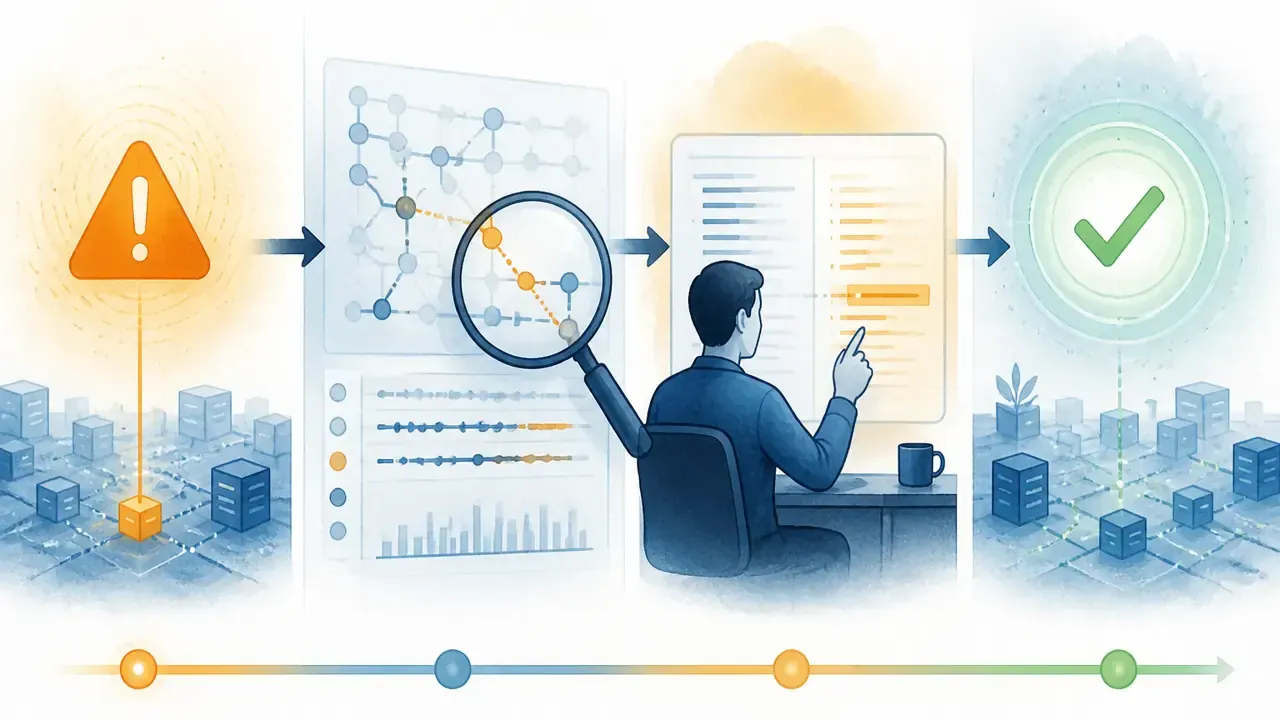
A latency alert is easy to acknowledge and surprisingly hard to close well. Someone must decide whether it is real, locate the change or system condition behind it, propose a safe remedy, get that remedy reviewed, and check that the metric actually recovered after deployment. Treating those as one vague “fix the regression” request hides handoffs and makes a green dashboard look like proof. OpenAI’s Performance Factory offers a useful workflow pattern: make each state and its evidence visible, while keeping engineers in the decision loop.
The signal
- Practitioner / team: OpenAI Performance Factory.
- Source: How OpenAI’s Performance Factory keeps ChatGPT fast, a first-party account.
- Why this matters: A durable task can carry findings across agent turns and people, reducing the chance that investigation context disappears between alert and deployment.
The method in one sentence
Convert a configured performance alert into a tracked task that advances through investigation, root cause, proposed fix, and post-deployment recovery verification, with engineers able to inspect and review the work.
What the source actually shows
Workflow
- A configured performance alert fires and opens a task. The task tracks status and key findings outside a single agent’s context.
- Agents investigate and move the task through stages, including finding a root cause and proposing a fix. Engineers can add context and review proposed changes through the workflow UI or Slack.
- After a fix is deployed, an agent checks whether performance has returned to its earlier state before resolving the task.
OpenAI describes four system components behind the factory: a task tracker with configurable workflows, a dispatch loop that assigns ready work, cloud execution for Codex, and subscriptions that announce changes. This is more than a prompt template. It is a stateful service coordinating work and surfacing evidence. The source calls the system autonomous, but that should not be read as permission for an adopter to skip review or deploy changes without controls; the described engineer review is an important boundary.
Inputs, tools, and outputs
| Element | Evidence from the source | What we can test |
|---|---|---|
| Input | Configured performance alerts open tasks | Whether seeded alerts contain enough context to investigate |
| Agent step | Agents investigate, root-cause, and propose a fix | Accuracy and usefulness of findings and proposed changes |
| Shared state | Task status and findings persist outside one agent context | Whether another reviewer can resume without redoing work |
| Quality check | Engineers review proposed changes; an agent checks recovery after deployment | Review rejection, verification correctness, and false closure |
The last check matters because “a change merged” and “the regression recovered” are different events. A verification step needs a defined comparison window and baseline. A metric may fluctuate naturally, or an unrelated deployment may move it. The post-deploy agent should report the observations and uncertainty, not turn correlation into causal proof.
Reconstruction plan
- Task: Use ten seeded, reproducible performance regression cases in a safe test service, each with a known metric change and a reference root cause.
- Baseline: Have an engineer follow a written conventional checklist, recording diagnosis, elapsed time, change proposal, review decision, and final metric check.
- Smallest useful experiment: In a separate matched run, use the same cases and permissions with an agent-supported task workflow. Hold model and task information constant where feasible. Do not allow direct production deployment.
- Artifact to save: Case definitions, alert payloads, task-state history, agent traces, proposed diffs, reviewer notes, metric windows, and a score sheet.
- Success condition: Predefine scoring; report every case. The workflow should preserve handoff context and correctly distinguish recovered, not recovered, and inconclusive cases without lowering fix quality or bypassing review.
- Stop condition: Stop if the cases are not reproducible, the metric baseline is ambiguous, the agent can affect production, or reviewers cannot inspect the proposed changes.
This comparison is a HYPOTHESIS , not a result: no local reconstruction is reported here. A ten-case exercise can expose workflow failures, but it cannot establish broad productivity or reliability gains. Small samples, differing case difficulty, and learning effects can dominate averages; preserve per-case results and avoid causal claims from unmatched runs.
Reality check
- Observed: OpenAI says alerts create tasks, agents investigate and propose fixes, engineers can review and add context, and an agent checks post-deployment recovery.
- Reported: The company says the workflow tracked more than 1,700 investigations and root-caused more than 600 cases in just over three months. These are vendor-reported operational counts, not an independent audit or a controlled comparison.
- Reconstructed: Nothing locally; the proposed ten-case comparison remains a HYPOTHESIS .
- Still unknown: The public account does not provide enough information to independently reproduce the reported scale, quantify intervention rates, or infer what fraction of proposed fixes caused recovery.
- Cost / latency / maintenance constraint: A task service, dispatch loop, cloud agent execution, and subscriptions add operational components. Alert quality, state hygiene, compute cost, reviewer load, and metric ownership all need maintenance. A broken or noisy alert can simply create more low-value work faster.
Transfer rule
Try this pattern when a recurring alert has a measurable signal, an identifiable owner, a reviewable remedy, and a post-change check. Start with one service and a small set of replayable cases. Keep task states narrow—investigate, root-caused, proposed, reviewed, deployed, verified—and require an explicit evidence artifact at each transition.
Avoid it when the signal has no stable baseline, the proposed action is difficult to inspect, or an incorrect change could cause harm without a human gate. A task should not close merely because an agent produced a plausible explanation or a deployment completed. Change the recommendation if a controlled reconstruction shows that state tracking adds more delay and review burden than it removes, or if verification frequently misclassifies recovery.
Practice card
- Inputs: Alert definition, recent metric history, code and deployment context, owner, and a reproducible test case.
- Steps: Open a durable task; attach the alert and baseline; investigate and record evidence; propose a minimal diff; route it for human review; after approved deployment, compare the same metric over a predeclared window; close only with a recovery record or an explicit inconclusive state.
- Expected output: A traceable task containing root-cause evidence, a reviewed proposal, deployment reference, and verification result.
- Quality check: Another engineer can tell what was observed, what was inferred, who approved the change, and whether the metric returned to baseline.
- Next iteration: Replay a failed or noisy case and revise the alert context or verification rule before expanding scope.
Links / sources
- Chinese companion: 从性能告警到已验证修复
- Related series article: Sandbox Boundaries, Fewer Approval Prompts
- First-party source: How OpenAI’s Performance Factory keeps ChatGPT fast
- Supporting source or video: None used.
- Reproduction artifact: Proposed protocol only; no experiment run.