AI Observability: Trace Dashboards vs. Causal Understanding

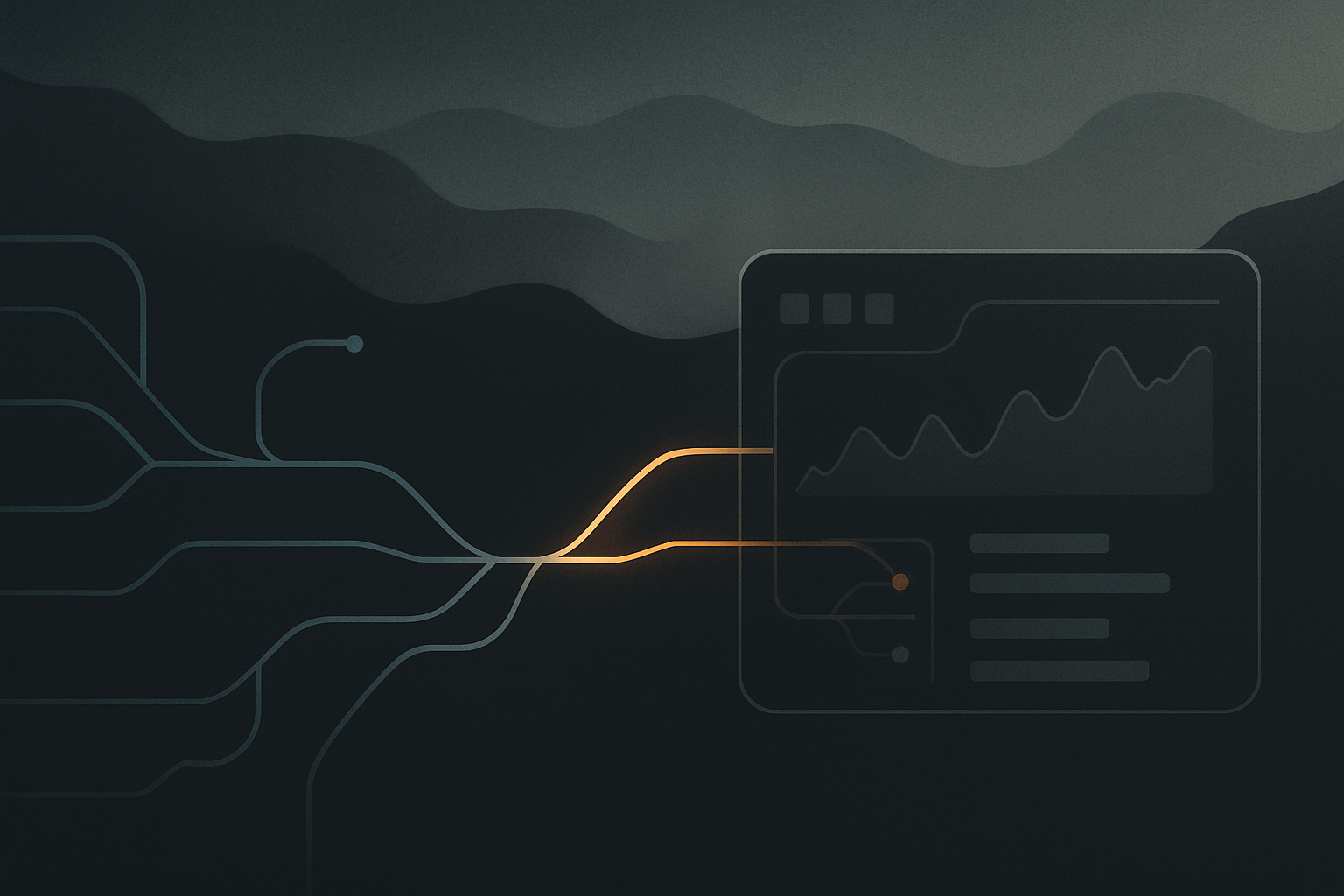
The signal: AI observability is becoming one of the most important layers in the production AI stack. The early wave of generative AI adoption was dominated by prompts, model choice, vector databases, and visible product demos. Now more teams are discovering that the hard question begins after launch: what exactly happened when the system gave this answer, used that tool, missed that policy, or cost three times more than expected?
That question is pushing observability from normal software monitoring into a more specialized AI discipline. Traditional systems already track uptime, latency, errors, logs, traces, and resource usage. AI systems need those, but they also need visibility into prompts, retrieved context, model versions, tool calls, intermediate reasoning artifacts where available, guardrail decisions, safety filters, human handoffs, token spend, eval scores, and user feedback. A modern AI application is not just a model endpoint. It is a chain of retrieval, ranking, generation, validation, routing, and sometimes external action. If that chain fails, the failure may not look like a clean 500 error. It may look like a fluent but wrong answer.
The market signal is strong because observability is where AI ambition meets operational accountability. Leaders want to know whether the system is improving or only appearing more fluent. Product teams need to understand which prompts, documents, and tools contributed to an output. Compliance teams need audit trails. Finance teams need cost visibility. Engineers need a way to compare model upgrades without breaking yesterday’s workflow. Support teams need to reproduce failures that users describe in vague language. Without observability, AI adoption depends too much on anecdotes, screenshots, and vibes.
This is why trace dashboards, prompt/version registries, replay tools, online evals, and feedback loops are gaining attention. They make AI systems less magical and more inspectable. A team can see the actual retrieved passages, the tool call sequence, the model response, the guardrail result, and the user outcome. That visibility changes the culture. Instead of arguing about whether a model is “smart enough,” teams can ask where the workflow is losing reliability.
The reality check: More telemetry does not automatically create understanding.
The first trap is confusing trace completeness with causal explanation. A beautiful dashboard may show every prompt, token count, latency spike, retrieved chunk, tool call, and final response. That is useful, but it still may not answer the real question: why did the system fail this time? Was the prompt ambiguous? Was the retrieval set stale? Did the ranking step surface the wrong document? Did a tool return partial data? Did the model over-weight a misleading phrase? Did a safety rule fire too late? Did a model upgrade change behavior in a subtle way? Observability shows the path. It does not always reveal the cause.
The second trap is signal overload. AI traces can become enormous, especially in agentic systems where one user request may involve planning, search, multiple tool calls, retries, validation passes, and fallback logic. If every run generates a wall of logs, teams can drown in detail while still missing the pattern that matters. The practical value of observability depends on disciplined questions: which failures deserve review, which metrics predict risk, which slices reveal drift, and which alerts actually lead to action?
The third trap is treating observability as a substitute for evaluation. Monitoring tells you what happened in production. It does not by itself define what good performance means. Teams still need task-specific evals, regression tests, acceptance thresholds, human review rubrics, and business outcome metrics. Otherwise observability becomes a sophisticated rearview mirror: excellent at showing the accident, weak at preventing the next one.
The best teams will use observability as part of a control loop. They will instrument the full chain, but they will also connect traces to eval failures, cost budgets, incident reviews, prompt and model versioning, and product decisions. They will sample intelligently instead of trying to inspect everything. They will preserve enough context to reproduce failures without turning every user interaction into a privacy risk. They will build dashboards for decisions, not for decoration.
Key points to remember:
- AI observability is becoming foundational - Production AI needs visibility into prompts, retrieval, tools, guardrails, costs, feedback, and model versions.
- Traces are not explanations - Seeing the full path helps, but teams still need causal investigation to understand why behavior changed.
- More logs can create more noise - The value comes from useful slices, alerts, and review workflows, not from collecting everything blindly.
- Observability and evals must work together - Monitoring reveals production behavior; evaluation defines whether that behavior is acceptable.
- Privacy and governance matter - Detailed AI traces can contain sensitive user input, documents, and intermediate outputs, so retention and access controls are part of the design.
The bottom line: The signal is that AI observability is moving from optional tooling to operational necessity. That is a healthy shift. Teams cannot govern what they cannot see. The reality check is that visibility is only the beginning. A trace dashboard can tell you what happened. Reliable AI operations require the harder work of deciding what matters, finding causes, fixing the workflow, and proving the fix still holds tomorrow.