AI Investment Research Needs Expiry Dates for Its Evidence
AI can compress research intake, but an investment workflow is safer when every claim carries a freshness window, source, transformation, and human check.

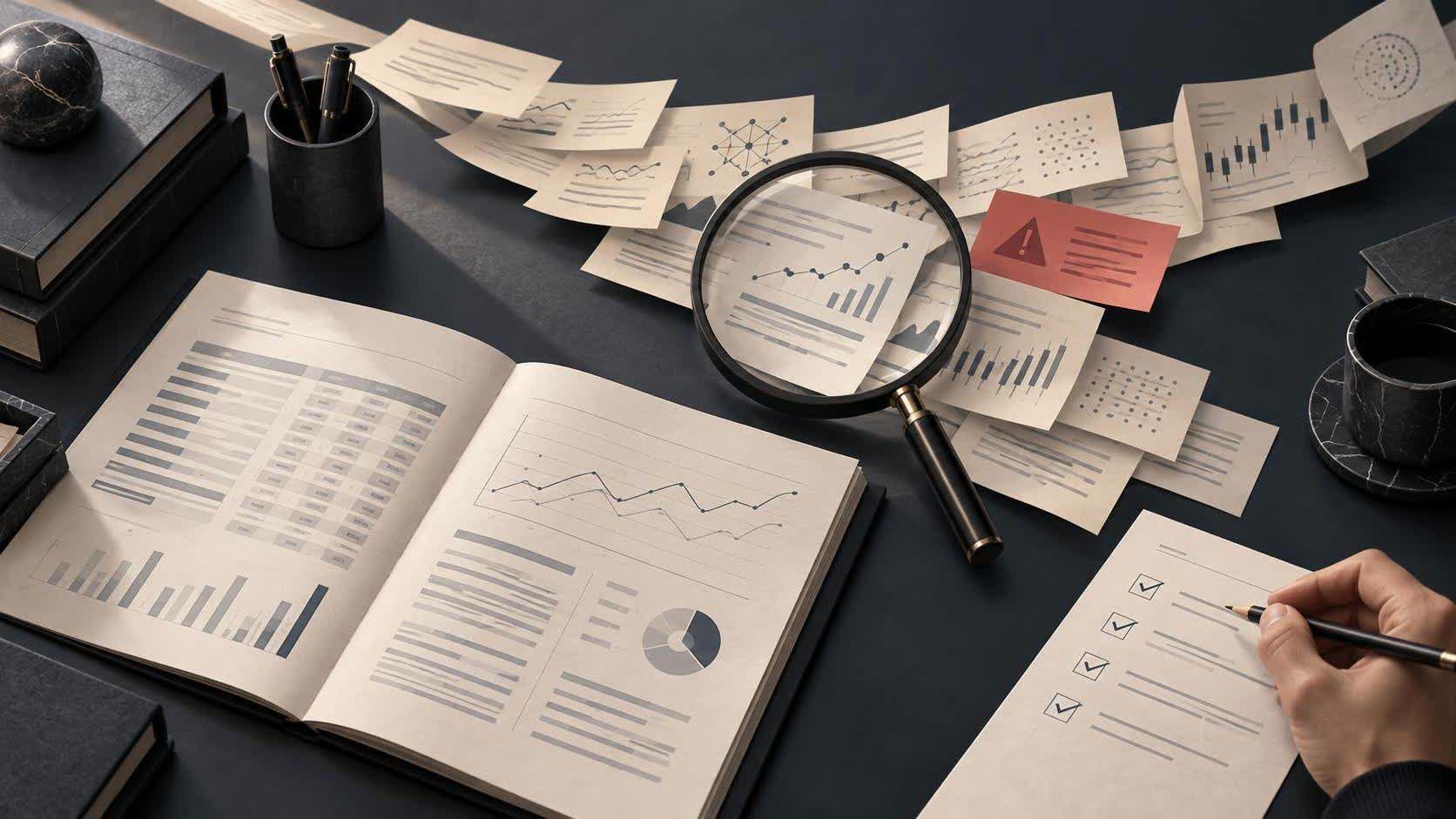
AI can make an investment research desk look faster while making its evidence harder to reconstruct. The practical change is not that a model writes a nicer memo. It is that a model can turn a large stream of filings, transcripts, papers, and market data into a queue of claims for a human to review. That queue is useful only if each claim keeps its provenance.
The judgment is therefore simple: before an AI research workflow scales, every claim needs an expiry date. A source ledger records the retrieval time, quoted passage or data slice, model transformation, uncertainty, and human disposition; a freshness window says when the claim must be checked again. Without both, a polished answer can become an untraceable mixture of current facts, stale context, inference, and model completion.
That concern is now a workflow issue, not a philosophical one. The SEC’s September 2026 remarks on “Information in the Age of AI” frame information integrity and investor protection as practical market concerns (SEC). Separately, recent work on time-series foundation models shows why transfer results need careful task and baseline definition: broad pretraining may help in some data regimes, but specialized models can still match or exceed it on particular tasks (arXiv:2507.07296). In both cases, the missing ingredient is not more fluent output; it is a way to inspect what supports the output.
The changed workflow
The old workflow begins with a researcher collecting documents, highlighting evidence, and writing a thesis. The AI-assisted version begins with a bounded question and a machine-generated claim queue. For each claim, the system should attach: the canonical URL or dataset identifier; publication and retrieval timestamps; the exact excerpt or observation window; a label for fact, calculation, interpretation, or forecast; the model and prompt version; and a review-by date based on how quickly the underlying fact can change.
The model can cluster duplicate disclosures, extract comparable fields, and propose contradictions. It should not silently resolve them. A human reviewer then marks each item as verified, unresolved, rejected, or requiring a primary-source check. The output is not “buy” or “sell.” It is a dated research packet whose reasoning can be rerun after the next filing, estimate revision, or data correction.
This is a narrower but more durable use of AI than asking for an autonomous investment opinion. It helps discretionary researchers reduce search and transcription work. It gives systematic teams a cleaner feature and label audit. It gives AI builders a testable product requirement: can another reviewer reproduce the claim from the stored evidence?
The design also connects to the site’s reproducible research trail and grounded advice evaluation work. A provenance ledger is the operational bridge between those ideas: it turns grounding and reproducibility into fields that can be inspected before a memo is trusted.
A reproducible desk pattern
Start with one narrow question, such as how a company’s disclosed operating metric changed across two reporting periods. Give the model only the dated primary documents and ask it to produce a table of claims, citations, calculations, and unresolved ambiguities. Require it to quote the supporting passage rather than paraphrase it. Then have a human check a sample of claims against the source and record the reason for every correction.
The useful output is a queue with a ledger, not a score. It should show which claims were directly supported, which depended on arithmetic, which were model interpretations, which had no adequate evidence, and which have gone stale. A second model can challenge the packet, but disagreement is a review signal, not proof that either answer is right.
A safe 60-minute exercise
Use three dated public documents and no live orders, holdings, or recommendations. In the first 15 minutes, write a baseline manually: ten claims and their sources. In the next 20, ask an AI system to produce the same claim table under a fixed prompt. Spend 20 minutes checking every claim and marking citation accuracy, missing context, timestamp errors, and unsupported inference. Use the last five minutes to record corrections and the time spent.
The metrics are citation precision, unsupported-claim count, timestamp accuracy, reviewer correction rate, and minutes per verified claim. The baseline is the manual table. The observation window is one session; repeat it on a different document set only if the first run is clean. Stop if the model invents a source, mixes document dates, or cannot expose the passage behind a material claim. This is a research-quality test, not a trading test.
What the ledger cannot solve
Provenance does not establish causality, predictive power, or economic value. The source itself may be selective, revised, promotional, or measured with a definition that changed over time. A clean citation can still support a weak inference. Public-document samples also carry selection and survivorship bias, while model and vendor incentives may favor impressive coverage over calibrated uncertainty.
There is a second failure mode: measurement becomes the target. If a team optimizes citation precision on an easy document set, it may look reliable while failing on tables, footnotes, scanned filings, or rapidly changing data. Time-series leakage, non-stationarity, costs, latency, and compliance constraints remain separate tests. A provenance ledger preserves the trail; it does not turn the trail into alpha.
The investment lesson is consequently modest. Automate collection, comparison, expiry alerts, and explicit bookkeeping where the evidence can be replayed. Keep thesis formation, conflict resolution, and material judgment reviewable by a human. The frontier is not an AI that speaks with more authority. It is a research process that knows when a claim is no longer safe to carry forward.