Visual Search Is Becoming Agent Memory

Visual Search Is Becoming Agent Memory
The important thing is not that web search can return images; it is that agents are starting to need visual evidence as part of their working memory because many real-world tasks are grounded in things users recognize by sight, not just facts they can phrase as text.
OpenAI's June 9 API changelog notes a small feature: web search in the Responses API can now return image results alongside regular text results, for use cases that need current or web-grounded visuals such as product photos, landmarks, places, events, or visual references. On its own, that sounds like a search improvement. The sharper read is that visual retrieval is becoming a runtime primitive for agents.
This is not about making chat answers prettier. It is about closing a common gap between how users identify the world and how LLM systems retrieve it. A user may not know the model number of a chair, the name of a building, the exact variant of a product, or the official title of a public event. They may point to a photo, describe a shape, ask for "the one with the green label," or compare two listings visually. Text search can help, but it often loses the discriminating feature that made the task concrete.
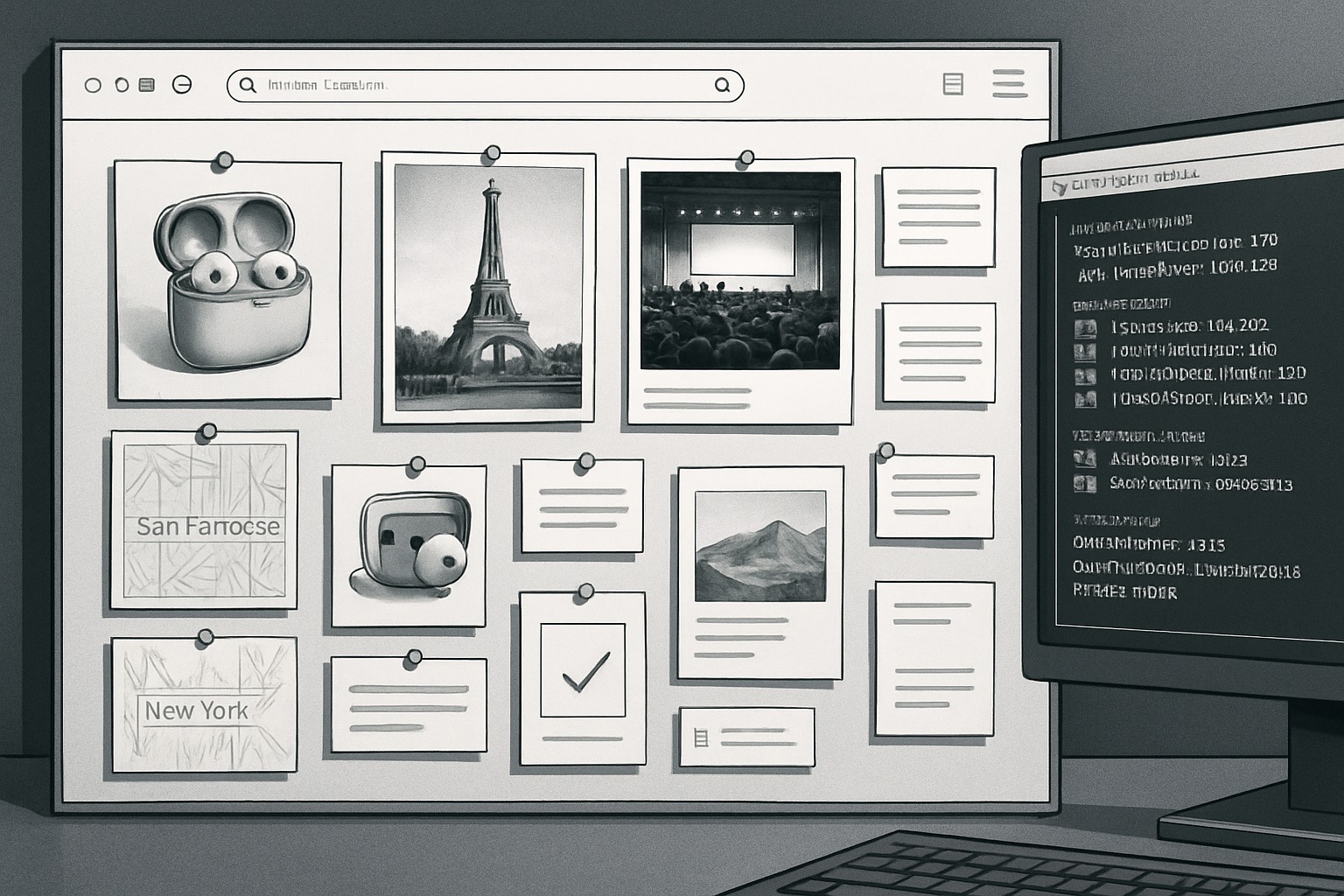
The named mechanism is visual grounding cache. In a serious agent workflow, image results should not be treated as decorative attachments. They should become temporary working memory: a set of visual evidence cards with source URLs, timestamps, captions, perceptual features, confidence, and downstream task links. When an agent recommends a product, identifies a venue, prepares a travel plan, checks a news image, or verifies a brand asset, it needs to preserve the visual basis for the answer long enough to reason over it and show its work.
That is why this June 9 update matters today even though it is not a frontier-model release. The last few years of agent design have centered on tools, function calls, browser control, memory, and evaluation. But many practical tasks fail before tool use because the system has the wrong representation of the object. A text-only agent may know that a restaurant exists and that reviews are recent, but it may miss whether the current storefront is under construction. It may know a product SKU, but not whether the image on a marketplace listing shows the right accessory bundle. It may summarize an event, but not distinguish official photos from old reposted images.
The missed tradeoff is retrieval breadth versus evidence hygiene. Adding images expands what the agent can inspect, but it also adds failure modes: stale thumbnails, copied product photos, AI-generated images, CDN duplicates, changed page context, and visual near-matches that look convincing but refer to the wrong item. Text retrieval already has citation drift; image retrieval adds perceptual drift. The agent can now be wrong in a way that feels more persuasive because the wrong evidence is visible.
Specific operator behavior will change first in commerce, travel, local search, media monitoring, and support. Users will ask agents to compare visual options, not just summarize pages. A shopper will ask whether the jacket in one listing is the same cut as another. A traveler will ask whether the hotel room view matches the advertised location. A support rep will ask whether a user's uploaded screenshot resembles a known UI state. A brand team will ask where a product image is being reused. These are not "image generation" tasks. They are visual evidence tasks.
The second-order consequence is that agent interfaces will need evidence workspaces, not just chat transcripts. If images are part of web search, then the UI must let users inspect, reject, pin, and compare visual results. Otherwise the agent will bury the most important evidence behind prose. The winning interface may look less like a chatbot and more like a lightweight investigation board: source cards, visual clusters, side-by-side comparisons, freshness labels, and task-specific notes.
There is also a developer-platform angle. OpenAI's June 3 deprecation notice for reusable prompt objects, the Evals platform, and Agent Builder pushes developers toward keeping prompts, agent logic, and evaluation workflows in application code or external tooling. The same direction applies here. If visual search becomes part of agent behavior, teams should not hide it inside an opaque prompt. They should log which image results were retrieved, which ones were used, what the model inferred from them, and whether a human accepted or corrected the inference.
The concrete builder implication is to separate "found image" from "trusted evidence." A production agent should store image result metadata, run lightweight deduplication, mark source freshness, keep the original page URL separate from the image URL, and preserve a short rationale for why each image mattered. For user-facing decisions, the system should expose the evidence card rather than only cite the page. For internal evaluation, test cases should include visual distractors: similar product variants, old event photos, stock images reused across listings, and generated-looking assets.
The counterargument is that this may be just a convenience feature. Many developers will use image results to enrich answers or produce nicer summaries, and that is fine. Not every web-grounded app needs a visual evidence pipeline. If the task is "summarize today's AI news," text sources remain the main substrate. The stronger claim applies where the user's objective depends on recognizing an object, place, interface state, or visual claim.
The watch-next indicator is falsifiable: look for agent products to expose image retrieval traces as first-class artifacts. If visual web results remain hidden in model context, the feature will mostly improve demos. If products start adding visual source cards, freshness warnings, reverse-image checks, screenshot-to-web matching, and eval suites with visual distractors, then visual search has moved from media enrichment to agent memory.
For operators, the practical takeaway is simple. Do not ask only whether your agent can search the web. Ask what kind of world state it can hold onto while acting. Text snippets are not enough for workflows where users make decisions by sight. The next useful agent will not merely answer with current information; it will maintain a small, inspectable visual record of what it thinks it saw.
Sources: OpenAI API changelog, June 9 web search image results, OpenAI web search guide, OpenAI API deprecations, June 3, OpenAI cookbook: moving from OpenAI Evals to Promptfoo.