Provenance Is Becoming a Distribution Feature
OpenAI and Google are not just labeling synthetic images. They are moving provenance checks into the places where trust decisions are made: search, browsers, platforms, and enterprise review queues.

Provenance Is Becoming a Distribution Feature
The important thing is not that OpenAI and Google can label AI-generated images. It is that provenance checks are moving into the distribution layer because trust decisions happen after media leaves the generator, not at the moment it is created.
That is the sharper signal from this week's provenance announcements. On May 19, OpenAI said it is combining C2PA Content Credentials, Google DeepMind's SynthID watermarking, and an early public verification tool for images generated through ChatGPT, Codex, and the OpenAI API. The same day, Google said SynthID verification for image, video, and audio is expanding from Gemini into Search and later Chrome, with C2PA credential checks rolling into Gemini, Search, and Chrome over the coming months.
The easy read is "AI images are getting watermarks." That is true but too small. A watermark at generation time is only useful if someone can still read it when the image is copied, resized, screenshotted, reposted, compressed, and debated where users actually make decisions. Provenance is becoming less like a label attached to a file and more like a runtime trust service embedded into search, browsers, social platforms, enterprise review queues, insurance claims, and newsroom workflows.
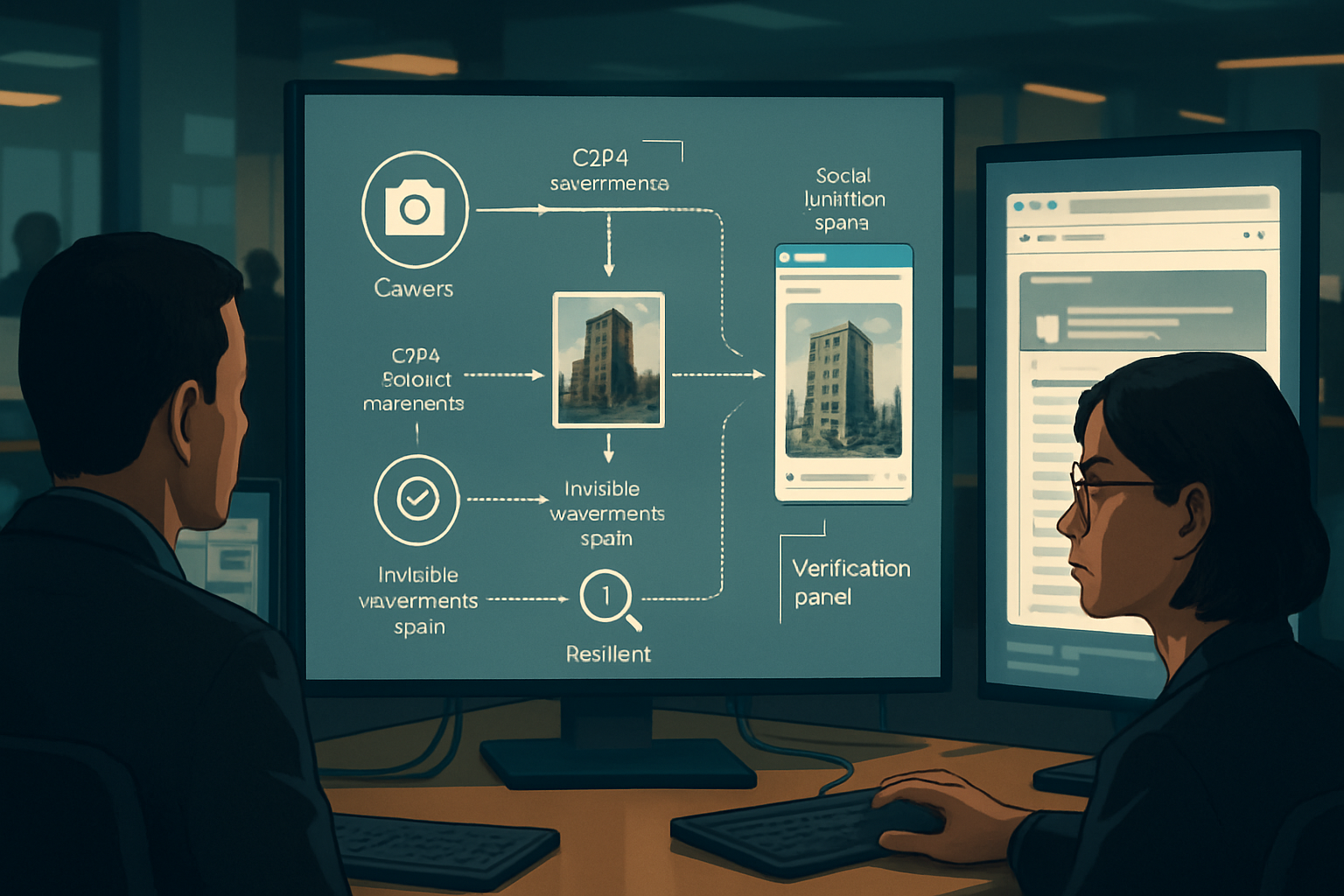
The named mechanism is signal layering. C2PA carries signed metadata: issuer, creation context, and edit history. It is expressive, but brittle because metadata can be stripped by uploads, downloads, format changes, resizing, and screenshots. SynthID works differently: it embeds an invisible watermark signal into the media itself. It carries less context than C2PA, but it may survive some transformations that break metadata. OpenAI's own announcement framed the point plainly: metadata gives detail; watermarking gives durability. The product move is to bind both to a verification surface.
Google's rollout makes the distribution point more explicit. Gemini's SynthID verification has already been used 50 million times globally, and users will be able to ask Lens, AI Mode, Circle to Search, and Gemini in Chrome whether an image was made with AI. Google is also launching an AI Content Detection API for backend uses like feed sorting, insurance fraud review, fact-checking, and synthetic-media labeling. That is not a creator-side disclosure feature. It is operational infrastructure for people who receive media from elsewhere.
The missed tradeoff is that provenance becomes most useful precisely when it stops being neutral metadata and starts becoming a platform decision. If Search, Chrome, Instagram, a claims system, or a newsroom CMS can interpret credentials and watermarks, they can reduce ambiguity. They can also create a new asymmetry: content from cooperating model vendors and camera makers becomes easier to trust, while unsigned or locally generated content may be treated as suspicious even when it is authentic. The second-order consequence is a market for "verified distribution," where provenance support affects reach, moderation latency, ad acceptance, marketplace listing review, and institutional credibility.
The uncomfortable evidence is that file-level provenance alone is not enough. A recent arXiv paper on GPT-Image-2 images collected from X found 10,217 confirmed generated images in a six-day window and reported that C2PA credentials were systematically stripped by Twitter's CDN upload pipeline, making cryptographic verification infeasible for those copies. Another April security analysis argued that current C2PA specifications should not yet be relied on for high-stakes uses such as financial disclosures, journalism, or legal evidence. The product implication is simple: provenance has to survive real distribution systems, not just pass a lab demo.
Specific operator behavior will change. A newsroom editor will ask whether the CMS, camera credential, search result, wire service, and social platform agree enough to publish. A marketplace operator will route suspicious product photos into review if the provenance signal is absent or conflicts with seller claims. An enterprise risk team will not give every employee a detector app; it will insert provenance checks into intake systems, fraud workflows, and approval gates. The user behavior is default triage.
For builders, treat provenance as an integration problem, not a model-output checkbox. If your product generates media, attach both rich metadata and durable signals where possible. If your product receives media, design a trust state machine: verified origin, partial signal, transformed but consistent, missing signal, conflicting signal, and unsupported format. Show uncertainty rather than turning "no signal detected" into "not AI." Log transformations so your own pipeline does not destroy the evidence you later need. Make escalation rules explicit, because a provenance failure in a meme feed and a provenance failure in a legal claim should not trigger the same action.
There is a counterargument. Provenance can become security theater if users do not understand it, platforms do not preserve it, attackers route around it, or open-source and local generation produce large volumes of unsigned media. The absence of a credential will never prove fakery. A visible "verified" badge can also be overread as truth, when it may only mean "this file came from this tool and then followed this path." Provenance does not replace source verification, forensic analysis, policy judgment, or media literacy.
The watch-next indicator is falsifiable: watch whether provenance checks become default infrastructure in the next six months, not whether more vendors issue announcements. Look for Chrome and Search surfacing verification in ordinary browsing flows, Instagram labeling camera-captured C2PA media, insurance and marketplace vendors adopting detection APIs, and social platforms preserving signed manifests. Also watch the negative indicator: if major distribution platforms still strip credentials by default, C2PA remains a fragile promise.
The reality check is that AI trust will not be solved inside the model lab. It will be decided in the messy middle where media is copied, compressed, monetized, moderated, litigated, and shared. OpenAI and Google are moving provenance there. That is why this week's signal matters today, even though the underlying standards and watermarking debates have been developing for years.
For AI builders, the question is no longer "Do we mark generated content?" It is "Where will that mark still be readable when someone must decide?"
Sources: OpenAI on content provenance, Google on identifying AI-generated media, GPT-Image-2 in the Wild, and Verifying Provenance of Digital Media.