AI Mental Health Frontier — Implementation Starts With Professional Logics
A new qualitative study of an LLM-enhanced mental-health chatbot shows why implementation depends on reconciling professional roles, evidence, workflow, and accountability—not just model quality.

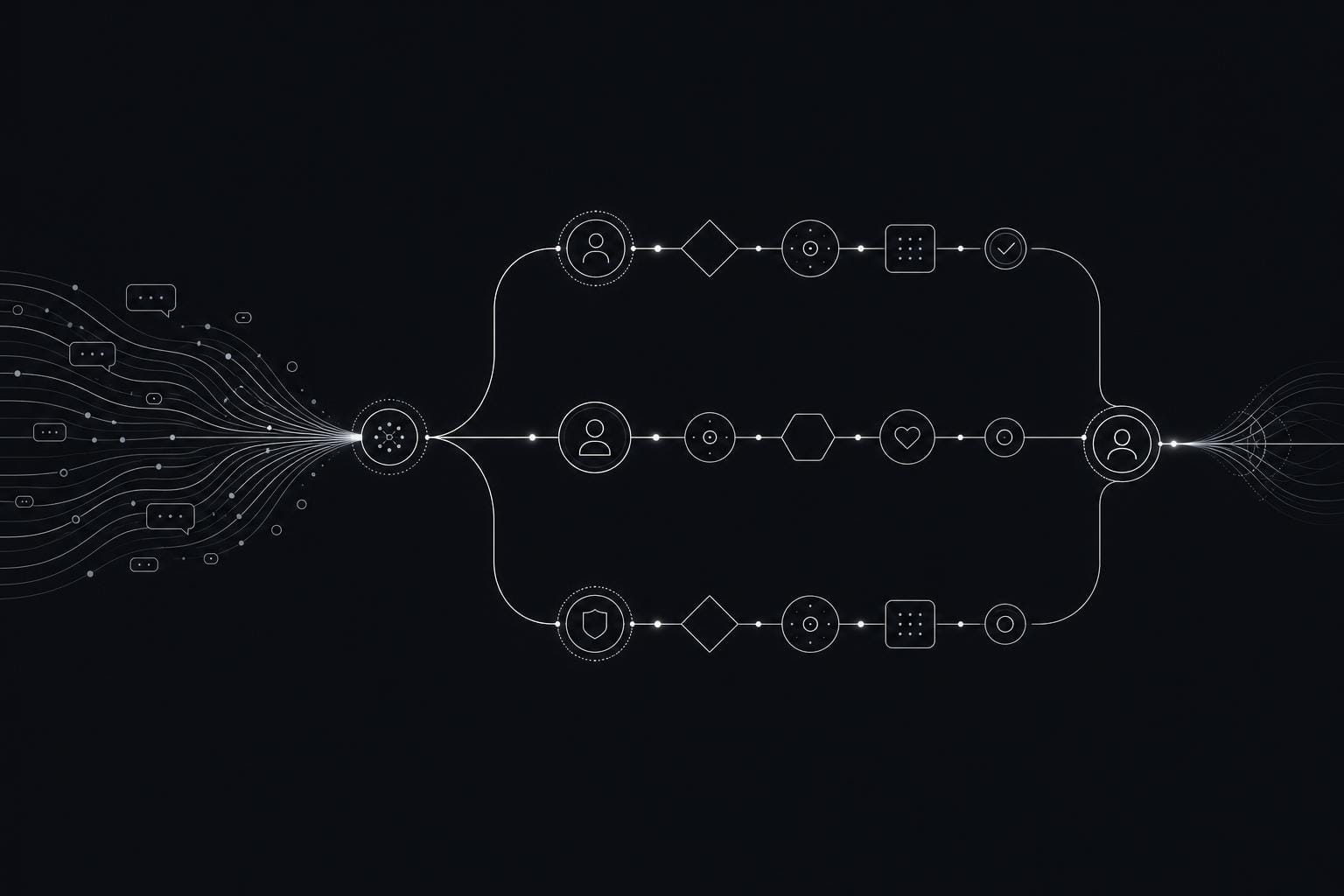
A qualitative study published today in Frontiers in Digital Health examines how professional logics shape implementation of an LLM-enhanced chatbot in mental healthcare. Its useful signal is not a new accuracy score. It is that the same system means different things to clinicians, service users, managers, and developers—and deployment fails when those interpretations are left implicit.
For builders, this changes the starting question. Instead of asking whether a model can produce a plausible supportive response, ask which professional judgment the system is entering, what evidence that judgment requires, and who remains accountable when the conversation goes off course.
The frontier signal
The paper, “How professional logics shape AI implementation in mental healthcare: a qualitative study of an LLM-enhanced chatbot,” focuses on implementation rather than presenting a new clinical efficacy claim. Its contribution is a close look at the institutional setting around an LLM system: professional norms, organizational priorities, expectations about care, and the practical negotiations required to make the technology usable.
That lens matters because “mental-health chatbot” is not one workflow. It may be framed as psychoeducation, intake support, triage, between-session support, documentation assistance, or a route into human care. Each frame implies different success criteria and different boundaries. A response that is acceptable for general information may be unsafe when users interpret it as individualized clinical guidance.
Why clinicians and builders care
Implementation is where abstract safety promises meet the care pathway. A clinician may need a concise, inspectable summary; a service user may value warmth and continuity; an operator may prioritize throughput; a privacy lead may focus on data minimization; and a developer may optimize latency or conversational quality. None of these goals is automatically illegitimate. The risk is allowing the most measurable goal to silently dominate.
This is why a system can pass a benchmark and still create friction. If it produces long conversations that clinicians cannot review, it adds work. If it compresses ambiguity into a confident label, it may distort intake. If it escalates every uncertain phrase, it can overwhelm a service and teach users that disclosure triggers surveillance. If it never escalates, the product has no credible safety boundary.
The practical implication is to design the human workflow before selecting the model. Define what the AI is allowed to notice, suggest, summarize, or route; define the handoff artifact; and define how a professional can disagree with or override the output.
Technical read-through
An LLM-enhanced chatbot is best understood as a sociotechnical system, not a text-generation component. The model sits inside a loop involving prompts, retrieval or policy constraints, interface cues, logging, review queues, and escalation operations. Professional logics enter at every layer.
For development, that means evaluating at least four objects separately: the response, the conversation trajectory, the downstream summary, and the action taken by the service. A response-level rubric can check relevance and unsafe content. It cannot by itself show whether a summary omits uncertainty, whether a queue receives the right cases, or whether staff can act within the available time.
The study also points toward a useful requirements artifact: a role-to-risk map. For each user and professional role, record the system’s intended benefit, the information that role can see, the decisions it may influence, and the failure owner. This makes “human oversight” testable. A human somewhere in the organization is not enough; the right person needs the right signal at the right time.
Clinical reality check
Qualitative implementation evidence is not a randomized clinical trial, and it should not be presented as proof that an LLM chatbot improves symptoms or access. Its value is diagnostic: it reveals organizational and professional conditions that efficacy studies may under-specify.
The main deployment hazards are therefore ordinary-looking mismatches. A product may call itself supportive while users infer therapeutic authority. A safety policy may exist but be invisible to the staff responsible for follow-up. A model may be culturally or linguistically fluent yet still misunderstand the service’s thresholds. Data collected for personalization may become an unnecessary record of vulnerability.
The relevant question is not whether the AI sounds caring. It is whether the entire pathway preserves uncertainty, consent, privacy, professional agency, and a reliable route to human support.
Builder takeaway
- Write a role-specific scope before writing the system prompt: what the AI may do, may not do, and may trigger.
- Evaluate response quality and workflow quality separately, including review time, disagreement handling, and escalation precision.
- Make uncertainty visible in summaries and preserve the original context needed for professional review.
- Pilot with the staff who inherit the work; measure added burden as seriously as user engagement.
- Treat governance artifacts—ownership, audit trails, override paths, and data retention—as product requirements.
Links / sources
- How professional logics shape AI implementation in mental healthcare — same-day qualitative study in Frontiers in Digital Health.
- The front door is a clinical workflow — related analysis of intake and access design.
- Safety must become an auditable workflow — related analysis of accountability and review.