Open Models Are Becoming Scientific Infrastructure
Reflection AI's DOE role points to a sharper AI infrastructure shift: scientific buyers increasingly need inspectable model supply chains, not just API access.

Open Models Are Becoming Scientific Infrastructure
The important thing is not that an open-model company won a government AI partnership; it is that scientific AI procurement is shifting from model access to inspectable model supply chains because labs need to customize, validate, and operate models against nonpublic data and physical workflows.
Axios reported on May 22 that Reflection AI is partnering with the U.S. Department of Energy to support the Genesis Mission, with Reflection serving as an AI model provider for DOE national labs and providing models that can be customized for DOE data. The Department of Energy describes Genesis as an effort to connect supercomputers, experimental facilities, AI systems, and unique datasets across scientific domains. Its own model-team fact sheet describes a portfolio that includes tuned frontier reasoning models, domain foundation models, predictors, and agent frameworks that plan and act across high-performance computing, experimental facilities, and production environments.
That combination matters more than the usual open-versus-closed debate. For consumer chatbots, closed APIs can be enough. For coding assistants, they may even be preferable if the vendor absorbs model upgrades, security review, and uptime. But scientific infrastructure has a different adoption test. If a model will influence a materials workflow, a fusion experiment, a nuclear cleanup simulation, or a robotics loop, the buyer does not only need a response. The buyer needs to know how the system can be tuned, inspected, constrained, reproduced, and audited when it touches domain data that cannot simply be uploaded into a generic product surface.
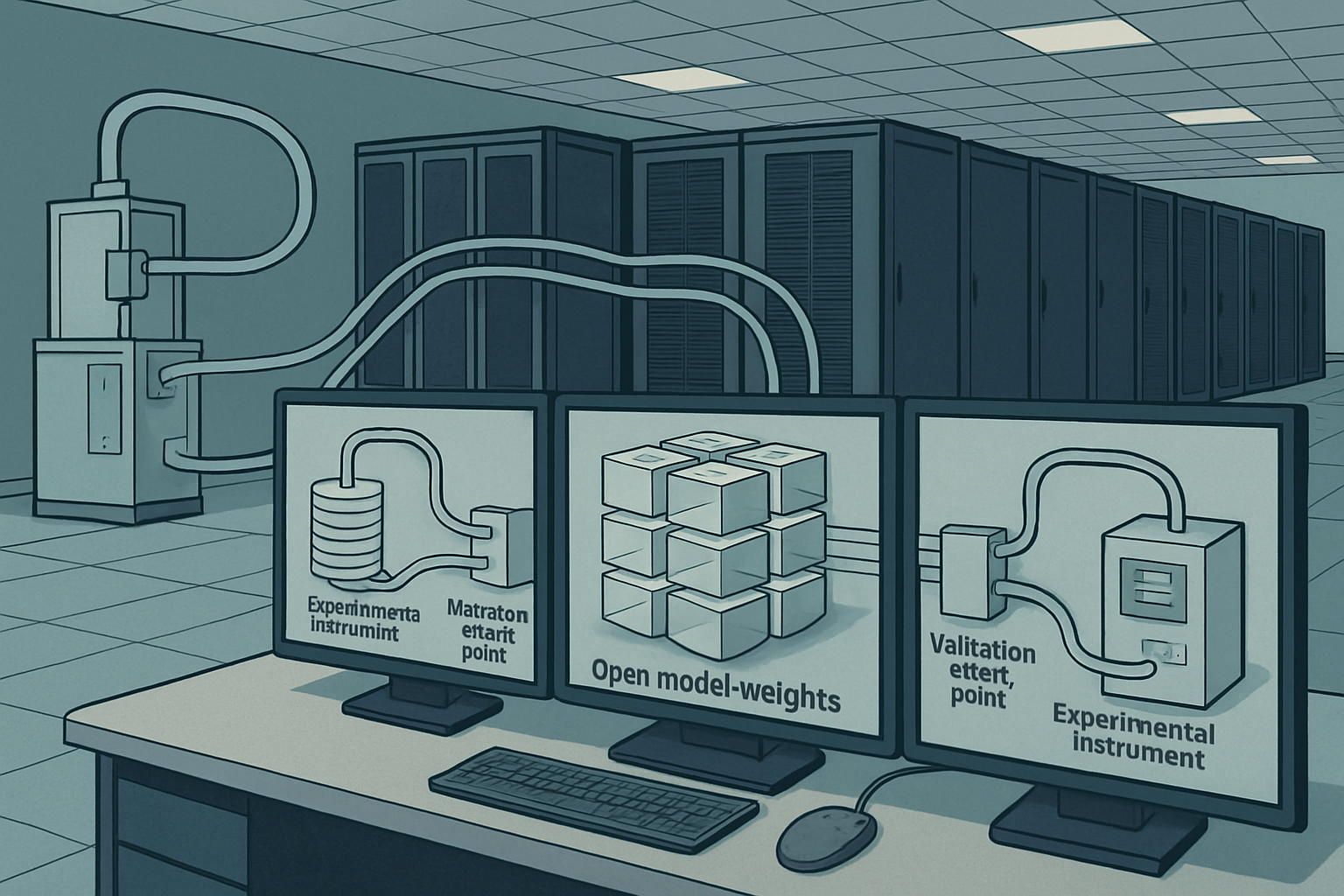
The named mechanism here is inspectable adaptation. Open weights are not magic, and they are not synonymous with trust. But they give a lab a different operational pathway: take a model, adapt it to private data, run it near controlled compute, instrument behavior against domain benchmarks, and investigate failures without waiting for a black-box vendor to explain what changed. In Genesis language, the model is not a remote assistant sitting outside the scientific system. It becomes one layer inside the scientific platform.
The missed tradeoff is that open models move complexity from vendor selection to model operations. A closed API asks the buyer to trust the provider's model quality and governance. An open or open-weight model asks the buyer to own more of the evaluation, security hardening, fine-tuning discipline, and release management. That is not cheaper by default. It may be more expensive in the short run because the institution needs model engineers, data governance, benchmark design, deployment plumbing, and incident response. The payoff is not lower procurement friction. The payoff is control over the adaptation loop.
This is why the Reflection signal is sharper than "the government likes open source." The specific operator behavior to watch is whether national labs begin treating model choice like they treat scientific instruments: calibrated, versioned, locally governed, and connected to experimental context. If the model participates in a closed-loop workflow, then the lab needs provenance for prompts, datasets, tool calls, simulator outputs, human approvals, and model versions. The institution cannot evaluate the result by saying "the API answered well yesterday." It needs experiment-grade traceability.
There is a second-order consequence for AI vendors. Frontier quality still matters, but in scientific and sovereign environments, distribution may increasingly depend on whether a vendor can fit into the customer's validation regime. The winning product may not be the model with the best public demo. It may be the model supply chain that supports local customization, data boundary enforcement, reproducible runs, red-team access, and controlled deployment across specialized infrastructure. That shifts the competitive surface from pure benchmark performance to integration credibility.
Builders should take the same lesson into less exotic markets. If you are building AI for healthcare operations, finance, industrial maintenance, legal discovery, education, or any domain with hard audit requirements, the open-model question is not ideological. Ask whether your customer needs inspectable adaptation. Do they need to know which data shaped the model behavior? Do they need to reproduce outputs under a specific model version? Do they need to run evaluation suites on private edge cases before each update? Do they need to localize the model inside a secure environment? If yes, your product roadmap needs more than a model picker. It needs model lifecycle infrastructure.
The counterargument is real: many organizations overestimate their ability to operate models. Open weights can become a procurement fig leaf if the buyer lacks evaluation discipline. A poorly tuned open model deployed inside a high-stakes workflow is not safer than a well-governed closed service. The practical question is not "open or closed?" It is "who owns the evidence that this model behaves correctly in this operating context?"
That is the reality check. Open models are becoming important because they can be embedded into systems where the model must be examined, adapted, and governed as part of the workflow. But openness only becomes infrastructure when it is paired with validation, versioning, and operational ownership. Without that, it is just another licensing story.
Watch the next indicator: whether Genesis and similar public-sector efforts publish concrete model governance artifacts rather than only partnership announcements. The useful signals would be domain evaluation suites, model cards for tuned scientific models, reproducibility requirements, incident reporting processes, and examples of lab workflows where model updates are gated by experimental validation. If those appear, open models will have crossed from narrative advantage into operating architecture. If they do not, the partnership will remain more symbolic than structural.
Sources: Axios on Reflection AI and DOE Genesis Mission, DOE Genesis Mission overview, DOE Genesis Mission Consortium announcement, DOE Genesis Mission Models Team fact sheet.