AI Mental Health Frontier — Adoption Is Ahead of Governance
New Australian evidence shows mental-health AI is already routine for administrative work, making governance and complexity-aware evaluation urgent.

New Australian evidence puts a sharper number on a shift many mental-health organizations are already feeling: general-purpose AI has entered routine practice faster than formal governance has caught up. In a survey of 278 clinicians, 43.5% reported using AI every day for at least one administrative or clinician-support task, and nearly 80% of clinicians or practices reported using it to listen to and transcribe sessions. The immediate lesson for builders is not that AI is ready to replace clinical judgment. It is that the administrative boundary is already a production boundary—and it needs real controls.
The frontier signal
The University of Queensland team combined the clinician survey with in-depth interviews with 12 clinicians. Participants commonly used AI for drafting reports, case notes, research preparation, and transcription. They often considered it better than a human for routine documentation, partly because it could reduce note-taking and return attention to the client.
The same evidence exposed a steep context gradient. In complex clinical scenarios, clinicians found general-purpose systems substantially less reliable. The researchers also reviewed 66 studies of large language models in mental-health settings and found that performance relative to humans worsened as simulated cases became more complicated. These are two different evidence streams—real-world self-reported use and a review of evaluations—but together they make a useful point: adoption for low-complexity work says little about readiness for high-stakes reasoning.
The studies do not establish that AI improves patient outcomes, nor do they show that every transcription workflow is unsafe. They show an implementation gap. Workplaces reported mixed policies: some banned AI during sessions, some encouraged administrative use, and others encouraged use in sessions. Clinicians wanted practical standards covering privacy, consent, accuracy, and accountability rather than rules that ignore actual behavior.
Why clinicians and builders care
Documentation is not clinically neutral. A transcript can contain identifying details, disclosures about family members, medication information, and context that a patient did not expect to leave the room. A summary can also become part of the record, shaping later decisions. If a tool misses negation, sarcasm, culturally specific language, or a change in affect, the administrative convenience can create clinical distortion.
For clinicians, the key question is where responsibility remains after AI has produced a plausible note. For operators, it is whether consent, retention, access, correction, and incident response are concrete product behaviors or merely policy language. For builders, the signal is a design constraint: the safer first deployment may be a bounded documentation assistant with review checkpoints, not an agent that proposes diagnoses or treatment plans.
Technical read-through
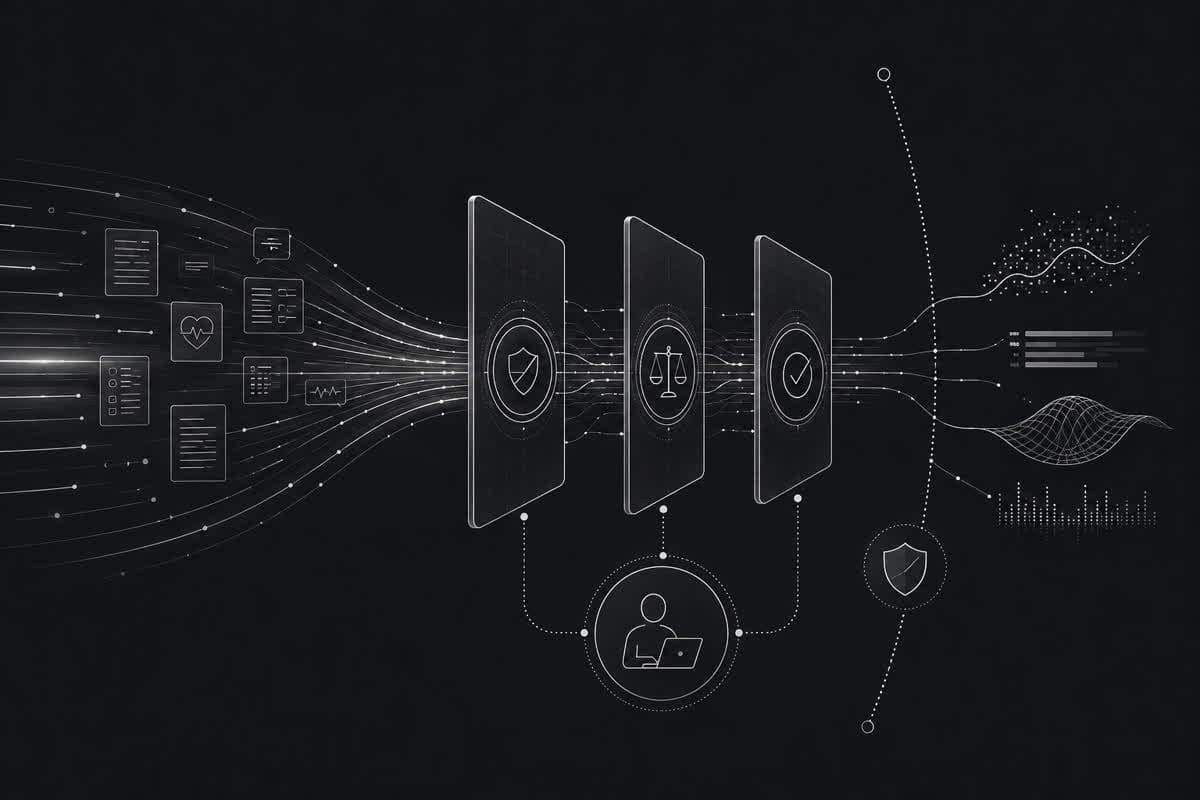
A production workflow should separate capture, transformation, review, and record insertion. Audio or text should enter a tightly scoped processing boundary; the system should expose what source material it used, what it inferred, and what it could not hear or resolve. Drafts should remain visibly provisional until a clinician accepts or edits them. Corrections should be traceable without silently rewriting the source.
Evaluation needs at least two axes. First measure ordinary documentation quality: omission, fabrication, speaker attribution, terminology, and time saved after review. Then stress the system with complex mental-health language, overlapping speech, interpreters, code-switching, indirect disclosures, and ambiguous risk statements. A polished average score can hide the exact edge cases that matter most.
The privacy architecture should be explicit. Minimize retention, encrypt data in transit and at rest, restrict reviewer access, log exports, and make deletion and correction feasible. Do not quietly reuse session material for model training. Where a vendor is involved, the organization needs a clear data-processing agreement and a way to verify the actual boundary rather than relying on a marketing claim.
Clinical reality check
The survey is not a randomized trial, and the systematic review does not prove that every model fails in complex care. Self-reported adoption can over- or understate use, while simulated evaluations may not predict real-world performance. But uncertainty is not a reason to skip controls; it is a reason to avoid unsupported claims.
There is also a risk of governance theater. A blanket ban may push use into unofficial channels, while a permissive policy without consent and review can normalize leakage. The right unit of accountability is the workflow: who obtains consent, who checks the draft, what happens when the model is uncertain, how errors are corrected, and who informs the patient after an incident. Human oversight must be operational, not a button labeled “review.”
Builder takeaway
- Start with bounded administrative tasks and prohibit autonomous clinical recommendations.
- Measure error severity and subgroup performance, not only average transcription accuracy.
- Make consent, retention, deletion, correction, and audit trails visible in the UX.
- Require clinician acceptance before AI-generated content enters the clinical record.
- Stress-test complex, multilingual, indirect, and risk-relevant conversations before expansion.
Links / sources
- JMIR — General-Purpose AI Use in Routine Mental Health Practice Among Australian Clinicians: mixed-methods survey and interviews.
- JMIR AI — Generative Large Language Models in Mental Health Care Settings: systematic review and meta-analysis of 66 studies.
- Medical Xpress — Guidelines needed as AI embraced by mental health practices: accessible report of the findings and publication details.
- WisdomChain — Mental-Health AI Needs Risk-Tiered Deployment: related deployment framing.
- WisdomChain — Ethical Evaluation Must Follow the Whole Care Path: related evaluation framing.