LLM Stock Forecasting Needs a Friction Test
A recent hedge-fund-oriented review of LLM stock forecasting argues that the hard problem is not only prediction, but leakage control, market frictions, liquidity, and workflow robustness.

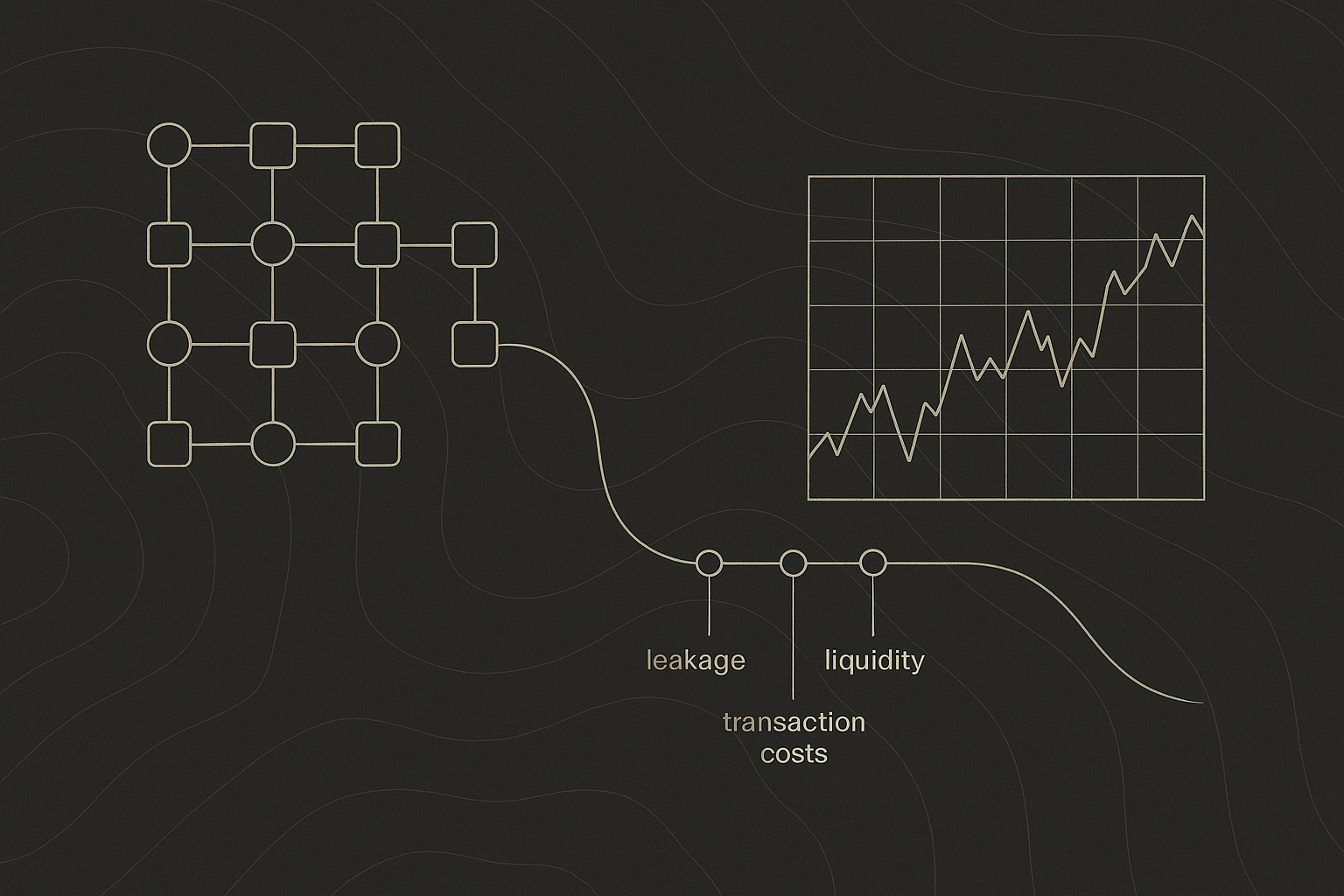
The most useful AI-in-investing signal today is not another claim that a language model can forecast prices. It is the opposite: a reminder that any LLM trading workflow should be judged by how well it survives leakage controls, horizon design, liquidity constraints, transaction costs, and model-risk review. The freshest 24–48 hour source flow was thin, so today’s post uses a high-signal paper that was recently surfaced in a weekly research recap and is tied to a May 2026 AI conference acceptance: Zhilin Zhang and Zhang’s arXiv review, “A Review of Large Language Models for Stock Price Forecasting from a Hedge-Fund Perspective.” Its value now is practical. It reframes LLMs less as standalone alpha engines and more as components inside a production-grade research and trading pipeline.
The frontier signal
The paper is a review, not a new live trading system. According to the arXiv abstract, it synthesizes recent uses of LLMs in stock price forecasting: extracting sentiment from financial news and social media, analyzing financial reports and earnings-call transcripts, tokenizing or symbolizing stock price series, and building multi-agent trading systems. The authors explicitly organize the review from a hedge-fund perspective and emphasize pitfalls that are often understated in academic or demo-oriented work: fragility in sentiment analysis, dataset and horizon design, evaluation metrics, data leakage, illiquidity premia, and the limits of stock-price predictability.
That positioning matters. Many investment AI discussions still compress the problem into “Can the model predict the next return?” A hedge-fund workflow has a harsher question: can the model produce a decision-useful signal after timestamp discipline, universe construction, borrow and liquidity constraints, execution assumptions, risk limits, and monitoring are applied? A model that looks intelligent in a prompt window may still be unusable if its inputs are not point-in-time, its labels are poorly aligned, or its apparent edge is compensation for holding hard-to-trade names.
Why investors care
LLMs touch several investment workflows at once. In research, they can normalize filings, transcripts, news, broker notes, and social data into structured features. In signal generation, they can turn text into event classifications, sentiment estimates, thesis changes, or factor exposures. In portfolio construction, they can help explain why a signal is concentrated in certain sectors, liquidity buckets, or regimes. In operations and compliance, they can document research trails and flag model-risk assumptions.
But the same breadth creates danger. If an LLM is used to summarize an earnings call, a small hallucinated detail may become a false feature. If it reads a filing through a non-point-in-time data vendor, the backtest may unknowingly include later corrections. If it is asked to reason over historical news without strict publication timestamps, it may infer tomorrow’s price action from information that was not actually available. If the evaluation ignores liquidity, the strongest “alpha” may simply load on names that are expensive or impossible to trade at the modeled size.
For investors, the implication is that LLM forecasting should not be treated as a generic model-selection contest. It is an infrastructure problem. The edge, if any, comes from building a disciplined research factory around the model: clean timestamps, realistic labels, robust ablations, capacity checks, cost models, and human-readable failure analysis.
Technical read-through
A builder can map the review’s themes into four layers.
First is the representation layer. LLMs can transform messy text into features: sentiment, topic, event type, management tone, guidance change, litigation risk, supply-chain exposure, or macro sensitivity. For price series, some approaches tokenize or symbolize market data so that sequence models can process them in language-like form. These are feature-engineering choices, not magic. Each representation should be tested against simpler baselines, including bag-of-words, dictionary sentiment, embeddings, tree models, and traditional technical or fundamental factors.
Second is the label and horizon layer. A one-day return label, a one-week residual return, an earnings-window abnormal return, and a regime-conditioned drawdown target are different tasks. LLM features that help with post-earnings drift may fail for intraday execution. Sentiment extracted from social media may be more useful for attention or volatility than directional return. The paper’s emphasis on dataset and horizon design is important because many inflated results start with mismatched labels.
Third is the evaluation layer. The minimum viable test should include chronological splits, point-in-time data availability, universe rules fixed before evaluation, transaction cost assumptions, liquidity filters, turnover, capacity, and multiple metrics. A Sharpe ratio alone is not enough. Builders should track hit rate, information coefficient, drawdown, turnover, exposure concentration, sector and beta loadings, tail behavior, and performance by regime. If the paper reports academic backtest evidence, that should be labeled as backtest evidence; if a vendor claims deployment, that should be labeled as a vendor claim. The review itself is a synthesis, so it should not be read as proof that LLMs produce exploitable alpha.
Fourth is the workflow layer. Multi-agent trading systems sound frontier, but production value may come from narrower agent roles: one agent extracts events, another checks timestamp validity, another compares the signal with baseline factors, another writes a model-risk memo, and another prepares a trade-candidate explanation for human review. That architecture is less glamorous than an autonomous trader, but more compatible with institutional controls.
Reality check
The core failure mode is leakage. LLM pipelines are especially vulnerable because they often ingest large, mixed, updated corpora. A model can leak through revised fundamentals, edited transcripts, news databases with later metadata, benchmark membership changes, or prompts that accidentally include future context. Leakage does not have to be obvious to be fatal.
The second failure mode is non-stationarity. Language-market relationships change. A phrase that signaled stress in one regime may be boilerplate in another. Social sentiment may be dominated by bots, promotional campaigns, or crowding. Earnings-call tone may change because companies learn how investors and models parse language.
The third failure mode is market friction. Illiquidity premia can masquerade as model skill. A backtest may overweight small names, wide spreads, high shorting costs, or assets with stale prices. Once realistic costs and capacity are applied, the attractive edge may shrink or disappear. The QuantSeeker recap of the review highlighted this same point: impressive LLM trading results can deteriorate when realistic frictions are considered.
The fourth failure mode is adoption risk. A model that cannot explain its inputs, timestamp assumptions, and failure cases will struggle inside a serious investment process. The question is not whether the LLM answer sounds plausible. The question is whether the research team can audit it after losses.
Builder takeaway
- Build an LLM signal audit harness before building a bigger model: point-in-time checks, prompt/input logs, dataset versioning, and leakage tests should be first-class artifacts.
- Evaluate LLM-derived features against simple baselines and ablations. If sentiment, embeddings, or event tags do not beat a cheaper baseline after costs, keep them out of production.
- Separate prediction tasks by horizon and use case: research triage, event detection, volatility/attention forecasting, and return prediction should not share one generic success metric.
- Add friction metrics to every experiment: turnover, spread proxy, liquidity bucket, capacity, borrow constraints where relevant, and performance after estimated costs.
- Prefer controlled agent workflows over fully autonomous trading agents: extraction, validation, explanation, and model-risk documentation are safer first deployments than direct order generation.
Links / sources
- https://arxiv.org/abs/2605.05211 — Zhilin Zhang and Zhang, “A Review of Large Language Models for Stock Price Forecasting from a Hedge-Fund Perspective”; arXiv abstract describes the review scope and practical pitfalls including leakage, illiquidity premia, evaluation metrics, and limits of predictability.
- https://www.quantseeker.com/p/weekly-research-recap-127 — Weekly Research Recap that recently surfaced the paper and summarized its practical warning about data leakage, short samples, illiquidity, and trading frictions.