Google Is Moving Agents Into the Default Surface
Google I/O's sharper signal is not more Gemini features. It is the attempt to make agents inherit Search, Workspace, Android, shopping, and developer distribution by default.

Google Is Moving Agents Into the Default Surface
The important thing is not that Google announced more AI agents. It is that Google is trying to move agents into default surfaces because the agent that wins will be the one that already has context, permissions, and transaction paths when the user decides to act.
That is the sharper read on Google I/O 2026. On May 19, Google framed the event around an "agentic Gemini era," with new models, Search agents, Gemini Spark, Daily Brief, Antigravity upgrades, and Managed Agents in the Gemini API. Its I/O announcement collection said agents are being unlocked across Search, the Gemini app, shopping, developer tools, Workspace, Android, YouTube, and new form factors. The breadth is the signal.
The easy read is that Google is chasing OpenAI and Anthropic with a bigger bundle. True, but too shallow. Google is placing agent behavior where users already search, read, shop, schedule, write, code, and carry their identity. If that works, the real comparison is not "Gemini app versus ChatGPT app." It is "standalone agent versus embedded agent with native distribution."
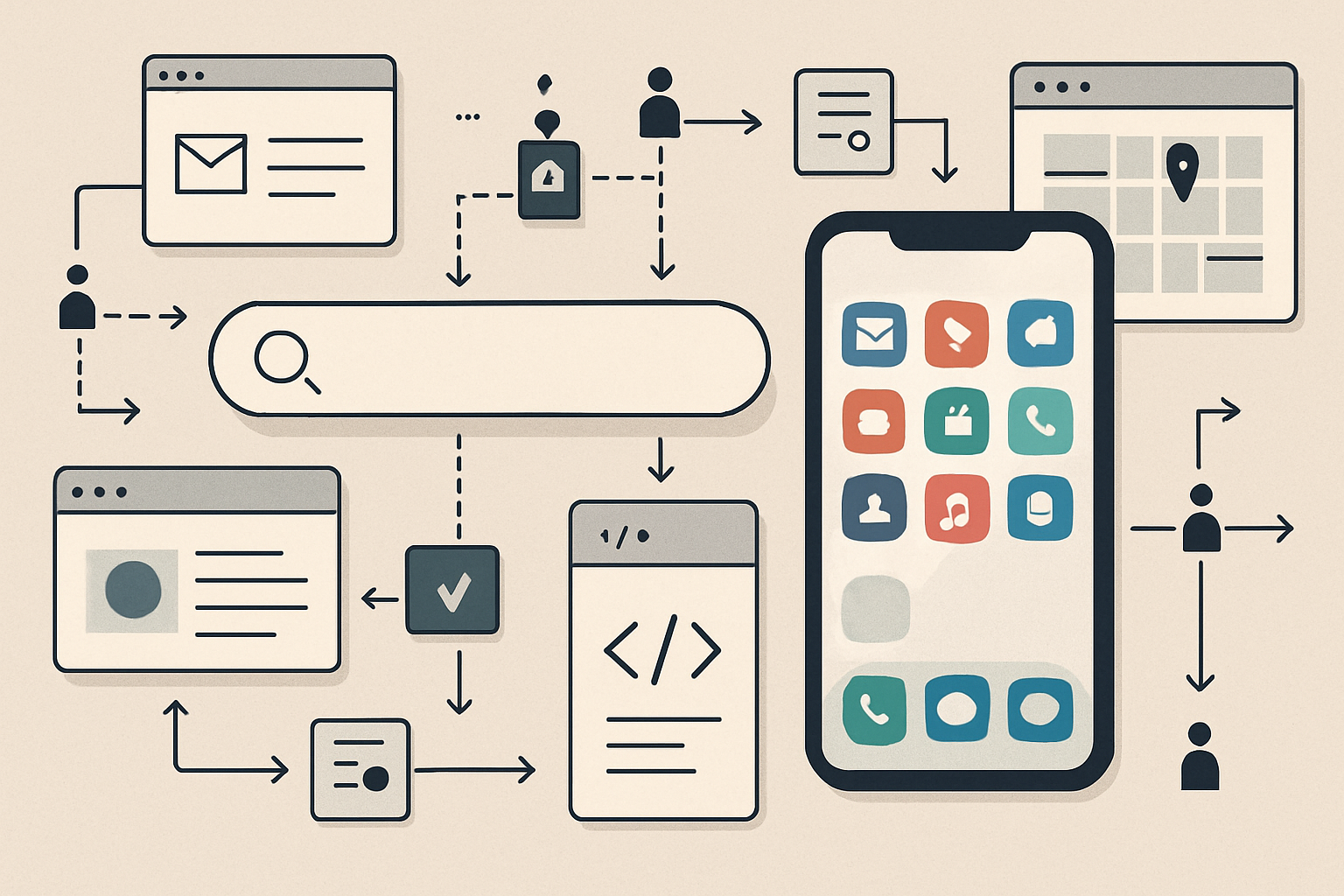
The named mechanism is surface inheritance. A normal chatbot has to persuade the user to bring the task into the chat window. An inherited-surface agent starts from an existing surface: Search, Gmail, Calendar, Docs, Android, Shopping, YouTube, AI Studio, or a developer platform. It inherits intent from the query, context from connected apps, permissions from the account, and a path to completion. That does not make the agent automatically good, but it changes the adoption math.
Google's Search announcement makes this explicit. Users will be able to create and manage multiple Search agents, starting with information agents that operate in the background and monitor the web, news, social posts, and real-time data such as finance, shopping, and sports. Google also described agentic booking and the ability to call businesses on a user's behalf in some categories. This is not a better answer box. It is a monitoring and action layer attached to Search.
The Gemini app announcement points the same direction. Daily Brief works across connected apps in the background, drawing from Gmail and Calendar to produce a morning brief with prioritized next steps. Gemini Spark is a 24/7 personal AI agent running on Gemini 3.5 and the Antigravity harness, integrated with Workspace tools. The behavior Google is training is not "ask a question." It is "delegate a recurring responsibility to a surface that already knows your routine."
The developer-side signal is just as important. Managed Agents in the Gemini API can spin up an agent that reasons, uses tools, executes code in an isolated Linux environment, browses the web, and resumes sessions with state intact. Antigravity 2.0, CLI and SDK options, terminal sandboxing, credential masking, Android skills, and Android Bench extend the same layer. Google is trying to make agent execution a platform primitive, not just a coding UI.
The missed tradeoff is that surface inheritance creates convenience by concentrating power. A standalone chatbot has weaker context, but clearer boundaries. An embedded agent can read the inbox, watch the calendar, monitor shopping needs, build UI inside Search, call providers, and keep working after the device is closed. That is useful because it crosses surfaces, and risky for the same reason. The product problem becomes permission design, revocation, task scoping, recovery, and auditability.
This will change user behavior before it changes org charts. Consumers may stop thinking of agents as apps they open and start treating them as background subscriptions to intent: alert me when this apartment appears, summarize the school emails, watch for hidden subscription fees, assemble the materials for this meeting. Developers may stop building a bespoke agent stack for every workflow and instead choose between managed infrastructure, local harnesses, and embedded platform actions. Operators will ask: where did the agent get authority to do that?
The second-order consequence is pressure on AI-native startups. A startup can still win with better reasoning, UX, vertical workflow depth, or trust. But if the task depends on Gmail, Calendar, Search, Android, YouTube, shopping inventory, local providers, or cloud deployment, Google can make the agent feel like it is already in the room. The startup has to acquire distribution and permissions one connector at a time.
There is a counterargument. Default surfaces do not guarantee trust. Users may reject background agents if they feel intrusive, hard to supervise, or wrong at the moment of action. Enterprises may prefer neutral agent layers over platform-owned agents that deepen lock-in. Developers may discover that managed agents are convenient for prototypes but restrictive for production systems with custom observability, routing, data residency, or cost controls. Google also has to avoid making Search feel less like a neutral discovery interface and more like a closed action funnel.
The watch-next indicator is falsifiable: measure whether users create persistent agents, not whether they try demos. Look for retention around Daily Brief, Search information agents, agentic booking, and Gemini Spark recurring tasks. Watch whether developers use Managed Agents beyond tutorials, and whether production apps expose clear controls for task state, permissions, logs, and handoff.
The builder implication is concrete. If you are building an agent product, do not treat distribution as a post-launch marketing problem. Decide which surface gives the agent native intent. Decide what permissions the user understands at delegation. Design the task ledger before the agent does meaningful work: what it watched, used, changed, could not do, and what needs human approval. The product surface is the control plane around background action.
Google I/O's message is easy to summarize as "AI everywhere." The more useful judgment is narrower: agents are being attached to the places where intent already appears. If that becomes normal, the agent market will not be decided only by model quality. It will be decided by who owns the surface where context becomes action.
Reality check: the winning agent may not be the smartest one in chat. It may be the one already waiting where the user was about to do the work.