Forecasting Models Need Stress-Test Benchmarks
FinStressTS, a new arXiv/KDD 2026 paper, argues that financial forecasting benchmarks should expose why models fail under volatility clustering, regime shifts, heavy tails, jumps, and sparse processes.

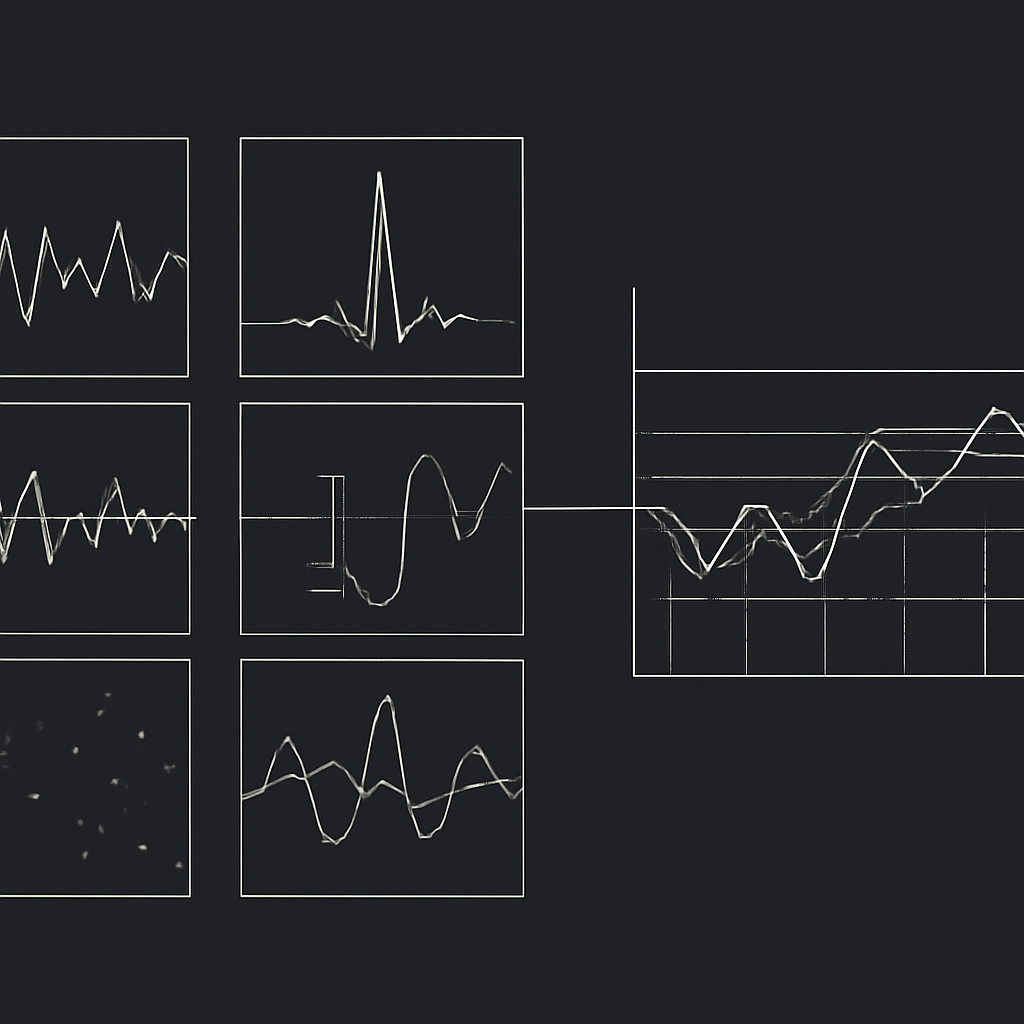
A new finance time-series benchmark is a useful reminder that investment AI should not only ask which model wins. It should ask why a model fails. FinStressTS, submitted to arXiv on June 2, 2026 and marked as a KDD 2026 oral paper, proposes a synthetic benchmark for financial forecasting where the market mechanisms are controlled rather than merely observed. That matters now because many investment teams are still evaluating forecasting models on realized historical paths, where volatility clustering, heavy tails, jumps, sparse observations, and regime shifts arrive tangled together. A benchmark that can separate those failure modes is not a trading system, but it is exactly the kind of infrastructure a serious investing AI stack needs.
The frontier signal
The paper, "FinStressTS: A Parametric Synthetic Benchmark for Time-Series Forecasting in Finance," is by Jiaze Sun, Kelvin J.L. Koa, Ruiyang Ni, Yize Liu, Haonan Chen, and Ke-Wei Huang. The authors describe FinStressTS as a mechanism-aware synthetic benchmark with 30 diagnostic environments organized around six mechanism families: volatility clustering, multi-scale persistence, heavy-tailed shocks, regime switching, self-exciting jumps, and zero-inflated processes.
The paper evaluates two forecasting tasks. For point forecasting, it uses normalized mean absolute error across five settings. For probabilistic forecasting, it uses continuous ranked probability score under known data-generating mechanisms. The authors benchmark 15 models, including classical methods such as HAR and VAR, Transformer forecasters such as PatchTST and iTransformer, and deep probabilistic architectures such as DeepAR and TSFlow.
The current signal is not that synthetic data is new, or that Transformers can be benchmarked on finance. The sharper signal is that financial model evaluation is becoming diagnostic. Instead of treating a single backtest score as evidence of general forecasting skill, FinStressTS tries to expose which structural mechanism a model handles and which mechanism breaks it.
That is why a paper from the last week is worth using today even though the strongest public details come from the arXiv abstract rather than a production deployment. This is academic benchmark evidence, not a vendor claim and not live portfolio performance. But the direction is directly relevant to investing systems: if an AI model is going to influence research, risk, allocation, or execution, the builder needs to know whether its error comes from tails, jumps, regime changes, sparsity, or sample inefficiency.
Why investors care
Financial forecasting has a nasty evaluation problem. Real market history gives only one realized path. If a model underperforms, the researcher can often see that it failed, but cannot cleanly isolate why it failed. Was the model too slow to adapt to a volatility regime? Did it underprice jump risk? Did it need more data than the market can realistically provide? Did a flexible architecture learn noise while a simpler autoregressive model captured the only durable structure?
For investors, those distinctions are not academic decoration. They change how a signal should be used. A model that is weak under heavy-tailed shocks may still be useful for calm-period ranking but dangerous for leverage-sensitive allocation. A model that handles regime switching but needs a long calibration window may be better suited for strategic risk monitoring than fast tactical trading. A probabilistic model that produces calibrated distributions in stationary settings but struggles with sparse or multimodal outcomes should not be trusted blindly for tail-risk budgeting.
The affected workflow is therefore broader than return forecasting. It touches signal validation, risk model design, portfolio construction, scenario analysis, model governance, and investment committee communication. A portfolio manager does not simply need an error metric. They need a map of model fragility.
This is especially important as teams experiment with larger sequence models for financial time series. Larger models can be useful, but the paper's abstract reports a sobering pattern: performance is mechanism-dependent, autoregressive and linear models are highly competitive in several volatility-, tail-, and jump-driven environments, and neural models often need more data to match simple baselines. That is not an anti-neural-network result. It is a warning against architecture theater. In finance, the dominant constraint is often not model expressiveness; it is whether the model has seen enough relevant regimes and whether the evaluation environment can tell the difference between skill and luck.
Technical read-through
The technical idea behind FinStressTS is to create synthetic environments where the hidden structural cause is known. Instead of asking a model to forecast one historical market series and then arguing about what the result means, the benchmark generates diagnostic worlds with controlled properties. Each world stresses a mechanism that is common in financial data.
Volatility clustering tests whether a model can adapt when risk arrives in persistent bursts rather than independent shocks. Multi-scale persistence tests whether the model can handle structure across short and long horizons. Heavy-tailed shocks test whether the forecast distribution respects rare but large moves. Regime switching tests whether the model recognizes that the same features can behave differently across latent states. Self-exciting jumps test whether one event raises the probability of more events. Zero-inflated processes test sparse outcomes where the absence of activity is itself part of the distribution.
The paper then separates point forecasting from probabilistic forecasting. That separation matters for investment systems. A point forecast may be enough for a ranking experiment, but portfolio construction and risk control need distributional behavior. If a model predicts the center of the distribution but misstates tail probability, the optimizer may size positions as if risk were lower than it is. If a probabilistic model is well calibrated in stationary environments but misses multimodal or sparse distributions, the right use may be limited to certain regimes or instrument types.
The model comparison is also useful because it spans old and new methods. HAR and VAR are not glamorous, but they encode strong financial priors and can be hard to beat in some settings. PatchTST and iTransformer represent the modern Transformer time-series family. DeepAR and TSFlow represent probabilistic deep-learning approaches. A benchmark that puts these families into mechanism-specific environments can help a builder decide when to escalate complexity.
For Kaizhi's development work, the immediate read-through is architectural. The evaluation harness should become a first-class component of the investing stack. A forecasting model should be tested not only on rolling historical splits, but also on synthetic stress suites that isolate specific mechanisms. The output should not be one leaderboard. It should be a model profile: handles volatility clustering, weak on jumps, data-hungry under regime switching, calibrated in stationary settings, unstable in sparse outcomes, and so on.
That profile can then govern how the model is allowed to affect capital. A model with good point accuracy but poor probabilistic calibration might feed research ranking, not sizing. A model that handles jumps poorly might require a separate risk overlay. A model that needs much more data than a simple baseline might be rejected for assets with short histories.
Reality check
The first reality check is that synthetic benchmarks are not markets. A controlled environment can reveal a failure mode, but it cannot prove a trading edge. The mechanism families in FinStressTS are economically relevant, but real markets combine mechanisms with microstructure effects, crowding, policy shocks, liquidity constraints, changing participants, and feedback from trading behavior.
The second limitation is benchmark overfitting. Once a benchmark becomes popular, researchers can tune toward it. A mechanism-aware benchmark is valuable because it exposes causes, but it still needs governance: hidden test sets, out-of-distribution variants, and periodic refreshes.
The third issue is calibration to actual assets. If a synthetic process creates useful stress cases but does not match the stylized facts of the instrument universe, the model profile may be misleading. Equity index returns, single-stock intraday series, credit spreads, crypto liquidity, and macro releases do not fail in identical ways. The benchmark should be a diagnostic layer, not the only validation layer.
The fourth issue is portfolio translation. Even if a forecaster is robust under a synthetic mechanism, that does not answer capacity, transaction cost, turnover, borrowing, tax, or compliance questions. Academic benchmark evidence should stay labeled as academic benchmark evidence until it survives an investment workflow test.
The practical lesson is restraint. FinStressTS does not tell investors which asset to buy. It tells builders that model selection in finance should become more causal and diagnostic. That is a much more useful frontier than another generic claim that deep learning beats classical models.
Builder takeaway
- Build a mechanism-aware evaluation suite alongside historical walk-forward tests. Start with volatility clustering, heavy tails, jumps, regime switching, sparsity, and multi-horizon persistence.
- Score models by failure profile, not just average error. A model that wins on mean error but fails under jumps may need usage limits.
- Separate point-forecast and probabilistic-forecast permissions. Ranking, sizing, hedging, and risk budgeting should require different evidence.
- Keep simple baselines in every experiment. HAR, VAR, linear models, and naive forecasts are part of the control system, not placeholders.
- Convert benchmark results into deployment rules: which assets the model may cover, which regimes trigger fallback, and which portfolio actions require a separate risk overlay.
Links / sources
- arXiv: "FinStressTS: A Parametric Synthetic Benchmark for Time-Series Forecasting in Finance," submitted June 2, 2026. Primary source for the benchmark design, mechanism families, model set, and reported high-level findings. https://arxiv.org/abs/2606.03184
- arXiv: "Derivative-Informed Operator Learning for Finance: On-the-Fly Greeks, Surfaces, Hedging, and Control," submitted June 4, 2026. Related recent finance-ML signal showing the same direction: evaluation and training should target downstream risk behavior, not only value prediction. https://arxiv.org/abs/2606.05900