How to Evaluate Agentic Coding Tools in a Real Repository
A practical evaluation rubric for agentic coding tools, covering context, tests, reviewability, approval gates, cost, and production risk.

Updated August 1, 2026.
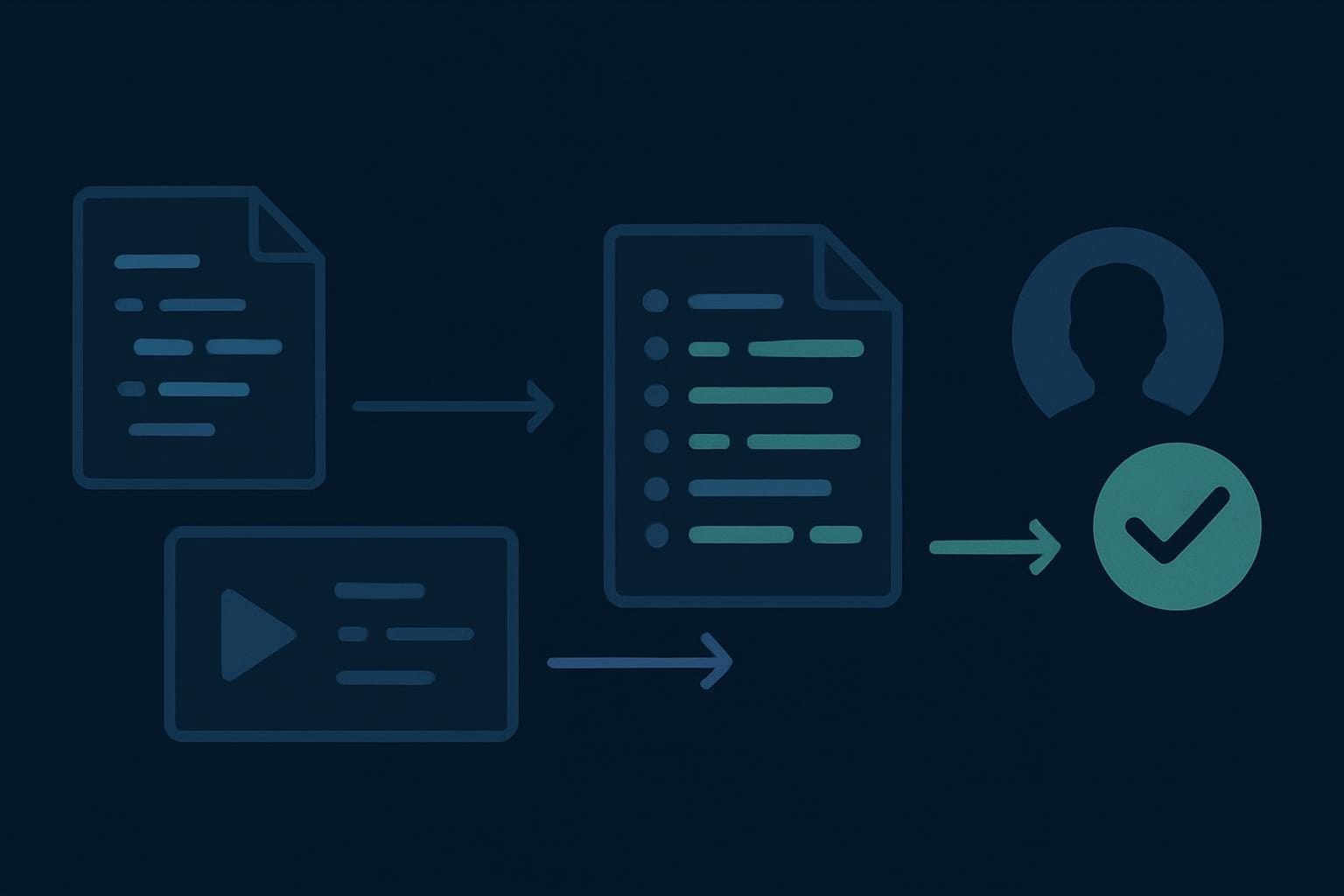
The fastest way to choose a coding agent is not to compare feature lists. Give two or three tools the same bounded task in the same repository, then record what happened. The evaluation should measure the complete loop: context, change, tests, review, approval, and correction.
The unit of evaluation is a completed task
Autocomplete quality is only one part of an agentic workflow. A useful test ends with a human-readable diff and an acceptance decision. It should answer:
- Did the agent find the right context?
- Did it change the right files and only those files?
- Did it run the relevant tests or checks?
- Could a reviewer understand what changed and why?
- Were risky actions gated by explicit approval?
- How much human rescue was needed?
Do not compare tools using different repositories or tasks. That turns a workflow evaluation into an anecdote.
Prepare a controlled repository test
Choose a non-production repository with representative conventions and a test suite that can run locally. Remove secrets and define the agent's allowed access before beginning.
Create three tasks:
- An explanation task that requires tracing one behavior across several modules.
- A bounded bug fix with a failing test or reproducible failure.
- A small feature that requires a multi-file change and new tests.
For each task, write acceptance criteria before opening the agent. Keep the prompt short enough to reveal whether the agent can discover context, but precise enough that a reviewer can decide whether the task is complete.
Score repository context
Ask the agent to explain an unfamiliar subsystem and name the files it used. Check the explanation against the code. A confident answer that cites the wrong module is a context failure, even if the prose sounds plausible.
Record:
- relevant files found without manual handholding;
- dependencies or conventions missed;
- whether the agent distinguished tests, generated code, and production code;
- how often it reread or searched before editing.
Context is not just a larger window. It is selecting the right evidence.
Score change quality and scope control
For the feature task, inspect the diff before running tests. Count unrelated edits, speculative abstractions, formatting churn, and changes to public interfaces. A smaller correct diff is usually more valuable than a large impressive one.
Useful measures include:
- acceptance criteria satisfied;
- files changed versus files expected;
- unrelated lines changed;
- manual corrections required;
- rollback clarity.
The agent should be able to explain each meaningful change in terms of the task.
Score the test loop
An agent that edits code but does not validate it leaves the expensive part to the human. Record the commands it runs, failures it encounters, and whether it responds to failures by diagnosing the cause or by weakening the test.
Check whether it:
- runs the narrowest relevant test first;
- expands validation when the change crosses boundaries;
- reports skipped or unavailable checks honestly;
- adds tests that reflect the behavior rather than the implementation detail;
- stops when the acceptance condition is met instead of continuing to make changes.
Never reward an agent for making a test pass by deleting coverage or changing the requirement.
Score reviewability and approval gates
Reviewability is a product feature. The agent should return a concise summary, list checks performed, identify uncertainty, and make the diff easy to inspect.
Test risky boundaries explicitly:
- shell commands and network access;
- writes outside the working directory;
- secrets and environment variables;
- dependency installation;
- database, deployment, or production actions.
Record whether each boundary produced an approval request, whether the request was understandable, and whether the agent continued safely after denial. Autonomous behavior without an observable control boundary is not a maturity signal.
Add cost and latency to the scorecard
Measure the complete task, not only the number of tokens or the subscription price. A cheaper agent that requires repeated rescue may cost more in engineering time.
Record:
- elapsed time to a reviewable diff;
- number of retries and failed attempts;
- model or usage cost when available;
- human review and correction time;
- time to reproduce the result.
Use cost per accepted task as the practical metric.
A compact scorecard
| Dimension | Weight | Score 1 means | Score 5 means |
|---|---|---|---|
| Context accuracy | 20% | Misses key code and conventions | Finds and explains relevant evidence |
| Change quality | 20% | Incorrect or sprawling diff | Correct, scoped, maintainable diff |
| Test behavior | 20% | Skips or weakens validation | Runs and responds to relevant checks |
| Reviewability | 15% | Opaque or overconfident handoff | Clear summary, risks, and checks |
| Approval and security | 15% | Unsafe or unclear permissions | Explicit, understandable gates |
| Cost and latency | 10% | Unpredictable or expensive | Predictable cost per accepted task |
Keep raw observations alongside the score. A single number should summarize evidence, not replace it.
Why benchmark rankings can mislead
Benchmarks are useful for generating candidates, but they are not a substitute for a repository test. Results vary with task mix, harness design, test quality, tool permissions, model version, retry policy, and contamination controls. Vendor rankings add another layer of bias because their evaluation criteria and incentives may not match yours.
Before citing a benchmark, record its date, version, task definition, allowed tools, scoring rule, and whether an independent party reproduced it. Treat a benchmark score as one input to the decision, not as a prediction of your team's throughput.
Turn the result into a deployment decision
After testing, choose one of four outcomes:
- adopt for a bounded workflow;
- pilot with tighter permissions and additional review;
- keep as an individual productivity tool rather than a team standard;
- reject because the verification cost exceeds the benefit.
Document the allowed tasks, required checks, approval boundaries, data rules, and review owner. Re-run the test when the tool, model, repository, or security policy changes materially.
Conclusion
Agentic coding tools earn trust through a visible loop: discover context, propose a bounded change, run checks, explain the result, and wait at the right approval boundary. The best tool for a team is the one that makes that loop reliable and economical—not necessarily the one that claims the highest autonomy.
Read the companion comparison: AI Coding Agents 2026: A Workflow-Based Comparison of the Leading Tools.
For the organizational side of the problem, see Domain expertise and the constraint on agentic coding.