How to Evaluate LLM Trading Agents Without Backtest Theater
A practical evaluation checklist for LLM trading agents: decision records, leakage controls, closed-loop tests, cost models, live tracks, and portfolio-level risk metrics.

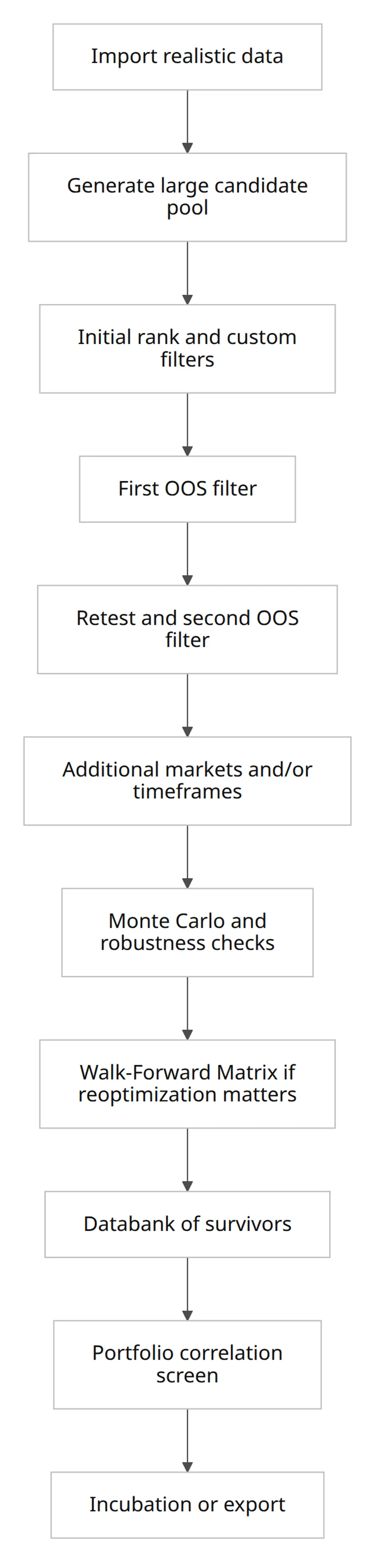
LLM trading agents are easy to demo and hard to trust. A convincing chart can come from a useful decision system, a lucky prompt, hidden lookahead, loose execution assumptions, or a benchmark that rewards commentary more than trading discipline.
The right question is not whether an agent can describe markets. The right question is whether it can produce a repeatable decision record that survives leakage controls, realistic costs, portfolio constraints, and live monitoring.
The Minimum Evidence Bar
An LLM trading agent should be evaluated as a decision process, not as a text generator. Every test should preserve the full path from information input to final action:
- What information was available at decision time
- What the agent believed and cited
- What action it recommended
- Whether the recommendation became a trade, risk adjustment, watchlist item, or no-op
- What rule accepted, rejected, or resized the recommendation
- What happened after costs, slippage, risk limits, and portfolio interaction
If that chain is missing, the evaluation is mostly theater. It may still be useful research, but it is not yet investable evidence.
For a running evidence map, keep this article paired with Agentic Trading Evidence Ledger. For portfolio-specific benchmark design, compare claims against Portfolio LLMs and Correlation-Aware Benchmarks.
1. Separate Forecasting, Decisioning, And Execution
Many agent demos blur three different jobs:
- Forecasting: estimating returns, volatility, regime, or event impact
- Decisioning: choosing position direction, size, hedge, rebalance, or abstention
- Execution: deciding order type, timing, venue, and cost-aware implementation
The agent may be useful in one layer and harmful in another. For example, an LLM may summarize macro and earnings context well but still be a poor position-sizing engine. A clean evaluation names the layer being tested and keeps the other layers controlled.
2. Use A Closed-Loop Decision Log
A useful agent leaves an audit trail. At minimum, log:
- Input timestamp and data sources
- Prompt/template version
- Model/version and tool calls
- Retrieved documents or market data
- Recommendation, confidence, and abstention rationale
- Risk constraints applied after the recommendation
- Accepted action and final portfolio state
- Outcome at predeclared horizons
This log makes it possible to distinguish genuine signal from prompt drift, retrieval drift, data revisions, and accidental future information.
3. Make Leakage Hard, Not Merely Forbidden
Lookahead bias often enters through quiet channels: revised macro data, late-arriving fundamentals, article timestamps, benchmark constituent changes, survivorship-filtered universes, or summaries written after the event.
Practical controls:
- Point-in-time datasets where available
- Document retrieval cutoffs enforced by timestamp
- Walk-forward splits with no prompt retuning on the test window
- Frozen benchmark universes or explicitly modeled membership dates
- Source snapshots for any research note used by the agent
- A no-internet replay mode for historical tests
If the agent uses web search or retrieval, the evaluation needs source-time proof. Otherwise, the model can accidentally read the answer key.
4. Price Turnover Before Celebrating Sharpe
An LLM agent that changes its mind often can look smart before costs and weak after execution. Any evaluation should report:
- Gross return and net return
- Turnover
- Commission, spread, slippage, and market impact assumptions
- Capacity sensitivity
- Average holding period
- Number of trades and no-trade decisions
- Performance after increasing costs by 2x and 5x
The cost model should be defined before the test. Adding costs after a beautiful backtest is how marginal systems survive too long.
5. Require Abstention Quality
Good trading systems know when not to trade. LLM agents should be scored on abstention:
- Did the agent avoid low-confidence regimes?
- Did abstention reduce drawdown or merely miss returns?
- Were no-trade decisions explained consistently?
- Did the agent become overactive after recent wins or losses?
This matters because the easiest way for an agent to appear useful is to produce constant commentary. The harder and more valuable behavior is selective action.
6. Test Portfolio Interaction
Single-asset prompts hide portfolio risk. A recommendation that looks reasonable alone can increase factor crowding, correlation, tail exposure, or liquidity stress when added to the book.
Evaluation should include:
- Marginal contribution to portfolio return
- Marginal contribution to volatility and drawdown
- Correlation with existing signals
- Factor exposure before and after the decision
- Concentration and liquidity limits
- Stress-period behavior
This is where correlation-aware benchmarks matter. A model that adds the same exposure through different language is not adding independent edge.
7. Keep A Small Live Track
Backtests are necessary, but not enough. A small live or paper-trading track catches issues that historical replay misses:
- Data delays and vendor outages
- Retrieval instability
- Market calendar errors
- Prompt regressions
- Execution assumptions that do not hold in real time
- Human override patterns
The live track should be small, boring, and persistent. It should measure whether the system keeps behaving after the team stops staring at it.
8. Compare Against Brutal Baselines
An LLM trading agent should beat simple alternatives:
- Buy-and-hold or cash
- Time-series momentum
- Equal-weight rebalancing
- Volatility targeting
- A non-LLM machine-learning model
- The same strategy with the LLM removed
If the agent only beats a weak baseline, the result is not enough. The cleanest test is an ablation: keep the pipeline, remove the LLM, and see what disappears.
A Practical Scoring Checklist
Use this as a first-pass gate before spending more time on any agentic trading claim:
| Area | Pass condition |
|---|---|
| Decision log | Full timestamped chain from input to action |
| Leakage control | Point-in-time data and retrieval cutoffs |
| Cost model | Net returns after realistic and stressed costs |
| Abstention | No-trade decisions measured, not ignored |
| Portfolio fit | Marginal risk and correlation reported |
| Baselines | Beats strong simple baselines and ablations |
| Live track | Paper or small-capital forward record exists |
| Failure cases | Drawdowns, misses, and bad recommendations documented |
Bottom Line
LLM trading agents should not be judged by how persuasive their market commentary sounds. They should be judged by whether they improve a controlled, auditable, cost-aware decision system.
The most useful agent may not be the one that trades autonomously. It may be the one that improves research triage, flags regime changes, explains risk concentration, or forces cleaner decision records. That is still valuable, but it should be measured honestly.