Data Science and AI Are Not the Same Discipline

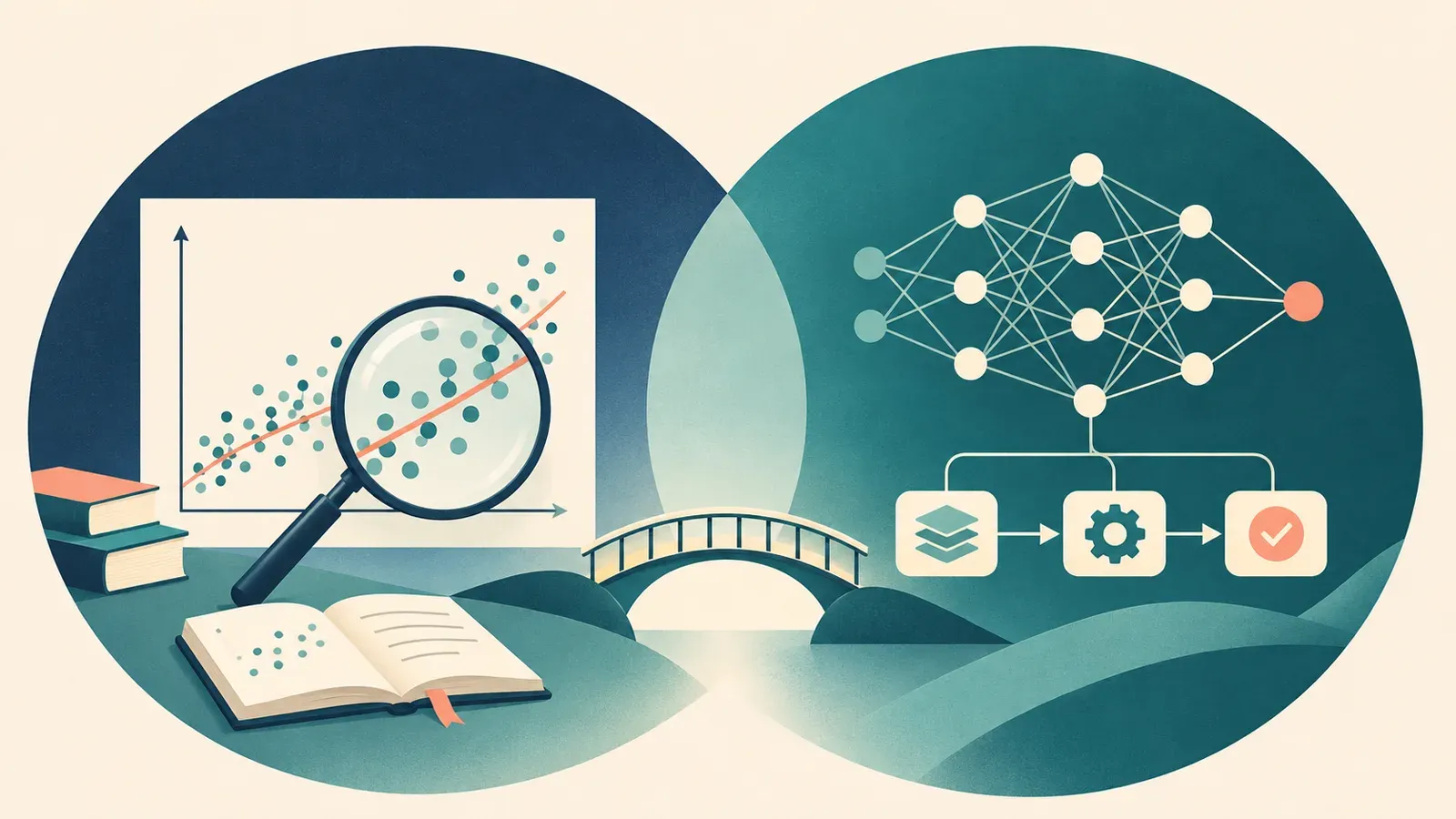
They overlap, share methods, and increasingly sit in the same department. But they begin with different questions, produce different deliverables, and fail in different ways.
A company discovers that customer cancellations have increased by 18 percent. One team investigates which customers are leaving, when the change began, and what may have caused it. Another team builds a system that predicts which customers are likely to leave and automatically chooses an intervention.
Both teams may use Python, SQL, cloud platforms, statistical models, and machine learning. They may even use the same customer data.
But they are not doing the same job.
The first team is trying to understand the world well enough to support a decision. The second is trying to give a machine a capability that operates repeatedly in the world.
That distinction is the clearest way to separate data science from artificial intelligence:
Data science primarily seeks understanding, evidence, and decision support from data. AI primarily seeks machine capabilities that can predict, generate, recommend, reason, decide, or act.
This is not a perfect boundary. A data scientist may build predictive models. An AI system may support rather than replace human judgment. Machine learning belongs to both fields, and generative AI has further scrambled the terminology.
Still, the distinction matters. Organizations that mistake an analytical problem for an AI problem often automate before they understand. Those that mistake an AI problem for an analytical exercise may produce impressive notebooks that never become reliable products.
The useful question is therefore not, “Is this data science or AI?” in the abstract.
It is:
Does this problem primarily require human understanding, machine capability, or both?
Two Fields With Different Origin Stories
The terms data science and artificial intelligence now appear together so frequently that they can sound like stages in the same technical progression: collect data, analyze it, train a model, and call the result AI.
Historically, however, the disciplines emerged from different intellectual projects.
Data science grew out of learning from data
The ancestry of data science runs through:
- statistics,
- scientific data analysis,
- survey research,
- operations research,
- databases,
- visualization,
- business intelligence,
- and data mining.
Its foundational concern is epistemic: What can we learn from the observations available to us?
In 2001, statistician William S. Cleveland proposed “data science” as an expansion of statistics. His emphasis was not on constructing autonomous machines. It was on widening the technical field surrounding data analysis, including computing, modeling, multidisciplinary investigations, and the practical needs of analysts. He argued that the value of this work should be judged by how effectively it enables analysts to learn from data. [jstor.org], [stat.purdue.edu]
That intellectual orientation remains visible in the definition used by theNational Institute of Standards and Technology, or NIST:
Data science combines domain expertise, programming, mathematics, and statistics to extract meaningful insights from data. [csrc.nist.gov]
The operative words are domain expertise, insights, and data.
A data-science project may end with:
- an explanation,
- an estimate,
- a forecast,
- a visualization,
- an experimental result,
- a quantified uncertainty,
- a recommendation,
- or a warning that the available data cannot support the proposed conclusion.
The recipient is usually a person or institution that must decide what to believe or do.
AI grew out of making machines intelligent
Artificial intelligence has a different lineage. It emerged from computer science, logic, cybernetics, cognitive science, information theory, and research into perception and reasoning.
The conventional founding event is the 1956 Dartmouth Summer Research Project on Artificial Intelligence. Its organizers included John McCarthy, Marvin Minsky, Claude Shannon, and Nathaniel Rochester. Their proposal advanced the conjecture that aspects of learning and intelligence could be described precisely enough for a machine to simulate them. [en.wikipedia.org], [home.dartmouth.edu], [ai.dartmouth.edu], [spectrum.ieee.org]
That is a different ambition from learning what a dataset tells us. The goal is to create a system that exhibits a capability associated with intelligence.
NIST captures that orientation by defining AI as a machine-based system that, for human-defined objectives, can make predictions, recommendations, or decisions that influence real or virtual environments. Its broader definitions also include systems capable of perception, planning, learning, communication, and physical action. [csrc.nist.gov], [nvlpubs.nist.gov]
The operative words are machine-based system, objectives, predictions, decisions, and environments.
An AI project may end with:
- a recommender,
- a classifier,
- a language model,
- a planning agent,
- a vision system,
- a robot,
- a fraud-detection service,
- or an application that generates text, images, audio, or code.
The deliverable is not merely knowledge. It is a functioning capability.
The Difference in One Sentence
A concise distinction is possible:
Data science asks what can be learned from data. AI asks what a machine can be made to do.
That formulation is more durable than defining either field by specific tools.
Python does not distinguish them. Neither do neural networks, cloud platforms, notebooks, vector databases, or even machine learning. A method can support different objectives.
Consider a model that estimates customer churn:
- If an analyst uses it to investigate which factors are associated with cancellations, it is functioning as data science.
- If a business uses its scores to help account managers prioritize calls, it is primarily decision support, still close to data science.
- If a production service continuously scores customers and automatically chooses retention offers, it has become part of an AI system.
- If the organization studies whether those interventions actually reduce churn, it needs data science again, particularly experimentation and causal inference.
The mathematical model may be identical. The role it plays is not.
A Comparison of the Two Disciplines
| Dimension | Data science | Artificial intelligence |
|---|---|---|
| Foundational question | What can we learn from data? | What capability can a machine perform? |
| Primary objective | Understanding, measurement, forecasting, or decision support | Prediction, generation, recommendation, reasoning, decision, or action |
| Typical beneficiary | Analyst, researcher, manager, policymaker, clinician, or other decision-maker | User, application, automated process, or physical system |
| Typical deliverable | Analysis, estimate, experiment, dashboard, model, report, or recommendation | Deployed intelligent system, feature, agent, API, model, or autonomous component |
| Main intellectual roots | Statistics, data analysis, operations research, databases, visualization | Computer science, logic, cognitive science, cybernetics, optimization |
| Central workflow | Frame question, collect data, analyze, test, interpret, communicate | Specify behavior, build or select models, integrate, evaluate, deploy, monitor |
| Common success criteria | Validity, insight, uncertainty, causal credibility, usefulness for decisions | Task performance, reliability, latency, safety, scalability, cost, user outcomes |
| Typical failure | A misleading or unsupported conclusion | A system that behaves incorrectly, unreliably, unsafely, or too expensively |
| Human in the loop | Human judgment is often the endpoint | Human oversight may be present, but system behavior is usually the product |
| Production requirement | Optional for many projects | Usually central |
These are tendencies, not jurisdictional boundaries. Forecasting can belong to either discipline. So can machine learning. The deciding factor is generally what the result is expected to accomplish.
Where Statistics, Machine Learning, and Software Engineering Fit
The confusion between data science and AI is partly caused by the disciplines surrounding them.
Statistics supplies the language of evidence
Statistics asks questions such as:
- Is the observed pattern likely to be real?
- How uncertain is the estimate?
- Is the sample representative?
- Which variables are confounded?
- Did an intervention cause the result?
- Will the conclusion generalize beyond the observed data?
These questions are central to data science because a human decision-maker needs more than a plausible pattern. The decision-maker needs to know how much confidence to place in it.
Statistics also contributes to AI, particularly through probabilistic modeling, evaluation, calibration, uncertainty estimation, and experimental design. But an AI system cannot be evaluated solely by whether its internal model is statistically elegant. It must work as a system under operational conditions.
Machine learning is the shared middle
Machine learning is commonly described as a subset of AI, but in industrial practice it is also one of data science’s core methodological toolkits.
That makes simple nesting diagrams misleading.
A better mental model is:
- Data science uses machine learning when predictive patterns help answer questions or support decisions.
- AI uses machine learning when learned behavior enables a machine capability.
- Machine-learning engineering turns those learned models into reliable, maintainable production systems.
Machine learning is therefore not a reliable boundary marker. It is the largest area of overlap.
Software engineering makes AI operational
A data scientist can complete a valuable investigation in a notebook and deliver the conclusion in a report. An AI product normally must survive contact with users, changing data, malicious inputs, network failures, model updates, latency constraints, and budget limits.
That requires software engineering:
- interfaces and APIs,
- testing,
- version control,
- deployment,
- observability,
- security,
- capacity planning,
- rollback procedures,
- and incident response.
This is why contemporary AI engineering often resembles product-oriented software engineering more than exploratory data analysis.
The model may attract the attention. The surrounding system determines whether it works.
Decision science asks what should be done
Data science can tell an organization what happened and what may happen next. Decision science connects that evidence to choices.
It incorporates areas such as:
- causal inference,
- economics,
- behavioral science,
- optimization,
- operations research,
- risk analysis,
- and decision theory.
The relationship matters because a prediction is not automatically a decision.
A model may predict that a patient has a high probability of hospital readmission. That does not determine:
- which intervention should be offered,
- whether the predicted risk is actionable,
- what the intervention costs,
- whether resources should be diverted from another patient,
- or whether the intervention improves the outcome.
Prediction estimates what may occur. Decision science evaluates what should be done about it.
Data Science Does Not Require AI
One of the most persistent misconceptions is that data science becomes legitimate only when it produces a machine-learning model.
It does not.
The CRISP-DM methodology, originally developed as a cross-industry process for data mining, includes business understanding, data understanding, data preparation, modeling, evaluation, and deployment. The process is iterative rather than strictly sequential. Importantly, its contemporary documentation explicitly recognizes projects in which exploration and visualization matter more than modeling. [ibm.com], [public.dhe.ibm.com]
Many important problems require data science but not AI.
Diagnosing a revenue decline
Suppose an online retailer’s quarterly revenue falls.
The practical questions may be:
- Did the number of customers decline?
- Did conversion fall?
- Did average order size change?
- Was the shift isolated to a region, channel, or product category?
- Did a price increase affect demand?
- Did a tracking-system change create an artificial discontinuity?
This is a data-science investigation. It may require decomposition, cohort analysis, time-series analysis, visualization, and careful validation of measurement systems.
An AI system that forecasts next quarter’s revenue does not necessarily explain the decline. A highly accurate prediction can coexist with a poor understanding of causes.
Evaluating an experiment
A company changes its checkout flow and conducts an A/B test.
The principal work includes:
- defining the outcome,
- choosing the unit of randomization,
- estimating required sample size,
- checking assignment integrity,
- controlling false-positive risks,
- calculating effect sizes and uncertainty,
- and evaluating heterogeneous effects.
No intelligent machine is required. The result is evidence for a human decision.
Constructing an official metric
A public agency or regulated enterprise may need to determine:
- the number of eligible beneficiaries,
- the rate of an adverse event,
- the historical trend in service performance,
- or compliance with a reporting requirement.
The critical properties are reproducibility, provenance, consistency, and interpretability. Adding AI may increase complexity without increasing value.
Estimating causal impact
A hospital wants to know whether a new discharge program reduced readmissions. A business wants to know whether an advertising campaign increased sales rather than merely reaching people already likely to buy.
These are causal questions.
Prediction can identify associations. It cannot, by itself, establish what would have happened without the intervention. That requires experimental or quasi-experimental reasoning, assumptions that can be defended, and explicit treatment of uncertainty.
AI Does Not Always Require Conventional Data Science
The reverse is also true. Some problems are fundamentally about machine capability rather than organizational analysis.
Language translation
A real-time translation service must convert speech or text between languages quickly and usefully.
The primary success criteria include:
- translation quality,
- latency,
- robustness,
- context retention,
- and appropriate handling of specialized language.
The central deliverable is a capability. Users do not principally need an analysis of the language corpus. They need the machine to translate.
Visual perception
A manufacturing system may inspect products for defects using cameras.
It must:
- detect relevant objects,
- distinguish acceptable variation from defects,
- operate under changing lighting,
- meet throughput requirements,
- and manage false positives and false negatives.
The organization will need data analysis to evaluate the system, but the core objective is machine perception.
Generative assistance
A coding assistant, document-drafting tool, or image generator creates new material in response to instructions.
NIST treats generative AI as a specialized category that introduces risks such as confabulation, harmful content, privacy leakage, misuse, and difficulties in evaluating open-ended outputs. Its Generative AI Profile extends the broader AI Risk Management Framework to these concerns. [nist.gov], [nvlpubs.nist.gov], [nist.gov]
The system is not simply summarizing a historical dataset for an analyst. It is producing an output as part of an interactive product.
Robotics and autonomous control
A warehouse robot must perceive its environment, plan a route, avoid hazards, respond to change, and act through physical controls.
This is unmistakably an AI and engineering problem. Descriptive analytics may improve operations around it, but analytics alone cannot give the robot the required behavior.
Where Both Disciplines Are Necessary
Many consequential projects need both data science and AI. In these cases, the disciplines should not be merged conceptually, because they provide different safeguards and capabilities.
Case Study 1: Fraud Detection
A financial institution wants to reduce payment fraud without blocking legitimate transactions.
The data-science work
Data scientists must determine:
- which transactions were actually fraudulent,
- how fraud patterns vary across channels and customers,
- whether labels are delayed or biased,
- what the current rules miss,
- the costs of false approvals and false declines,
- and whether the intervention changes criminal behavior.
They may conduct exploratory analysis, construct features, estimate prevalence, evaluate segments, and design experiments.
The AI work
The institution then needs a system that:
- scores transactions in milliseconds,
- applies thresholds or recommends interventions,
- routes ambiguous cases for review,
- adapts to shifting patterns,
- and operates reliably at production scale.
Why neither discipline is enough
An analytical report cannot intercept a fraudulent payment in real time. But a highly accurate model can also damage the business if it disproportionately blocks legitimate customers, relies on leaked information, or deteriorates as adversaries adapt.
The AI system provides the capability. Data science establishes what should be measured, whether the capability works, and what tradeoffs it creates.
Success criteria
This project should not be judged only by model accuracy. It needs metrics such as:
- fraud losses avoided,
- false-decline rate,
- customer complaints,
- manual-review workload,
- latency,
- calibration,
- performance by customer segment,
- and behavior after deployment.
Case Study 2: Hospital Readmission Prevention
A hospital wants to identify patients at high risk of readmission and intervene before discharge.
The data-science work
The analytical team must investigate:
- which factors are associated with readmission,
- whether preventable and unavoidable readmissions are distinguishable,
- how missing data affect conclusions,
- whether historical treatment patterns create bias,
- which interventions have credible evidence,
- and whether predicted risks are well calibrated.
The AI work
A deployed system may:
- calculate risk during the clinical workflow,
- summarize relevant patient information,
- recommend follow-up services,
- or prioritize cases for care coordinators.
Why neither discipline is enough
A retrospective analysis may identify risk patterns but do nothing at the point of care. A predictive system may produce risk scores without establishing that the proposed intervention benefits patients.
A patient can be accurately classified as high risk even when the hospital has no effective action to offer. Prediction is not impact.
Success criteria
A complete evaluation includes:
- discrimination and calibration,
- clinician adoption,
- alert burden,
- access to recommended services,
- patient outcomes,
- fairness across populations,
- and readmissions prevented rather than merely predicted.
Case Study 3: A Customer-Support Copilot
A company wants an AI assistant that helps support agents answer questions.
The data-science work
Before building the assistant, the company should understand:
- why customers contact support,
- which issues take the longest to resolve,
- where agents search for information,
- what causes repeat contacts,
- how resolution quality is currently measured,
- and which types of mistakes carry the greatest risk.
After deployment, data science is needed to determine whether the tool improves outcomes.
The AI work
The AI system must:
- retrieve relevant information,
- interpret the customer’s question,
- draft an accurate response,
- cite or expose its sources,
- preserve conversational context,
- and know when to defer to a person.
Why neither discipline is enough
Without data science, the company may automate a poorly understood process and optimize the wrong metric. Without AI engineering, the analysis never becomes an assistant agents can use.
Generative AI adds a further complication: a response can be fluent, helpful-looking, and wrong. Traditional accuracy metrics may not capture whether an answer is grounded, policy-compliant, appropriately cautious, and useful in context.
Success criteria
The organization should measure:
- resolution accuracy,
- unsupported statements,
- escalation appropriateness,
- repeat-contact rate,
- handling time,
- agent acceptance and editing,
- customer satisfaction,
- privacy incidents,
- and cost per successfully resolved case.
The Roles Are Changing Faster Than the Titles
TheU.S. Bureau of Labor Statisticsdescribes data scientists as professionals who identify useful data, collect and analyze it, create and test models, visualize findings, and make business recommendations. This definition combines technical modeling with communication and decision support. [bls.gov]
In practice, however, titles vary dramatically among employers.
Data scientist
The title can describe at least four different jobs:
- Analytics-oriented data scientist
Focuses on SQL, experimentation, metrics, visualization, and business decisions. - Modeling-oriented data scientist
Builds forecasting, classification, ranking, or risk models. - Research-oriented data scientist
Develops novel methodology, often with advanced statistical or scientific training. - Product data scientist
Works closely with product teams on user behavior, experimentation, growth, and feature evaluation.
The common thread is usually responsibility for learning from data and translating that learning into organizational action.
Machine-learning engineer
The ML engineer generally focuses on turning models into dependable systems.
Typical responsibilities include:
- production pipelines,
- training infrastructure,
- feature systems,
- deployment,
- model serving,
- monitoring,
- performance optimization,
- and reliability.
If the data scientist asks, “Does this model provide useful evidence?”, the ML engineer often asks, “Can this model operate reliably for millions of requests?”
AI engineer
The rapid adoption of foundation models has popularized a newer role: the AI engineer.
This role often integrates existing models rather than training one from scratch. Common work includes:
- selecting foundation models,
- prompt and context design,
- retrieval-augmented generation,
- tool use and agent workflows,
- structured-output enforcement,
- evaluation systems,
- safety controls,
- latency and cost optimization,
- and product integration.
The role is emerging rather than standardized. At one company, an AI engineer is an ML engineer specializing in large language models. At another, the same title describes a software engineer assembling model APIs. Elsewhere, it refers to an applied scientist fine-tuning models.
Current practitioner-oriented role comparisons consistently warn that responsibilities are more informative than titles. They commonly frame data scientists around insight and analysis, ML engineers around production model systems, and AI engineers around end-to-end AI applications, especially those built with foundation models and retrieval. [letsdatascience.com], [refontelearning.com]
This evidence should be treated as an observation about industry practice, not a universal occupational standard.
Why Organizations Use the Terms Interchangeably
If the intellectual distinction is real, why has the language become so muddled?
1. AI is a stronger commercial label
“AI” attracts executive attention, investment, press coverage, and applicants. Work previously described as predictive analytics, optimization, natural-language processing, or machine learning is frequently grouped under AI.
That does not necessarily mean the work changed. Sometimes only the label did.
2. The same teams perform both kinds of work
Smaller organizations rarely maintain clean disciplinary boundaries. One person may:
- investigate data quality,
- build a forecasting model,
- deploy an API,
- construct a dashboard,
- and present recommendations to leadership.
A single title must cover a mixed role, so organizational vocabulary becomes imprecise.
3. The same technical stack supports both
Both fields can involve:
- Python,
- SQL,
- cloud data platforms,
- notebooks,
- machine learning,
- APIs,
- GPUs,
- data pipelines,
- and model evaluation.
Observers naturally infer that people using the same tools are practicing the same discipline.
But tools do not define purpose. A spreadsheet can support accounting, experimental science, inventory planning, or election analysis without turning those activities into one field.
4. Machine learning connects insight to automation
Machine learning can be an analytical method, a production capability, or both.
A recommendation algorithm illustrates the ambiguity:
- analyzing purchasing behavior is data science,
- estimating user preferences is machine learning,
- serving recommendations is AI and software engineering,
- measuring whether recommendations increase value is data science,
- deciding what long-term behavior to optimize is decision science.
The production system crosses boundaries continuously.
5. Generative AI entered knowledge work
Earlier AI applications were often easier to distinguish from analysis. Computer vision, speech recognition, robotics, and game-playing clearly created machine capabilities.
Generative AI now performs tasks involving documents, language, summaries, research, and code. Those activities sit close to the work of analysts and data scientists. As a result, AI can now participate in the process of understanding data, while data scientists can use AI to conduct their work.
The boundary has not disappeared. It has become recursive.
Different Workflows Reveal Different Priorities
A typical data-science workflow
A data-science project often proceeds like this:
- Frame the decision.
What question matters, who will act on the answer, and what choices are available? - Define the concepts and measures.
What exactly counts as churn, fraud, quality, engagement, or success? - Identify and assess the data.
Where did it come from? Who is missing? How was it generated? - Explore and clean.
Find anomalies, inconsistencies, distributions, relationships, and measurement problems. - Choose a method.
This may involve descriptive statistics, visualization, forecasting, experimentation, causal inference, or machine learning. - Validate the result.
Check robustness, uncertainty, alternative explanations, and generalizability. - Interpret and communicate.
Explain what the evidence means, what it does not mean, and what action it supports. - Measure the decision’s outcome.
Determine whether acting on the analysis improved anything.
The key risk is reaching a confident conclusion that the data cannot support.
A typical AI workflow
An AI project often proceeds differently:
- Specify the required behavior.
What should the system perceive, predict, generate, decide, or do? - Define the operational environment.
Who will use it? Under what conditions? What happens when it fails? - Choose a technical approach.
Train a model, fine-tune one, call an external model, combine models, or use explicit rules. - Create or obtain evaluation data.
Design tests that represent actual tasks, difficult cases, and potential harms. - Build the surrounding system.
Add retrieval, interfaces, permissions, tools, logging, fallback behavior, and human escalation. - Test performance and risk.
Evaluate accuracy, robustness, security, bias, hallucination, latency, and cost. - Deploy gradually.
Use pilots, monitoring, access controls, and rollback procedures. - Monitor behavior over time.
Detect changes in users, inputs, models, environments, and failure modes.
The key risk is deploying behavior that is impressive in a demonstration but unreliable in reality.
NIST’s AI Risk Management Framework formalizes this broader view through the functions Govern, Map, Measure, and Manage, emphasizing that trustworthy AI depends on organizational and operational risk management rather than model performance alone. [nist.gov], [nvlpubs.nist.gov]
Their Success Criteria Are Not the Same
A data-science project can succeed without producing software. An AI project usually cannot succeed without operating as software.
Data-science success
Relevant criteria include:
- Is the question well defined?
- Is the dataset appropriate?
- Are the measures valid?
- Is the analysis reproducible?
- Is uncertainty communicated?
- Are causal claims justified?
- Can stakeholders understand the result?
- Did the analysis improve the decision?
AI success
Relevant criteria include:
- Does the system perform the task?
- Does it behave reliably outside a controlled demonstration?
- How does it handle unfamiliar inputs?
- Does it fail safely?
- Is it fast and affordable enough?
- Can it be monitored and updated?
- Does it respect privacy, security, and access controls?
- Does it produce better user or organizational outcomes?
Both may share metrics, but interpret them differently
A data scientist may use model performance to compare hypotheses or estimate practical usefulness.
An AI engineer must treat performance as one system requirement among many. A model with slightly lower benchmark accuracy may be preferable if it is more stable, interpretable, affordable, or safe.
A 95 percent accurate analysis may be informative. A system that performs the correct action only 95 percent of the time may be unacceptable in aviation, medicine, security, or financial control.
The context changes the meaning of the number.
The Strongest Challenges to the Thesis
A useful distinction should survive criticism. Several arguments challenge the separation between data science and AI.
Challenge 1: Data science already includes prediction
The proposed distinction can make data science sound purely descriptive. That would be false.
Data scientists routinely build:
- demand forecasts,
- credit-risk models,
- churn predictions,
- survival models,
- anomaly detectors,
- and recommendation models.
Some of these models trigger operational actions. Prediction is not exclusive to AI.
Response: The distinction should be based on the project’s primary objective and deliverable, not whether prediction occurs. A forecast intended to help a planning team is decision support. A forecasting service that autonomously adjusts inventory is part of an intelligent operational system.
Challenge 2: AI also helps humans understand
AI systems can summarize documents, explain patterns, write queries, generate hypotheses, and help users explore information.
A research assistant powered by a language model does not necessarily make the final decision. It may support human understanding.
Response: Human involvement is not sufficient to classify a project as data science. The AI assistant still provides a machine capability: language generation or reasoning-like interaction. What the user does with that capability may be analytical.
Challenge 3: AI is built from data science
Training and evaluating modern AI involves:
- data collection,
- sampling,
- labeling,
- statistical estimation,
- experimentation,
- and error analysis.
It may therefore seem that AI is simply an application of data science.
Response: AI depends on data science but is not reducible to it, just as aviation depends on physics but is not merely a branch of physics. AI introduces system behavior, interaction, autonomy, engineering, and operational risk.
Challenge 4: The categories are socially constructed
Job titles are inconsistent, and organizational structures reflect hiring markets, internal politics, and branding as much as scientific taxonomy.
Response: This criticism is correct. The categories are not laws of nature. But a distinction can still be useful if it improves planning. “Understanding” and “machine capability” reveal different requirements even when job titles do not.
Challenge 5: A full data product contains both
A mature product team may analyze behavior, build models, deploy systems, run experiments, and monitor outcomes as one continuous process.
Response: This is the strongest challenge. At the product level, separating the disciplines too sharply can create harmful handoffs. Yet integration does not imply equivalence. Medicine combines diagnosis, treatment, pharmacology, nursing, and surgery without pretending they are the same discipline.
A Practical Framework: Does Your Problem Need Data Science, AI, or Both?
Start with the outcome rather than the technology.
Step 1: Complete this sentence
At the end of the project, we need to know ______.
If that sentence is easy to complete, the project probably begins with data science.
Examples:
- why service requests increased,
- whether a policy improved compliance,
- which factors predict equipment failure,
- whether customer satisfaction is declining,
- how uncertain next quarter’s demand forecast is.
Now complete this sentence:
At the end of the project, the system must be able to ______.
If that sentence is more natural, the project probably requires AI.
Examples:
- classify incoming documents,
- recognize damaged components,
- propose responses to users,
- recommend the next action,
- navigate a changing environment.
If both sentences matter, the project needs both.
Step 2: Identify the final consumer
Ask who or what consumes the output.
- Human consumes evidence: usually data science.
- Software consumes a score or generated output: usually AI or production ML.
- Human uses a machine-generated capability: AI, with data science needed for evaluation.
- Automated process takes consequential action: AI plus strong governance, engineering, and outcome analysis.
Step 3: Determine whether automation is necessary
If a monthly report or one-time analysis solves the problem, an AI system may be unnecessary.
Automation becomes more plausible when:
- decisions occur frequently,
- response time matters,
- the input volume exceeds human capacity,
- the behavior is sufficiently repeatable,
- consistent execution is valuable,
- and errors can be detected and controlled.
Step 4: Identify the dominant uncertainty
Different uncertainties point toward different expertise.
Data uncertainty
- Are the records complete?
- Is the sample biased?
- Is the metric valid?
- Is the relationship causal?
- How precise is the estimate?
This points toward data science and statistics.
Behavioral uncertainty
- What will the system produce for an unfamiliar input?
- Can it be manipulated?
- Will it call the wrong tool?
- Can it act outside its authority?
- Does it fail safely?
This points toward AI evaluation, software engineering, security, and governance.
Decision uncertainty
- What action creates the greatest benefit?
- Which tradeoff is acceptable?
- What does an error cost?
- Who should bear the risk?
This points toward decision science and accountable human leadership.
Step 5: Define success before choosing tools
Use the following decision matrix:
| If the principal goal is… | Begin with… | Add AI when… |
|---|---|---|
| Explain what happened | Data science | A recurring diagnostic task should be automated |
| Estimate what will happen | Data science | Predictions must be served continuously in a system |
| Determine what caused an outcome | Statistics, experimentation, causal data science | AI is needed to operationalize the resulting intervention |
| Help humans choose | Data science and decision science | Personalized recommendations or interactive assistance add value |
| Generate content | AI | Data science is needed to measure quality and outcomes |
| Recognize language, images, or speech | AI | Data science is needed for dataset design and evaluation |
| Automate repeated decisions | AI and software engineering | Data science is needed to establish thresholds, tradeoffs, and impact |
| Discover patterns in records | Data science | AI is needed only if pattern detection must become an operational capability |
Warning Signs That an Organization Is Solving the Wrong Problem
It may not be an AI problem if:
- No one can specify the decision or behavior to improve.
- The organization does not trust or understand its own data.
- The task occurs only a few times a year.
- A query, report, or procedural change would solve it.
- There is no way to evaluate whether an AI output is correct.
- The cost of integration exceeds the value of automation.
- Leadership wants “an AI strategy” but cannot name a user need.
It may not be only a data-science problem if:
- The analysis must run continuously.
- Outputs must be delivered in milliseconds.
- The model interacts directly with customers.
- The result triggers automated actions.
- Performance must be monitored after deployment.
- Users can submit adversarial or unpredictable inputs.
- Failure can propagate through other production systems.
It probably requires both if:
- A model influences consequential decisions.
- The intervention may change the data-generating process.
- The system must be evaluated for real-world impact, not merely benchmark performance.
- Human behavior and machine behavior affect each other.
- Fairness, privacy, or safety depends on context.
- The business needs both an explanation and an operational response.
Underexplored and Surprising Findings
1. The divide is as much epistemological as technical
Data science is concerned with the quality of claims:
- What do we know?
- From what evidence?
- Under which assumptions?
- With how much uncertainty?
AI is concerned with the quality of behavior:
- What can the system do?
- Under which conditions?
- How reliably?
- With what consequences?
One discipline evaluates beliefs. The other evaluates capabilities.
Modern projects need both forms of evaluation, but they are not interchangeable.
2. A more accurate model may produce a worse decision
Organizations often optimize predictive metrics because they are measurable.
But improving predictive accuracy does not guarantee:
- improved outcomes,
- better interventions,
- greater fairness,
- lower cost,
- or increased trust.
If a hospital cannot intervene on a predicted risk, a better prediction may contribute little. If a fraud model raises review volume beyond operational capacity, it may reduce total effectiveness. If a recommendation system increases clicks but decreases long-term satisfaction, the local metric conceals the larger failure.
The gap between prediction and decision is one of the most important places where data science, AI, and decision science must meet.
3. “Human in the loop” does not settle the classification
Both disciplines can involve people.
A data scientist may automate an analysis. An AI system may require human approval. The presence of a human therefore does not distinguish the fields.
The more useful question is:
Is the machine presenting evidence for judgment, or performing a cognitive task whose output becomes part of the product?
Often it is doing both.
4. Many AI failures begin as data-science failures
An AI system may fail because:
- the target variable was poorly defined,
- historical labels encoded institutional bias,
- the training population differed from actual users,
- the metric did not represent the real objective,
- or the evaluation excluded difficult cases.
These are not exclusively model-engineering problems. They begin with measurement, sampling, inference, and domain understanding.
5. Many data-science failures become software failures at scale
An analysis may be valid in a controlled environment but fail when operationalized because:
- features are computed differently in production,
- data arrive too late,
- definitions drift,
- dependencies change,
- monitoring is absent,
- or users adapt to the system.
The moment an analysis becomes recurring infrastructure, software engineering becomes part of its scientific validity.
6. Generative AI makes evaluation harder, not obsolete
Traditional supervised models often have comparatively clear targets: a transaction is fraudulent or not; an image contains a defect or not.
Generative outputs can have several simultaneously relevant properties:
- factuality,
- relevance,
- completeness,
- style,
- safety,
- grounding,
- originality,
- and usefulness.
These qualities may conflict. There may be no single correct answer. Consequently, generative AI increases the need for careful measurement, human evaluation, experimental design, and decision analysis. It does not replace data science. It creates new demand for it.
So, Is the Distinction Obsolete?
No, but it can be misleading if treated as a rigid taxonomy.
It would be wrong to claim:
- data science only describes the past,
- AI always acts autonomously,
- machine learning belongs exclusively to AI,
- data scientists never deploy software,
- or every project can be assigned neatly to one category.
The fields overlap in methods, people, data, infrastructure, and organizational ownership.
Yet collapsing them into the single label “AI” creates practical problems. It can cause organizations to:
- reach for automation before defining the decision,
- prioritize model demonstrations over evidence quality,
- underestimate data and measurement work,
- hire for the wrong skills,
- evaluate analytical work using production metrics,
- or evaluate production systems using notebook metrics.
A distinction remains useful when it clarifies the center of gravity.
If the center of gravity is learning, explanation, evidence, and human decision support, the project is primarily data science.
If the center of gravity is machine behavior, product capability, and repeated operational performance, the project is primarily AI.
If the machine’s behavior must be understood, validated, governed, and improved through evidence, the project requires both.
Conclusion: Start With the Problem, Not the Label
Data science and AI are not the same discipline. They arose from different histories and still optimize for different outcomes.
Data science turns observations into defensible understanding. It helps people measure reality, test beliefs, estimate uncertainty, and make better decisions.
AI turns models, rules, and computation into machine capabilities. It allows systems to recognize, predict, recommend, generate, plan, and act.
Machine learning connects the two. Software engineering makes AI operational. Statistics disciplines the evidence. Decision science connects predictions to choices. Generative AI expands what machines can produce while making rigorous evaluation more important.
Organizations do not need perfect terminology. They do need to know what kind of problem they are solving.
Before launching the next “AI initiative,” ask:
- What do we need to understand?
- What decision must improve?
- What must the machine be able to do?
- Who or what will consume the output?
- How will we know that the result improved the real outcome?
- What happens when the system is wrong?
The answers will reveal whether the work needs data science, AI, or both.
And sometimes the most intelligent conclusion will be that the organization does not need AI at all.
Selected Sources
- NIST Data Science Glossary, current glossary definition.
- NIST Artificial Intelligence Glossary, current glossary definitions.
- William S. Cleveland, “Data Science: An Action Plan for Expanding the Technical Areas of the Field of Statistics”, 2001.
- William S. Cleveland’s Purdue University research page, background on the development of his data-science formulation.
- Dartmouth: “Artificial Intelligence Coined at Dartmouth”, history of the 1956 workshop.
- Dartmouth: “The Founding and Future of AI”, historical account and text from the original proposal.
- IEEE Spectrum: “The Meeting of the Minds That Launched AI”, May 6, 2023.
- NIST Artificial Intelligence Risk Management Framework 1.0, January 2023.
- NIST Generative AI Profile, July 26, 2024.
- U.S. Bureau of Labor Statistics: Data Scientists, occupational responsibilities and outlook.
- IBM CRISP-DM overview, data-mining lifecycle and project flexibility.
- CRISP-DM 1.0 guide, 2000.
Further reading
- Read the Chinese companion for the same distinctions and examples.
- When Random Splits Test the Wrong Generalization shows how a data-science evaluation choice changes the question a model test answers.