AI Search Ads Are Becoming a Control Migration

AI Search Ads Are Becoming a Control Migration
The important thing is not that Google is adding AI to search ads; it is that paid search control is migrating from advertiser-authored targeting to platform-managed learning loops because AI search monetization depends on who owns query intent.
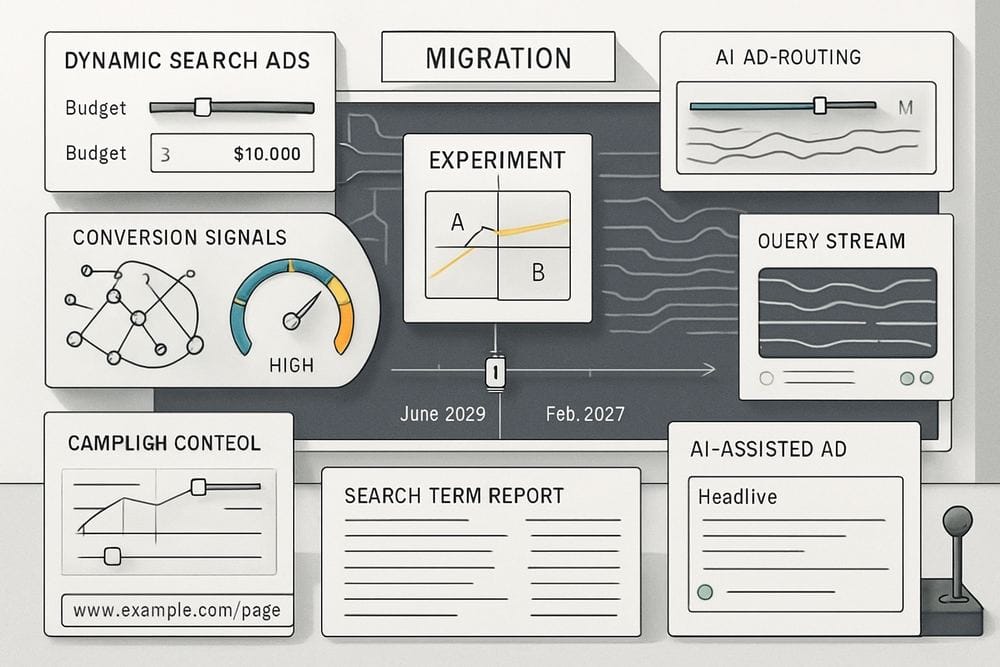
On June 11, Google told Ads API developers that it is delaying the automatic migration of Dynamic Search Ads to AI Max for Search campaigns from September 2026 to February 2027, and restoring new DSA campaign creation on June 15. The developer post says the delay gives advertisers more time to test, manage transitions, and preserve control over campaign structure. That update revised Google's earlier April plan, which had said legacy features such as Dynamic Search Ads, automatically created assets, and campaign-level broad match would start upgrading to AI Max in September.
This looks like a timeline adjustment. It is more revealing than that. Google is not walking away from the direction of travel. It is buying time for advertisers to accept a new operating model: search campaigns where keywords, landing pages, site content, assets, conversion history, and real-time intent signals are inputs to a platform-managed matching system rather than hard boundaries set by the advertiser.
The named mechanism is intent-routing substitution. In classic paid search, the advertiser tries to encode intent through keywords, negatives, match types, landing pages, and campaign architecture. Dynamic Search Ads already loosened that by using website content to capture relevant searches without manually writing every keyword. AI Max goes further: Google describes it as combining advertiser inputs with richer signals to find untapped queries, customize text, and expand final URLs. The practical question is no longer only, "What query did I bid on?" It becomes, "What intent did the platform infer, what evidence did it use, and can I prove the resulting conversion was incremental?"
That is why the June 11 delay matters today. A mature platform can force a migration when the replacement is operationally boring. Google delayed because the replacement is not boring for operators. It changes where control sits. Advertisers are being asked to move from explicit query construction toward supervised automation, and the supervision layer is only as good as the conversion signals, brand controls, URL rules, reporting granularity, and experiment discipline underneath it.
The easy misread is to frame this as an AI creative story. AI-generated headlines and asset optimization are visible, so they attract attention. But creative is not the main strategic surface. The main surface is query eligibility. If AI Max becomes the route into AI Overviews, AI Mode, conversational product recommendations, and future sponsored answers, then the scarce thing is not a better ad sentence. It is privileged access to commercial intent as it appears in AI-mediated search.
Search Engine Land's June 9 practitioner note captures the operator anxiety well. It argues that many accounts still lack the foundations AI Max needs: reliable conversion tracking, offline imports, clean account structures, and enough signal volume. It also warns that adding AI Max to already efficient brand campaigns can make attribution murky, because conversions that exact or phrase campaigns were already winning may appear in a new automation bucket. That is the missed tradeoff: automation can discover demand, but it can also relabel demand.
This tradeoff will shape user behavior inside marketing teams. Paid search managers will not simply ask whether AI Max increases reported conversions. They will ask whether it increases incremental conversions after controlling for brand spillover, match-type cannibalization, landing page expansion, and lead quality. In-house teams will want experiment holdouts before letting automation touch defensive brand campaigns. Agencies will have to explain whether a reported lift came from new demand or from the platform taking credit for traffic that was already reachable.
The second-order consequence is that search marketing becomes more like model operations. The operator's job shifts from manually enumerating every possible query to managing a signal pipeline: conversion taxonomy, offline quality imports, exclusions, URL boundaries, brand protections, experiment design, and post-click value measurement. Weak data does not get fixed by AI; it gets amplified. If every form fill is treated as equal, the system can optimize toward easy, low-quality leads. If brand and non-brand structures are muddled, automation can improve dashboard numbers while making marginal economics worse.
Google's own updated migration guidance points in that direction. It tells API users to audit active DSAs, run side-by-side campaign experiments, and use upgrade tools that map DSA targets into modern equivalents while preserving historical reporting. That is not the language of a simple feature sunset. It is migration choreography for an economic control plane. The platform wants advertisers to move, but it also knows that a forced move without trusted baselines would create resistance.
The builder implication is concrete. Any AI product that mediates commercial discovery needs an operator console, not just an automation toggle. The console must answer five questions: what did the model match, why did it match, which control allowed it, what would have happened under the old route, and whether the downstream value justified the expanded eligibility. Without those answers, the AI product may still generate revenue for the platform, but it will be hard for sophisticated buyers to trust.
There is a reasonable counterargument. Google has spent years pushing search advertisers toward broader matching, Smart Bidding, Performance Max, and automated asset systems. AI Max may simply be the next step in a long automation arc. Many advertisers also under-manage keyword accounts; a system that uses landing pages, assets, and intent signals can outperform manual sprawl, especially for long-tail products and messy inventories. Google's April post cited an average 7% lift in conversions or conversion value at similar CPA or ROAS when advertisers used the full AI Max feature suite rather than search-term matching alone, based on internal 2026 data for non-retail advertisers.
That counterargument is real. The mistake is treating it as universal. Automation works best when the objective function is trustworthy, volume is sufficient, and the operator can distinguish incremental demand from credit reassignment. That is why the February 2027 delay is useful signal: even Google is implicitly acknowledging that advertisers need more time to build the measurement and migration muscle around the new system.
The falsifiable watch-next indicator is not whether Google eventually completes the DSA migration. It almost certainly will. Watch instead for three narrower signs. First, whether Google improves AI Max search-term reporting enough for operators to separate discovery from cannibalization. Second, whether brand controls and URL exclusions become dependable enough for defensive campaigns. Third, whether agencies start reporting AI Max results through incrementality tests rather than platform-reported conversion lift.
The broader market read is that AI search monetization is becoming a battle over control semantics. Search used to monetize by matching typed intent to advertiser-authored targets. AI search will monetize by inferring intent inside longer, conversational, product-rich journeys. That inference layer is powerful, but it is also harder to audit. Whoever owns it can reshape budgets, reporting, and discovery.
For builders outside advertising, the lesson travels. When AI absorbs a workflow, the hard product question is not "Can the model automate this task?" It is "Which human controls are being translated into model inputs, and can operators still tell whether the model created value or merely reassigned credit?" Google's DSA delay is a small product-timeline update. The reality check is bigger: AI adoption in distribution markets depends less on raw capability than on whether buyers trust the new control layer enough to move budget into it.
Sources: Google Ads Developer Blog, "Dynamic Search Ads (DSA) Automigration Delayed to February 2027 and Campaign Creation Restored," June 11, 2026, https://ads-developers.googleblog.com/2026/; Google Ads & Commerce Blog, "We're upgrading Dynamic Search Ads to AI Max," updated June 11, 2026, https://blog.google/products/ads-commerce/dsa-upgrade-to-ai-max-2026/; Search Engine Land, "Why your brand campaign may not be ready for AI Max," June 9, 2026, https://searchengineland.com/brand-campaign-not-ready-ai-max-479663; The Verge, "Google Search's AI evolution includes more ads," May 2026, https://www.theverge.com/tech/934585/google-ai-shopping-ads-search.