The New AI Product Is the Permission Layer

The New AI Product Is the Permission Layer
The important thing is not that Anthropic launched a stronger model; it is that the same underlying capability is now being packaged through different permission layers because frontier AI distribution is becoming a trust-routing problem, not a simple API availability problem.
Anthropic's June 9 launch of Claude Fable 5 and Claude Mythos 5 looks, at first glance, like a familiar frontier-model announcement: better coding, stronger knowledge work, improved vision, long-context persistence, customer quotes, benchmark comparisons, and a new price point. The headline numbers are easy to repeat. Fable 5 and Mythos 5 are priced at $10 per million input tokens and $50 per million output tokens, less than half the price of the earlier Mythos Preview, according to Anthropic.
But the more important product decision is not the price. Anthropic says Mythos 5 is the same underlying model as Fable 5, with safeguards lifted in some areas, and that Mythos access is initially restricted to Project Glasswing partners through a collaboration with the U.S. government. Fable is generally available; Mythos is trusted-access infrastructure. That is the signal.
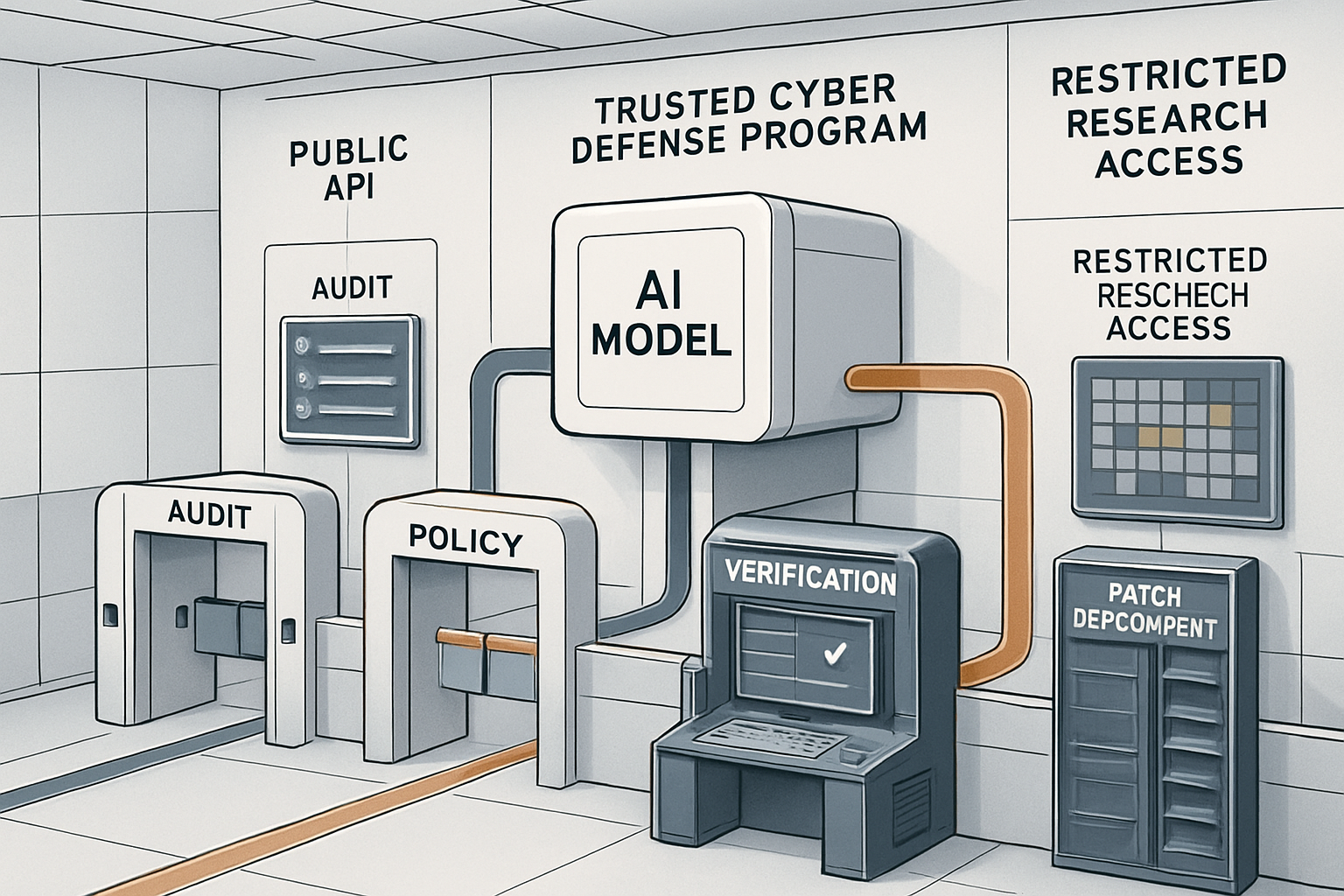
The named mechanism is capability partitioning. Instead of treating a frontier model as one product with one safety posture, Anthropic is splitting the model's distribution surface by access rights, safeguard settings, domain risk, and institutional trust. The same core capability can be exposed differently to a normal developer, a vetted cyber defender, and soon, according to Anthropic, selected biology researchers. In practice, the product is no longer just "the model." It is the model plus the permission layer around it.
This matters because the frontier-model market has been trained to compare providers by intelligence, context length, latency, price, and developer experience. Those still matter. Yet for dual-use capabilities, especially cybersecurity and biology, the real bottleneck is becoming who is allowed to do what, under which monitoring regime, with which audit trail, and with which escalation path if misuse or false positives appear.
The missed tradeoff is blunt: general availability maximizes adoption, but trusted access maximizes control. Anthropic's Fable safeguards are tuned conservatively and may catch harmless requests in less than 5% of sessions on average, according to the launch post. That is a visible product cost: false positives irritate legitimate users and can make a model feel unreliable in expert workflows. But lifting those safeguards for everyone would create a different cost: powerful cyber capabilities becoming broadly available before the defensive ecosystem has norms, verification, and response capacity.
Project Glasswing shows why this is not theoretical. On June 2, Anthropic said it was expanding Glasswing from roughly 50 initial partners to about 150 organizations across more than 15 countries, including power, water, healthcare, communications, hardware, and critical open-source maintainers. It also said the hard part is shifting from finding vulnerabilities to verifying, disclosing, fixing, and deploying patches. That is a useful reality check. A model that finds more flaws is only helpful if the surrounding system can absorb the findings.
The specific operator behavior to watch is vetting and queue management. Security teams will not buy Mythos-class capability the way they buy a chat model. They will ask: Who can prompt it? Which repositories can it scan? Are exploit-generation paths blocked or logged? How are findings deduplicated? Who validates severity? How are maintainers contacted? What happens when the model produces a plausible but wrong patch? What is the service-level expectation for triage? These questions sit outside normal token pricing, but they define whether the capability is usable.
There is a second-order consequence for AI business models. The high-margin product may not be the raw model call; it may be verified access to dangerous capability. That pushes frontier labs toward a structure that looks less like a pure cloud API and more like regulated infrastructure: partner programs, user classes, audit requirements, policy-specific model variants, and domain-specific distribution channels. The model's intelligence gets monetized through trust gates.
Builders should take the cue seriously. If your product touches a high-risk domain, do not design a single on/off safety switch. Design an entitlement system. Separate capability from permission. Track tenant class, user role, task type, data boundary, tool access, safeguard mode, and audit requirements as first-class runtime state. A support chatbot, internal security copilot, external bug bounty assistant, and autonomous patching agent may share model infrastructure, but they should not share the same policy path.
The same lesson applies below the frontier. A startup using open-weight models for code review, medical summarization, fraud detection, or compliance workflows will face the same shape of problem, only with fewer institutional resources. The product question becomes: Which users get high-autonomy modes, which actions require review, which outputs are safe to stream, which tasks must be logged, and which capabilities are reserved for trained operators? If this is bolted on later, the product will either become too permissive or too frustrating.
The counterargument is that this may be partly strategic positioning. Anthropic benefits from defining advanced capability as something that requires trusted distribution, especially if competitors prefer broader release. A permission-heavy model can protect users, but it can also entrench incumbents, slow smaller developers, and turn safety into a market-access advantage. Builders and policymakers should be honest about both sides. Safety gates are necessary in dual-use domains; they can also become gatekeeping power.
The watch-next indicator is falsifiable: do other frontier labs start publishing not just model cards and prices, but access architectures? Look for named trusted-access programs, domain-specific safeguard modes, audit IDs, partner verification requirements, restricted model variants, and APIs that expose policy state as clearly as they expose latency or usage. If this remains an Anthropic-specific posture, the market may treat it as brand differentiation. If it spreads, the next frontier competition will be over permission design as much as model quality.
The practical takeaway is simple: capability is no longer the whole product surface. As models become stronger and cheaper to run, the hard question shifts from "Can the model do it?" to "Who is allowed to make it do that, under what controls, and who is accountable afterward?" Anthropic's June 9 launch is important today because it makes that shift visible in packaging. Fable and Mythos are not just model names. They are an early map of how frontier AI may be sold: one intelligence layer, multiple permission regimes.
Sources: Anthropic, "Claude Fable 5 and Claude Mythos 5", Anthropic, "Expanding Project Glasswing", Gartner inference cost forecast.