AI Can Compare Research Views—But the Risk Check Still Belongs to Humans
A new institutional workflow uses AI to compare research perspectives and surface risks, changing the analyst’s job from collecting views to auditing the comparison.

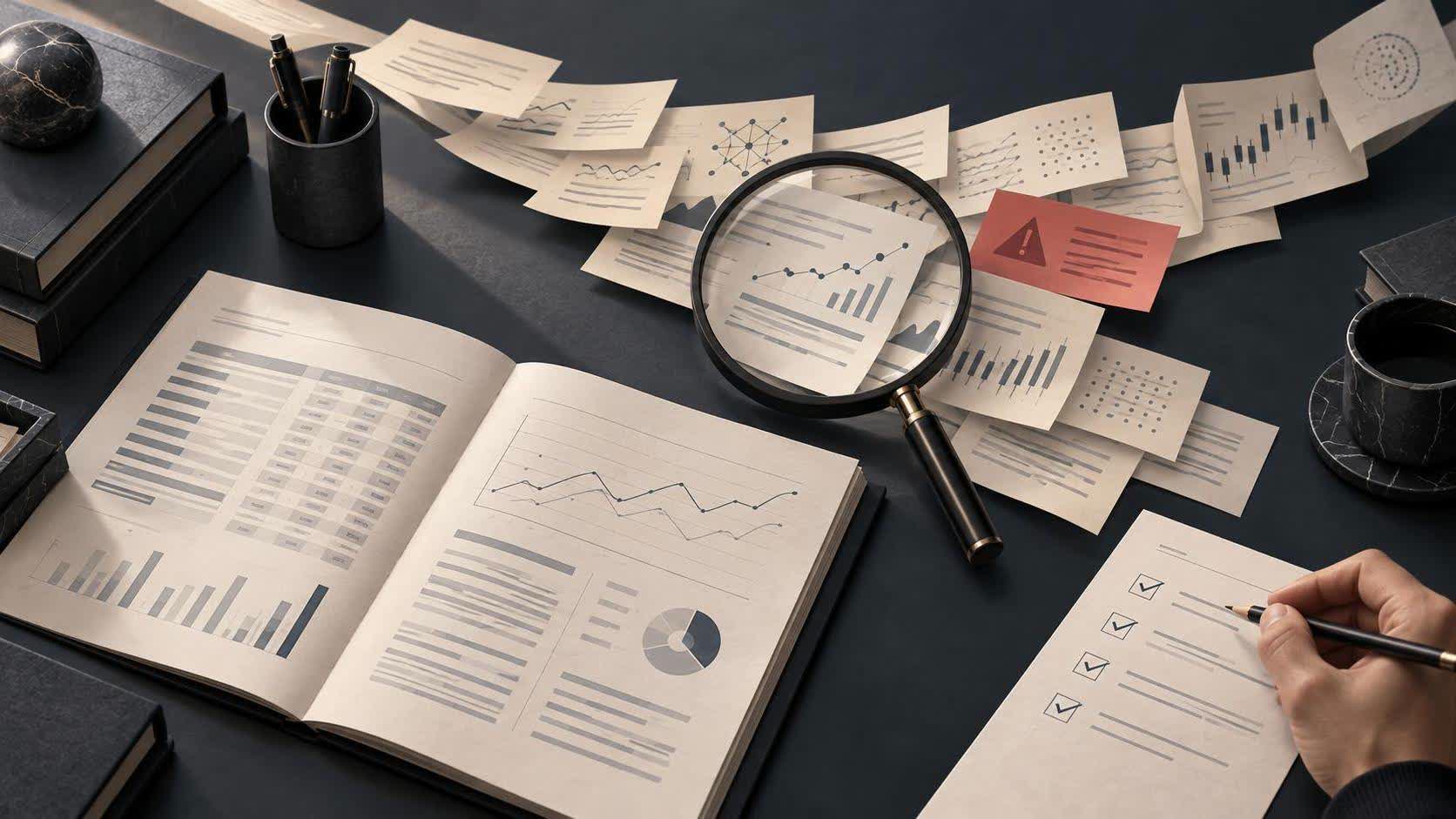
AI is moving one investment-research task from collection to comparison. Franklin Templeton says it is developing workflows that help portfolio managers compare research perspectives and examine the risks behind an idea, beginning with equity research. The important change is not that a model writes another memo. It is that the workflow can put competing views, evidence, and risk questions in one review surface.
My judgment: this is useful only when comparison remains an auditable research step. A fluent synthesis can hide disagreement, flatten source quality, and turn a missing caveat into false consensus. The human gate is not a ceremonial approval; it is the measurement point for whether the AI found a real difference or merely produced a more polished summary.
The old and new research workflow
The old process is usually serial: an analyst gathers broker notes, filings, internal work, and alternative-data commentary, then produces a view. A second analyst may read the result, but the comparison between views is often informal. It lives in comments, meetings, or a portfolio manager’s memory.
The emerging workflow is structured. AI retrieves bounded documents, extracts each view’s thesis and assumptions, maps claims to sources, and places disagreements beside a risk checklist. The manager still decides what matters. This can reduce the cost of asking, “What does this source actually disagree with?” It does not answer whether either source is correct.
The Franklin Templeton case study is an institutional deployment report, not an independent performance study. OpenAI describes the aim as helping portfolio managers examine different research views and risks; it does not establish improved returns, accuracy, or causal investment outcomes. That distinction matters because vendor and adopter incentives favor successful workflow narratives, while failed comparisons may never be published.
What a reproducible comparison should contain
Start with an information cutoff and a fixed document set. For each view, require the system to record the thesis, horizon, assumptions, evidence links, confidence, and what would falsify the claim. Then ask the model to produce a disagreement table: claim, source, opposing claim, source quality, missing data, and decision relevance.
The risk pass should be separate from the synthesis. Check concentration, liquidity, balance-sheet or cash-flow assumptions, regime dependence, data leakage, conflicts of interest, and whether the conclusion changes when one weak source is removed. A model can classify these questions, but it cannot supply evidence that is absent. A human reviewer should sign off on unresolved contradictions and preserve the rejected alternatives.
Two internal examples show why this control matters: AI Can Classify Investment Disclosures—If Humans Audit the Measurement and AI Investment Agents Need Near-Miss Logs. The first concerns measurement validity; the second concerns operational failure. Comparison workflows need both.
A 60-minute research-only exercise
Choose one historical question and freeze the public information set at a known date. Baseline: a human compares two documents using a blank template. Treatment: an AI system extracts the same two views and fills the disagreement and risk tables. Do not use current prices to make a selection, and do not place a trade.
Spend 15 minutes defining the cutoff and schema, 20 minutes running both comparisons, 15 minutes checking every material claim against its source, and 10 minutes scoring the outputs. Record disagreement recall, citation completeness, unresolved contradictions, reviewer corrections, and minutes required. Observe the workflow for seven days of paper review only, using the same frozen evidence for any follow-up.
The stop condition is information leakage, an invented citation, an untraceable claim, or a risk conclusion that changes without a documented input. A useful result is not a winning paper position. It is evidence that the AI comparison exposes more decision-relevant disagreement at an acceptable review cost than the baseline.
Reality check
Selection bias is immediate: a team may choose cases where its documents are clean and the model performs well. Survivorship and reporting bias favor deployed prototypes that survived internal review. Measurement bias enters when “better comparison” means more extracted fields rather than better calibration or fewer missed risks. The causal gap from workflow adoption to investment outcome remains untested.
There are also practical constraints: proprietary research may not be legally reusable, documents can change after retrieval, and model versions can alter classifications. A comparison that looks independent may simply repeat a common source. The right output is therefore an evidence map with uncertainty, not a consensus score.
For discretionary investors, practice preserving opposing views. For systematic teams, measure missed-risk rate and reviewer correction rate before speed. For builders, expose cutoffs, provenance, model versions, and rejection reasons. AI can make disagreement easier to see; it cannot make uncertainty disappear.
Sources: Franklin Templeton uses OpenAI to support investment research and OpenAI’s related case-study reporting.