AI building operations need an exception queue before autonomy
Facilities teams are expanding AI use, but the practical control point is not a dashboard: it is a ranked, auditable queue that keeps humans responsible for unusual building conditions.

Facilities teams are moving from asking whether AI can analyze building data to deciding where it may safely influence daily work. A November 2026 IFMA report says 61% of facilities teams plan to expand AI use, with energy optimization the leading current and planned use case. NIST’s building-systems program describes a related technical goal: combining HVAC, lighting, security, transport, energy-management, and emergency-response systems to detect and diagnose unwanted operating conditions.
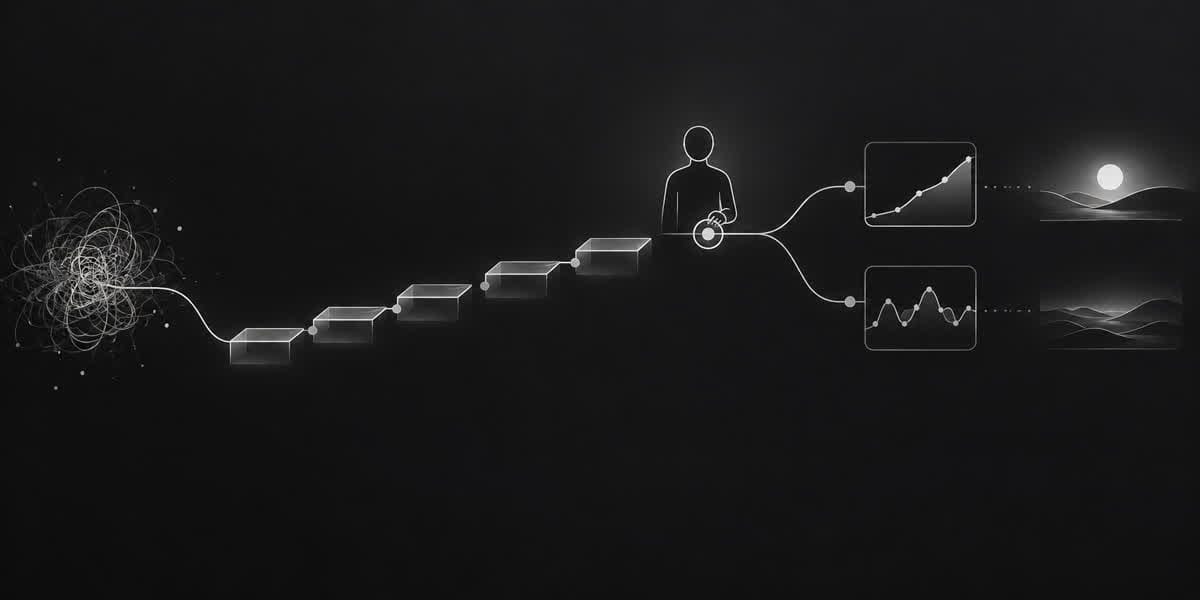
The practical judgment is narrower than “autonomous buildings.” For owners and operators, the next useful product is an exception queue: a ranked list of unusual conditions, with the evidence behind each alert, a proposed next check, and a named human who can accept, defer, or reject it. That design can reduce search time without turning a noisy model prediction into an unsafe control command.
What changed in the real-estate workflow
Traditional building operations spread attention across alarms, work orders, meter data, weather, tenant complaints, and periodic inspections. Operators often reconcile these sources manually. AI can now summarize streams, detect patterns, group related alarms, and route a case to the right technician or energy manager.
That changes the first five minutes of an incident. Instead of scanning every alert, an operator can receive a case such as: “South wing cooling demand is inconsistent with occupancy; inspect sensor calibration and damper position before changing the setpoint.” The value is not the model’s confidence score by itself. It is the conversion of scattered signals into a traceable work item.
The affected actors include property managers, facilities engineers, tenants, contractors, and owners paying utility and maintenance costs. The workflow can improve prioritization, but it also changes who is accountable when a recommendation is wrong. An energy-saving action that creates heat stress, poor ventilation, equipment damage, or a tenant complaint is not a successful optimization.
How the AI-assisted workflow works
A bounded deployment can have five layers:
- Ingest: collect time-stamped meter, HVAC, equipment, occupancy, weather, work-order, and complaint data, with source and quality flags.
- Detect: identify deviations from a building- and season-specific baseline rather than assuming one normal pattern fits every property.
- Explain: show the signals, missing data, comparison window, and uncertainty that produced the exception.
- Route: send the case to a role with the right authority and checklist; separate information requests from commands that change equipment.
- Close the loop: record the operator’s decision, action, outcome, and override reason for later review.
NIST’s AIBSI program supports the direction toward interoperable building systems and diagnosis of conditions that waste energy and money. Honeywell’s November product announcement illustrates the vendor side of the market, where AI tools are being added to building operations and safety workflows. The evidence supports growing capability and deployment interest; it does not establish that a vendor’s tool will generalize across buildings or improve tenant outcomes.
Human review should be risk-tiered. A low-risk recommendation to inspect a dirty filter can be queued automatically. A change affecting ventilation, life-safety systems, vulnerable occupants, or a tenant’s comfort should require explicit approval, a reversible action, and an escalation path. No model should silently suppress an alarm because it resembles a previously benign event.
Who benefits and what could break
Operators benefit when the queue removes duplicate alerts and preserves context. Owners benefit only if the system reduces avoidable work without shifting hidden costs to tenants or contractors. Tenants deserve notice and a complaint path when monitoring or automated controls affect comfort, access, or privacy.
The failure modes are familiar but easy to hide behind a polished interface: sensor drift, missing occupancy data, leakage from future work-order outcomes, seasonal changes, equipment replacement, biased complaint records, and false precision in a model’s ranking. A building with better instrumentation may appear to have more incidents than a poorly monitored building. A model trained on one climate or asset class may fail elsewhere. Logs can also expose tenant schedules or behavior if data minimization is ignored.
Practice lab
Exercise: Test whether an AI-assisted exception queue improves triage for one building zone, without allowing it to change controls.
Inputs and steps: Use four to eight weeks of historical meter, HVAC alarm, weather, work-order, and occupancy-proxy data. Freeze the first two weeks as a baseline. Compare a simple rules-based queue with an AI-assisted queue for the remaining weeks. Require each ranked case to include its source signals, missing-data flags, and a human disposition. Exclude personally identifying tenant data.
Baseline, metrics, observation window, and stop condition: Measure time to first valid triage, duplicate-alert rate, confirmed-issue precision, unreviewed high-risk cases, override rate, and tenant comfort complaints over four weeks. Stop if the AI queue increases missed high-risk cases, materially worsens complaint rates, recommends actions without sufficient evidence, or cannot produce an auditable reason for its ranking. This is a research exercise, not a property, energy, or financial decision.
Builder and operator takeaway
- Build the exception queue and audit trail before adding autonomous controls.
- Treat interoperability and data quality as product requirements, not integration details.
- Use risk tiers, reversible actions, and explicit human ownership for safety- or tenant-impacting changes.
- Report energy results alongside comfort, complaints, overrides, maintenance burden, and privacy controls.
- AI permit research can compress intake—but the evidence boundary stays human — related series context on evidence boundaries.
Links / sources
- IFMA: Top 3 Insights From the 2026 AI & Digitalization in Facilities Management Report — reports planned AI expansion and energy optimization priorities among facilities teams.
- NIST AI for Building Systems Innovation program — describes interoperable building systems and AI-assisted diagnosis goals.
- Honeywell adds AI tools for building operations and safety — documents a vendor announcement; it supports market activity, not independent performance proof.
- Building AI needs an energy-control loop, not another dashboard — prior series context on measurement and human overrides.